

I.
“That building behind you is not just a church, man,” actor and sometimes Upper West Side resident Mark Ruffalo tells newly elected incoming Assembly Member Eli Northrup in a vertical video posted on social media last week. “That’s a 135 year-old landmark building. It’s been a sanctuary for artists, for activists, it’s been a rehearsal space, a performance space, it’s been a place where people have met for community meetings… and they’re trying to demolish it! They want to tear it down and sell it to a big developer and build another luxury high-rise.”
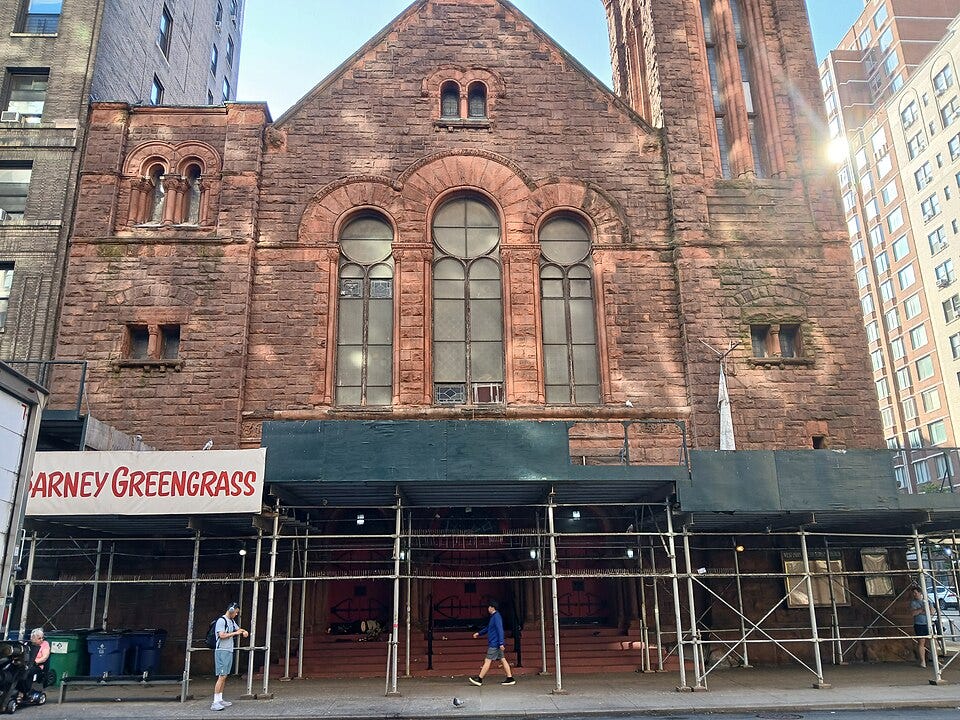
The building in question is West-Park Presbyterian, a Romanesque Revival church on the northeast corner of 86th and Amsterdam. The video cuts between Northrup standing on the southwest corner, a good distance away from the building, and drone footage of the building from above. Both shots are impressive, displaying the building’s dark red sandstone walls, round arched roofs, intricate facade features, and massive corner belltower, stretching nearly ten stories tall. But curiously, Northrup does not cross the street to get any closer to the building in the video, or go inside. He does not go inside because the building has been closed to the public for over a year. The church’s congregation, which owns the building, successfully evicted their primary tenant, an arts organization called the Center at West Park, after a lengthy legal battle, and it has sat locked and empty ever since. And Northrup does not approach the building, because he would not be able to see it if he stood on the other side of the street. His view would be obstructed by a dark green sidewalk shed, which surrounds the entire property, and has shaded the building’s entire abutting sidewalk since it was erected in 2001. Whatever architectural value the building provides to the character of the neighborhood, actual Upper West Side pedestrians have not been able to enjoy it from the street for twenty-five years. I am twenty-seven, and I have walked by that block literally thousands of times in my life. The same sidewalk shed has blocked my view every single time.
The scourge of years-old sidewalk sheds has become an increasingly hot political topic on the Upper West Side in the last few years. It is one of the single biggest gripes that everyday neighborhood civilians have with their local government, and Northrup made it a signature plank of his campaign platform. He’s not alone; Mayor Zohran Mamdani recently announced a few reforms to DOB regulations aimed at reducing the number of sheds on the street, telling reporters at the press conference: “In the greatest city in the world, we should not accept darkened sidewalks and covered walkways as a fact of life.” His reforms mostly have to do with frequency of facade inspections and the stringency of a few requirements related to shorter buildings. They are a step in the right direction, but will do nothing for the shed at West Park. That shed is not there to comply with some needlessly burdensome government regulation, or to enrich a lazy or derelict contractor. It’s there because in 2001, particles of the sandstone facade began flaking off and falling onto the sidewalk. Ever since, the building has been ruled an active risk to anyone walking by, and the shed is the 25 year-old band-aid solution to the problem of a building that is literally falling apart. Presbyterians reject the doctrine of purgatory, but these particular ones find themselves there anyway.
This is a story about architectural landmarks, about housing, about arts nonprofits and their perilous plight in an unaffordable city. But it is primarily a story about government inertia, and about how people in power learn to grimly accept an unacceptable status quo, because we have made it too difficult for them to do anything else.
The debate around this building, and others like it, is often framed as a choice between two possible outcomes. Do we want this lot to be a 19-story market-rate apartment building? Or do we want it to be an old church that houses an arts nonprofit, which uses the revenue from their programming, plus a ton of fundraising (and government support), to maintain the building indefinitely? This is a less obvious choice than it sounds to many aging Upper West Side liberals, especially because in the former option, the congregation has pledged to spend their $30 million windfall to fund worthy neighborhood social justice initiatives, including “programs addressing food insecurity, housing instability, education, health, and other social needs.” Some self-described progressives on the preservation side might want to consider whether it is truly progressive to prioritize the maintenance of an aesthetically valuable building that is nice to look at for people who live in a rich neighborhood over fully funding a local food bank that serves the poor and the homeless. Others might conclude that the building is so uniquely valuable that it is worth it, and that a rich neighborhood in a rich, high-tax city should be able to do both.
But either way, this “two-choices” framing elides the third choice, which is the one that we keep making over and over: nothing. Instead of either serving the neighborhood as a nonprofit arts space, as a beautiful and historically interesting building for pedestrians to look at, or as desperately needed market-rate housing, the plot of land on the northeast corner of Amsterdam and 86th street, one of the most valuable plots of land in the entire world, has sat empty, as its sidewalk shed becomes a quarter of a century old.
II.
In a city full of housing disputes between sympathetic current residents who want to preserve their home and external Goliath developers who want to demolish them to build monstrous skyscrapers, it is disorienting to see the residents and developers on the same side. But this is the structure of virtually every big landmarking dispute. If we trusted property owners, responding to free-market incentives, to preserve their historically important properties, we would not need landmark laws at all. We don’t trust them (for good reason), so we heavily restrict what they’re allowed to do with their landmarked property, and they often bitterly resent it.
In 2010, (the continuous sidewalk shed’s ninth year, right around the time the congregation stopped renting from a shed company and decided to just purchase a shed outright), Gale Brewer, during her first stint as Upper West Side City Councilmember, led a successful push to designate the church as a landmark. Robert L. Brashear, the church’s pastor at the time, decried this move as an imposition on the separation of church and state, telling the New York Times: “Forced landmarking has the effect of imposing the governmental idea of mission on the congregation… Religious liberty has not been well-served by this decision.” Brashear admitted that he had financial objections as well as constitutional ones: The building required at least $11 million in repairs and had been closed for almost two years, while the congregation met in St Paul’s and St. Andrew’s down the street on 86th between West End and Broadway. The landmarking prevented Brashear and his congregation from engaging in a partial sale that would have allowed them to sell part of the lot to a developer.
It has been a rough 16 years for that congregation since then. Their membership has dwindled to twelve people. Forced to devote 100% of their resources to keep up the increasingly expensive and dilapidated building, the congregation ran out of funds to pay for their pastoral leadership in 2017. As of 2025, they were hundreds of thousands of dollars in debt, with less than a thousand dollars in the bank. During this period, construction costs have skyrocketed, and the building’s physical condition has deteriorated significantly.
In 2014, a group of concerned neighbors unaffiliated with the congregation gathered in the church’s sanctuary, which, at the time, had no heating during the freezing winter because of a broken boiler and a burst pipe. They formed an informal organization devoted to saving the building, which eventually became the Center at West Park, an official 501c(3) nonprofit. The Center is nominally an arts nonprofit, which “serves as an incubator for emerging artists as well as an infrastructure for arts & culture and community groups that don’t have the economic or human resources to showcase their work,” according to their website. What this means in practice is that they do very little programming in-house, instead mostly serving as a relatively low-cost rental venue for other arts organizations to hold their rehearsals and performances. As of July 20th, they have two events on their calendar scheduled for the month of September and none for October.
Their true mission, evident not just from their genesis and their current operations, but from the second paragraph of the website’s mission statement, is to “save the NY Landmark West Park Presbyterian Church, and prevent its demolition, as well as… to establish a model of financial self-sustainability and a proven track record of affordability, accessibility, inclusivity and diversity.” In other words, they aim to show that there is a financially viable alternative for the congregation that preserves the 135-year-old building, where the Center operates as a nonprofit arts space that can raise enough money through programming, government support and (mostly) fundraising to renovate the building and then maintain it indefinitely.
In 2017, the Center embarked on a mission to demonstrate this and signed a five-year lease, with an option to renew for another five years in 2022. This lease was heavily discounted, in part, because of the Center’s pledge to take on the challenge of raising money to repair the building. According to the congregation, the Center did not come close to meeting that pledge: “In total, less than 2% of the necessary funds have been raised by the community to date, including $135,000 raised by the Center at West Park between 2017 and 2019, nowhere near the amount needed to address even just the façade repairs,” a congregation spokesperson told the West Side Rag. The Center contests these figures, but annual Form 990 filings show that they raised less than $100,000 a year from 2017 to 2020, $242,000 in 2021, and $346,000 in 2022, impressive numbers for an arts nonprofit in a vacuum, but not for one that is trying to undergo an eight-figure capital repair project, or even one that is equipped to help out with smaller-scale building needs. Instead, the congregation, not the Center, was forced to continue to pay the ever-growing list of bills incurred by the aging building, including $75,000 in “emergency repairs to prevent the south wall from collapsing,” which drove the congregation further into debt.
In 2022, the congregation sued the Center to terminate its lease, prevent it from signing another five-year term, and evict it from the building. The congregation’s argument rested in part on the claim that the existing lease agreement was unfairly burdensome to the congregation, because it set a “negligible amount of monthly rent rate” due to the understanding that the Center would “raise funds towards restoration and take steps towards restoring the Premises, which it never did.” The Center countersued, and the case dragged on.
At the same time, the congregation began the arduous application process to convince the city’s Landmark Preservation Committee to de-landmark the building. The congregation and developer made two presentations to Community Board 7, the local neighborhood advisory board, which has no official say on the process, but gets to vote on a recommendation to the LPC. Then, the LPC reviews all materials and (eventually) makes a ruling. The Community Board 7 meetings occurred in the summer of 2022, but because LPC is not allowed to rule on a hardship application for a property until all pending litigation with tenants is resolved, the congregation was forced to withdraw its hardship application in January 2024. The Center lost its suit to stop eviction in the following month, and finally exhausted their appeals in May 2025. It was evicted in June, and set up operations in St Paul’s and St. Andrew’s (one avenue block away), but kept the name “Center at West Park.” Since then, it has operated as a kind of government-in-exile, in the hopes that some external power will re-install it, kick out the usurping developers (and the congregation), and declare it the legitimate heir to the operations of this building.
With the eviction litigation finally resolved, the congregation then had to restart its hardship application process (with two more Community Board 7 meetings in the fall of 2025). Last month, LPC set July 10th as the final deadline for submissions related to the decision, implying that it will make a determination sometime this month.
III.
The case rests on two basic factual disputes: (1) how much would it cost to refurbish and repair the building, and (2) does the Center have a viable path to raising that much money, plus the money it would then need to operate itself in the building indefinitely?
In a presentation to the Community Board 7 Preservation Committee meeting last October, the developers described the current condition of the building, and what it would take to fix it. The sandstone facade has deteriorated in dozens of spots, and sizable chunks of stone regularly flake off the wall and onto the sidewalk shed. The south-facing wall leans more than twelve inches outward into the street, implying that “in its current condition, the structure will be overstressed when subjected to code prescribed snow and wind or seismic loads.” In other words, a serious snow storm could cause the entire building to collapse.
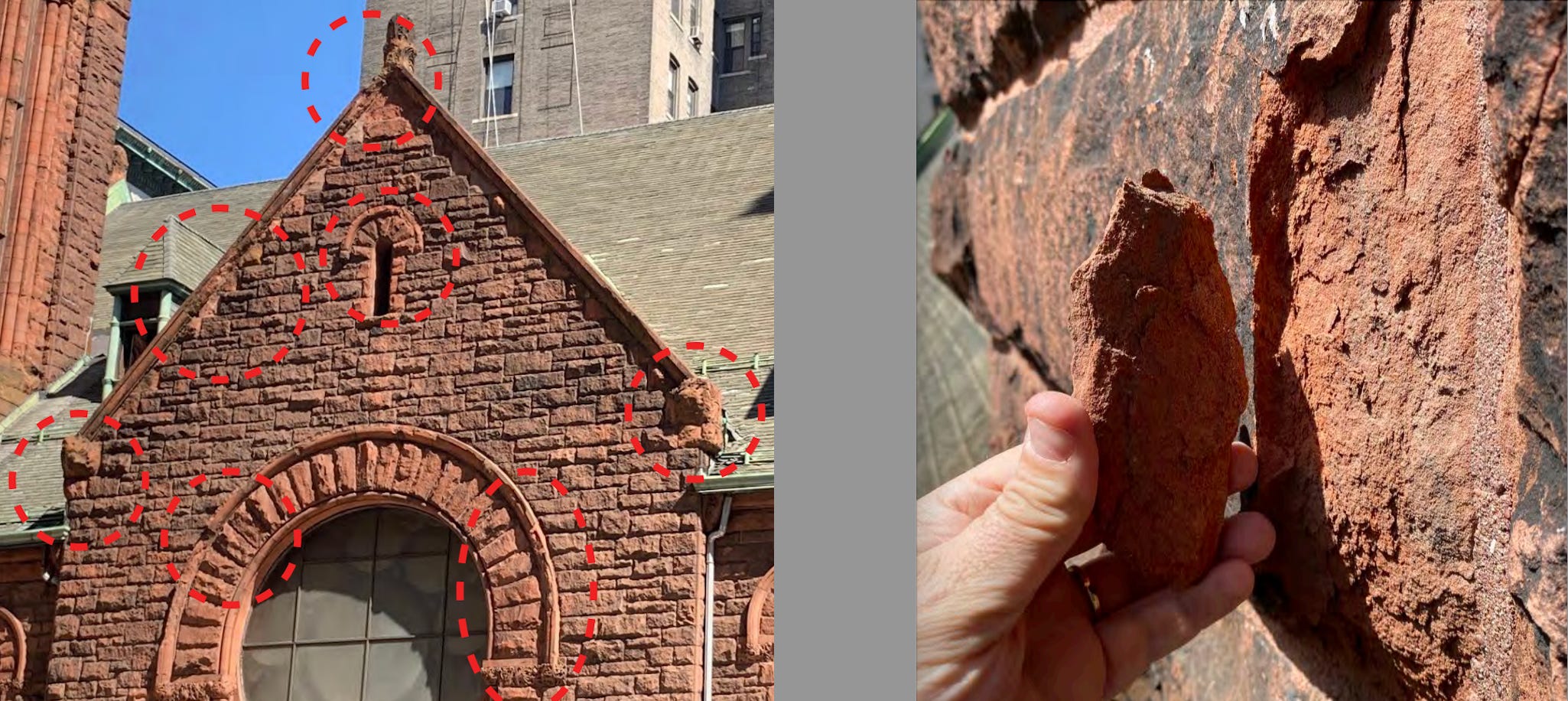
Inside, many of the buildings’ walls and ceilings have suffered significant water damage, and there is a 20-foot long crack on the east side of the roof. Repairing these physical conditions, the developer reports, will cost about $17 million as of 2022. (It projects that with insurance costs, inflation, and conservatively modeled contingency budget slots for overruns that happen on every construction project, it will actually cost closer to $30 million, but let’s keep the $17 million figure for now).
If the Center could get the facade and interior fixed, it would still have work to do, because the building is severely out of compliance with local building law. It has an ancient sprinkler and alarm system that is not up to fire code, frequently racks up DOB violations for all sorts of internal health and safety issues, and is ludicrously (and illegally) inaccessible, with narrow hallways and staircases everywhere and no wheelchair-accessible entrance (or particularly straightforward place to put one). The developers report that compliance-related work will cost an additional $14.5 million (which it raises to $25 million after similar adjustments.)
Its total estimate crosses $50 million, a number that the Center and their allies find dubious. “$50 million is way too high and you’re going to hear that from others who are more experienced than me,” Councilmember Gale Brewer told Community Board 7 in their first round of meetings in May 2022. Her side believes that fixing the facade will cost somewhere between $10 and $20 million, and that they can start there, get the sidewalk shed down, and worry about the rest later. This is not an insane amount of money for a nonprofit in one of the wealthiest and most civically active neighborhoods in the country to raise, the Center argues, especially with support from elected officials. (At Brewer’s urging, every elected official representing this block signed her letter to the LPC urging them to deny the congregation’s hardship application.)
But even if Brewer’s right about the cost of the facade, her claim raises an obvious question: If repairing the facade is an achievable undertaking for a nonprofit with the revenue and size of the Center at West Park, then why has it not achieved it in the nine years since it started operations in 2017? Brewer attempted to address this at the CB7 meeting in 2022: “I’ve talked to foundations in the area. They won’t allocate money to the church, they will allocate money to a nonprofit. It’s very easy to raise that kind of money, it’s not easy to raise for a church.” But this makes no sense. The Center at West Park was a nonprofit in 2022, just as it was in 2017, and just as it is in 2026. Moreover, it was, and remains, a nonprofit that is specifically raising money to repair the church. Since 2017, anyone who wants to give money to repair this building has a 501(c)(3) nonprofit to give to.
The more coherent argument, made more explicitly in the Community Board meetings last fall, acknowledges that the Center could not come up with the money for nine years, but alleges that it finally has now. Northrup and Ruffalo take us through the math of this argument in last week’s video: The Center has $5 million raised for a special “Landmark Preservation Fund,” to be deployed immediately for capital repairs. They have resources to commit to a ten-year lease at $60,000 a month ($720,000 a year). And they have an extra $3 million from the state government. By this math, assuming that none of the $3 million from the state would go towards paying rent, there is enough money to pay for about half of the facade repairs (at the cheapest estimate) right now, with the remaining half coming in $720,000 installments over the course of the next ten years.
There’s a problem here: The facade needs to be fixed now. The shed can’t come down until it’s fixed, and more to the point, until it is fixed, there is a real danger that the roof might collapse. If somehow the church can use the $720,000-a-year lease to back some sort of bridge loan, there’s still no money left over for any of the internal repairs, or the day-to-day maintenance costs. When I asked Northrup about this last week, he told me that the Center’s current finances represented only the start of possible fundraising. “I do think this is a community of connected people, in entertainment and otherwise, that are committed to this space. I think they have the means to raise more and invest in it… it’s not easy to raise $5 million, and if you can do that, you can raise more.”
Unfortunately, it is not clear that the Center has actually managed to raise even the $5 million. In an Exhibit attached to submission to the LPC, the congregation points out that to get to $5 million, the Center includes a $3 million pledge from an anonymous donor, which the Center also included, and therefore had already received and spent, in the statements for prior years. Once you correct this double-counting error, the Center has raised only $1.7 million, which, the congregation alleges, based on their net operating costs, they will spend through within two years, leaving virtually nothing left over for the building.
In Exhibit E of the same submission, the congregation shows that Michael Hiller, the Center’s lawyer,, bragged about “income” projections, by identifying a single $2 million anonymous donation (by far the largest in the Center’s history) as “profit,” used that to claim that the arts operations and programming generate net revenue, and then projected that “profit” out in perpetuity, separated out from fundraising. “The Hiller letter is hyperbolic and highly misleading,” Exhibit E concludes.
I reached out to Hiller, Councilmember Brewer, and the Center’s CEO Debby Hirshman for comment for this piece. Hirshman told me that the congregation’s submissions to the LPC contain “multiple inaccuracies.” Hiller and Brewer did not respond, but I imagine that if they had, they would agree with Hirshman, strenuously deny both of the congregation’s financial allegations, and argue, as they have in their public remarks before the Community Board, that they have the $5 million that they say they have, ready to go, plus $3 million from the state. Even if that is true, and even if the facade plus bare-bones interior repairs cost only $17 million (and not the $30 million plus the developers allege), they’re still significantly short.
So while I’m a big fan of Eli Northrup (I had him on my podcast this spring, and found him incredibly impressive, especially on issues related to criminal legal reform), I respectfully disagree with his assessment of the Center’s finances. I do not see it as a fundraising juggernaut that is building momentum and capable of raising a lot more than they already have. I see it as pursuing a Marty Supreme-style, fake-it-until-you-make-it campaign that is based on the Hail Mary hope that if they stall for long enough, eventually someone will swoop in with a massive eight-figure donation.
And it’s worth noting that Hirshman has a track record of this kind of hyperbole around ambitious fundraising campaigns. Before joining the Center, Hirshman ran the JCC on Amsterdam and 76th, a pillar of UWS civic life. She presided over a period of immense ambition and success for the JCC, but was fired in 2003 after embarking on an $85 million construction project for which she had only raised $60 million, eventually forcing the organization into a budget crunch that led to staff layoffs. (I asked Hirshman for a comment about this episode and she did not give one.) Charitably, I think she and the rest of the Center’s allies are engaging in the same misguided optimism once again.
IV.
The less charitable explanation is that the people organizing against demolition and development know that there is no financially viable alternative, but they do not care. In this cynical interpretation, the decade-long delays, the years lost to futile legal disputes, the many promises that enough money is right around the corner, all of which keeps the shed up and the building empty as it falls into worse disrepair–all of this is not an unfortunate gestational period on the way to a better future. It’s the desired end result. Because they’d prefer anything, even an empty lot permanently surrounded by a sidewalk shed, to new housing construction. Preventing what Ruffalo pejoratively calls “another luxury high rise” is a win in and of itself.
This attitude is pervasive among Upper West Siders, particularly those who have lived here for decades and watched these loathsome buildings come up at the same time that the neighborhood, once a haven for yuppie intellectuals and artists on decidedly middle-class salaries, has become extremely unaffordable, seeing a 15-20x increase in residential property values over the past 50 years, compared to only an 8x rate of inflation. The widespread belief is that the construction of these shiny glass condos, with their ugly floor to ceiling windows, boxy designs, and excessive heights (unlike the elegant, stately pre-wars of West End Avenue, which normally reach only twenty stories tall, and which contain apartments that are often worth significantly more than the ones in the new buildings), mechanically cause neighborhood-wide price increase, inducing demand for rich people around the city and country, and shoving them into the neighborhood. The academic literature on this topic is crystal clear: the reverse is true. Price increases occur when a neighborhood becomes more desirable to live in, and the rush to build new housing in response to that demand actually lowers prices for everyone else, or at least mitigates those price increases, by about 1% for every 10% increase in supply. We do not see 1% decreases in rent, because we do not permit anything close to that 10% figure to be built. Instead, we relentlessly restrict supply, and then wonder why rents and prices keep surging, with Manhattan’s median apartment rent crossing the $5k mark earlier this year.
There are Abundance bros out there who believe that our landmarks law has gotten out of control, and that we need to reform the statute to make it easier to knock down decrepit landmarks to build housing. I think this argument is politically toxic, and doomed to fail among the majority of New Yorkers, especially Upper West Siders. In a Daily News op-ed last week, James Lima and Peg Breen make the argument that granting a hardship application would give these anti-preservationists a win, and put all other landmarks at risk.
But we don’t need sweeping statutory reform to get to the right answer for West Park Presbyterian. The existing law allows for the LPC to remove a building from landmark status if the property owner can show that it is in “hardship,” genuinely unable to continue to advance its mission. I believe that the congregation of West Park Presbyterian has clearly met that bar, and predict that the LPC will rule in their favor in the coming days.
If they do, I sincerely hope that neighborhood organizations, advocates, and especially elected officials, accept this ruling, and use their considerable influence to make sure that the demolition and construction is completed as soon as possible. I worry that they will instead continue to fight on, look for any possible pretext or legal loophole to delay indefinitely, in the hope that the developer gets sick of fighting and throws in the towel. After all, it’s hard to get anything done with buildings on the Upper West Side. It’s so much easier to make sure nothing ever changes.
Special thanks to Gus Saltonstall of the West Side Rag for his help with some of my initial questions as I began my research on this topic. The West Side Rag has reported on West Park for over a decade, in incredible depth and detail. They are an incredible resource for the neighborhood and you should consider giving them money.
Fantastic analysis, as always Eli. A few thoughts:
1. Part of me hopes there's a win-win solution out there somewhere. For example, a zoning variance allowing a future developer to build more housing, in exchange for spending more $$ to preserve the original facade and providing additional arts space.
2. This reminds me of the BQE - everyone agrees the status quo is unsustainable (literally in both cases - as both could collapse in the not-so-distant future!) but the only plans to fix it require financing that will never appear, resulting in status quo paralysis.
3. Mark Ruffalo's political activism greatly frustrates me. While he has done good work on the national level, at the local level his two biggest causes seemed to be shutting down Indian Point (working with RFK Jr. and Cuomo to do so), and now this. All while buying a 3-family townhouse in Carroll Gardens and converting it into a single-family home, contributing to the housing crisis. Very frustrating!
! GO E.M. GO !