

I.
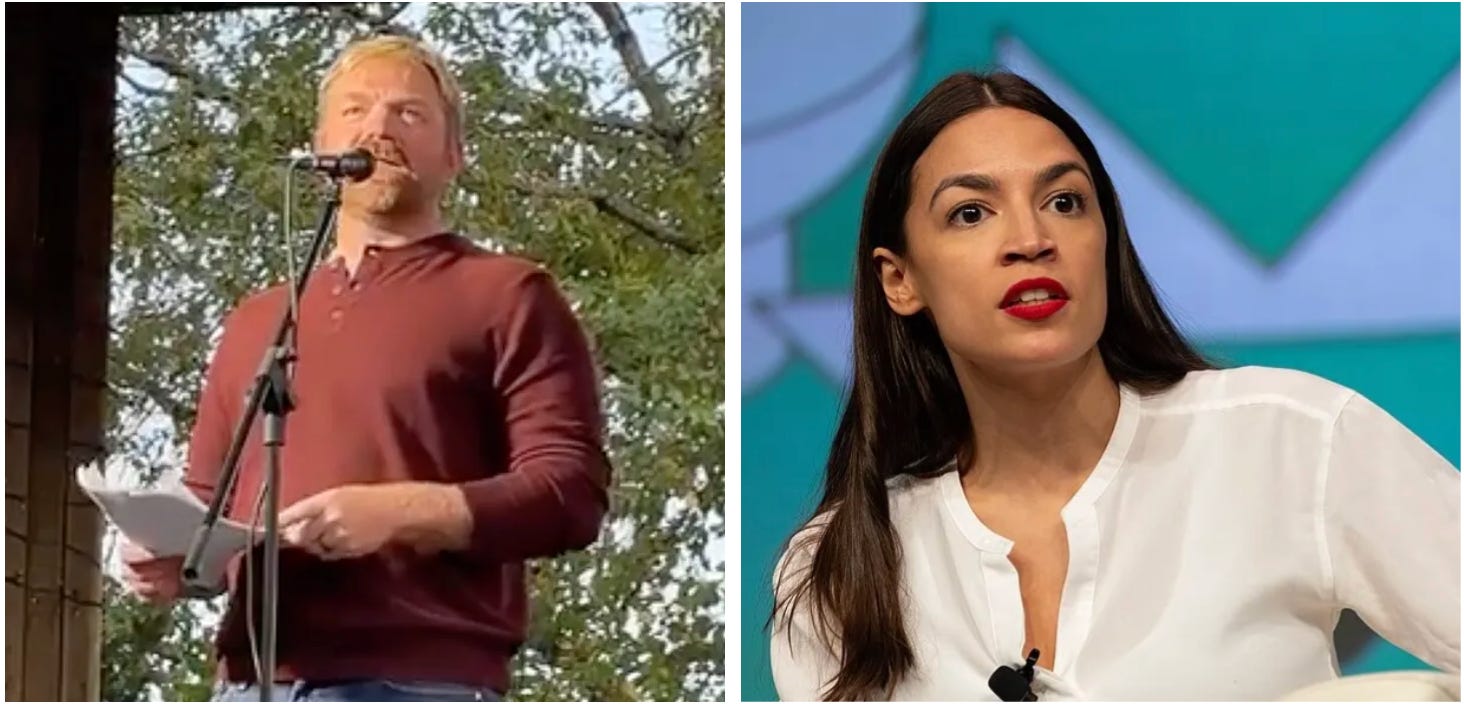
“There are things that women candidates can’t do,” political commentator, former ACLU attorney, and current director of Colby College’s Center of Public Affairs Alison Beyea told oysterman Graham Platner, then the Democratic nominee for U.S. Senate in Maine, on her podcast Politics Between Us, only six weeks ago. “[Maine Governor] Janet [Mills] can’t drop the F-bomb. [Former Senate candidate] Betsy Sweet ran on many of the platforms you are running on now, and people called her a witch. There is a difference in how women are perceived.”
At the time (the last week of May, an eternity ago), Platner was a political juggernaut, who, despite his outsider status, had dominated the Democratic primary so thoroughly that his opponent, the incumbent governor of the state, had suspended her campaign a month earlier. Some establishment Democrats still had concerns, not just about his lack of experience or fierce opposition to many of the party’s mainstream policy positions, but also about his character and fitness. Platner had given them plenty of fodder for these concerns, including his vividly offensive Reddit posts, the massive tattoo of a Nazi skull symbol on his chest, the unusually high turnover on his campaign staff, and the week this podcast aired, the revelation that he had sent sexually explicit texts and images to women besides his wife as recently as last summer. But for the most part, Maine Democrat voters were not deterred. To many commentators, Platner’s checkered past (and present?) was actually part of the winning formula. Democrats need to run “real people” in order to win, Platner’s strategist extraordinaire, the 27 year-old Beacon High School graduate Morris Katz told NPR’s Morning Edition last November, “and real people who haven’t thought they were going to run for office have lived imperfect lives.” “The era of smoothgroin politicians is coming to an end,” the Intercept’s Ken Klippenstein wrote on his personal substack, affixing an image of Ryan Gosling as a Ken doll. On Twitter, commentator Matt Stollar went a step further, declaring that Platner’s success augured “a rejection of HR lady politics” (he later took down this tweet and wrote a long post about why, but stood by much of the underlying substance.) Democrats had lost their connection to “real people” by becoming too uptight, too woke, and possibly too feminine, the argument went. If we wanted to win, we needed an uncouth, unvarnished, man-of-the-people who spoke common sense, not college-campus identity-politics buzzwords.
Beyea’s question to Platner on whether he benefited from an unfair gender double-standard got right to the heart of this argument, and Platner responded enthusiastically, and ironically, with a surprisingly heavy helping of college-campus identity politics-buzzwords.
“I agree,” he told Beyea. “There’s this ironic thing where I’m a cisgendered white male running for office, while simultaneously believing we need less [sic] cisgendered white males in political office. I recognize that I am privileged in many ways… Betsy literally ran on pretty much everything I talk about. Everything. They went after her, called her a witch because that’s what this society does. And then I get to do it and people are like, this sounds reasonable. That’s insane to me. But it’s also a reality. I recognize my privilege but I also think there’s a responsibility to use it in some way.”
This was a brilliant answer, and it played extremely well with the podcast hosts, and beyond. Writing in New York Magazine, feminist writer Rebecca Traister, a Maine resident, admitted that it was precisely this answer, and others like it, that made Platner so endearing to her and to thousands of her fellow liberal women in the state. “He comes off as an apple-cheeked kid who might remind white resistance moms of their very good boys” she wrote.
It’s a brilliant answer for two reasons. First, by “acknowledging his privilege” (a staple of Woke 1.0 “HR politics,”), Platner turns the issue of gender representation on its head. We need to run more white men like me, Platner implicitly argues, because we can win races that women can’t, and saying that is actually just recognizing disparities and being a good ally. Second, by placing 100% of the blame for Betsy Sweet’s 2020 campaign woes on her gender, he conveniently ignores any other possible factors. Without going too far down the rabbit hole on this, to the extent that Sweet was labeled a witch, it was not just because of her politics and her gender. Sweet’s prior career as a psychic medium who advertised the ability to “receive messages from loved ones who have passed,” her advocacy for and practice of alternative medicine, and her close friendship with Marianne Williamson all likely played some role too.
And there are ways to distinguish Platner’s campaign from Sweet’s besides gender. Most obviously, Platner spends a lot more time talking about Israel, and a lot less time talking about climate change than Sweet did. But this would be an awkward difference to point out to someone like Beyea, a GenX liberal white woman who, unlike the vast majority of Maine Democrats, likely had no objection to Sweet’s politics and points of emphasis. It’s much more convenient for everyone involved to chalk it entirely up to a misogynistic (Democratic) primary electorate.
It is not an exaggeration to say that Platner, and some of the other Fight Agency candidates like John Fetterman and Dan Osborn, are the logical conclusion of this kind of argument, which holds that Democrats keep losing because we run too many buttoned-up women as candidates. If we swap them out for charismatic, uncouth, burly dudes with deep voices, the aesthetics of a manual laborer, and an intense aversion to suits, we should be able to win without having to do the uncomfortable, difficult work of changing our policy positions at all.
If this argument held up, it would pose a thorny dilemma for liberal feminists. Must we give up on the worthy ambition of increasing representation in elected office in order to secure victories in key swing districts and protect fundamental rights for women that are under attack? Must we rely on gross men, including even some with checkered personal backgrounds and possibly even misconduct allegations, to win elections and enshrine reproductive freedom?
It’s a tough one. But it’s moot, because it turns out that the argument does not hold up. In fact, though absolutely no one in Democratic politics right now seems to believe it, women candidates do just fine. If anything, they’re probably even a little better than men on average. And we should nominate them for competitive primaries much more often than we do.
II.
In 2022, political science professors Suzanne Schwarz and Alexander Coppock published a meta-analysis of the substantial academic literature on the effect of candidate gender in electoral politics. First, they reviewed one study that compared the performance of ideologically similar men and women in US House of Representatives races from 1980 to 2012, finding that the genders had “virtually identical” win rates. Another study attempted to reproduce this finding in 2016, an election cycle in American politics that featured historic amounts of misogynistic vitriol due to Hillary Clinton’s presidential campaign. Despite this, Democratic women actually outperformed men in both primary and general election races.
Women candidates’s track record of success violates the established narrative, but it doesn’t get us all the way there. The past is not necessarily predictive, and correlation (women candidates do better in House races than men) does not necessarily imply causation (holding everything else equal, if you swap out a man for a woman in a competitive election, you’ll win more votes). Schwarz and Coppock highlight one possible confounder, that the women on the ballot, who have managed to clear the additional hurdles that the patriarchy places in their way to even get that far (“it’s literally impossible to be a woman,” one contemporary scholar argues), may be, on average, higher-quality candidates than the men who did not have to face the same adversity. If that’s true, then women performing similarly to men, or even only slightly better, would imply an electorate that is biased against women candidates, who have to work harder and be better than comparable men to achieve the same results.
It’s worth pausing for a moment and noting that if this is the case, if women succeed because the ones that run are able to overcome a sexist electorate with superior skills, we should absolutely run more of them, especially the women who have demonstrated these skills with a track record of winning tough elections. But Schwarz and Coppock don’t stop there. Instead, they look for actual evidence of the direct, causal impact, controlling for all possible variables besides gender.
And they find it, in something called a “candidate choice survey experiment,” a type of “conjoint analysis” where survey respondents are presented with a series of hypothetical candidates, compared side-by-side, with randomly varying attributes. With enough responses and random variations of otherwise-similar candidates, surveyors can isolate the impact of each attribute. This has significant advantages over simply polling people about whether they’d prefer to vote for a man or woman candidate. You can test for multiple things at once (these have also been used to isolate the impact size of party endorsements, candidate experience, race and pretty much every other candidate attribute), and crucially, respondents do not know what they are being tested on. Even on an anonymous poll, respondents might feel embarrassed to admit that they have gendered biases, and lie about their preferences, if they know that that is what they are being tested on. In a conjoint analysis with multiple variables, respondents feel no shame, because they have no idea what they are being assessed on.
It turns out over the past few decades, political science academics have conducted no fewer than 67 such candidate choice survey experiments assessing the impact of candidate gender on voters, including 35 on the impact on American voters specifically. As a society, we’ve decided to devote an incredible amount of time and resources to obsessive nerds who spend years rigorously answering and then re-answering the same questions over and over, inching ever closer to something approximating objective truth. Academia rules.
The studies all had slightly different methodologies and survey populations, but they yielded remarkably consistent results: voters prefer women candidates by about two percentage points. In other words, swapping an otherwise identical woman candidate in for a man leads to a two-percentage point increase in voter approval. The impact size is even a little larger if you only look at the American studies, and larger still for the American studies post-2014. It’s not completely unanimous. There are three American post-2014 studies that find a negative impact for women, two that find virtually no impact either way, and two more with wide enough confidence intervals that it could go either way. There are also, however, five studies that find the positive impact of gender to be far larger, with women candidates gaining more than five percentage points over equivalent men. The rest all land in between.
Democrats, especially college-educated liberal white GenX women, famously like to broadcast their belief that “women’s rights are human rights” and that “science is real.” The idea that voters prefer women candidates to men in modern American society is so counterintuitive that it might be hard to take my word for it just because I cited a bunch of pointy-headed ivory tower nerd scientists that did complicated experiments. But it is the scientific consensus, and it is just as real as climate change, coronavirus vaccine efficacy, or any other scientific consensus that liberals feel more comfortable with.
And if that consensus isn’t enough, simply look at the track record of women candidates in the 2024 election cycle. According to Lakshya Jain’s Candidate Wins Above Replacement model, the most valuable candidate in the entire cycle, the one whose candidate quality outperformed the fundamentals of the race by the highest decisive margin, was a woman, Michigan-08’s Representative Kristen McDonald Rivet. Of the fourteen congressional races that were decided by candidate quality, where the fundamentals implied that the other party’s candidate should have won, five of these overperformers were women: Rivet, Washington’s Marie Gluesenkamp Perez, Ohio’s Marcy Kaptur, New York’s Laura Gillen, and Michigan’s Elissa Slotkin. Less than 30% of 2024 congressional general election candidates were women, so women were overrepresented among the most valuable candidates of the cycle. Which is a long way of saying that the women that ran for Congress, on average, slightly outperformed comparable men, just as the surveys suggested they would.
III.
When Beyea and Platner say that “there are things that women candidates can’t do,” and that Platner’s gender automatically made him a more electable candidate, it is not hard to understand where they are coming from. Hillary Clinton’s shocking loss to Donald Trump in 2016 remains a singular, era-defining trauma for the Democratic Party, one that we have still not recovered from a decade later. In the wake of that loss, Democrats fumbled around desperately for some sort of explanation that could identify the election as a freak anomaly, and absolve Clinton and the party establishment of any responsibility, lurching from “Russian Interference,” to “Cambridge Analytica” to James Comey and the “But Her Emails” meme. But by far the most comforting narrative was one that Clinton herself had supplied in a speech two months before Election Day: “You know, just to be generalistic, you could put half of Trump’s supporters into what I call the basket of deplorables: racist, sexist, xenophobic, homophobic, Islamaphobic.” Clinton went on to say that the rest were motivated by economic factors, were “desperate for change,” and Democrats needed to figure out a way to reach them, but everyone ignored that part. The notion that the majority of American voters were simply too bigoted, and specifically too sexist, to ever consider electing a woman president, was much more palatable for the grieving liberal Clinton supporter.
In the Democratic primary for the 2020 presidential election, this idea haunted the campaign of women candidates like Kamala Harris, Elizabeth Warren, and Amy Klobuchar with a vengeance. Klobuchar in particular tried valiantly to convince primary voters that she was electable, and made progress with data nerds like the New York Times’s David Leonhardt, who highlighted her exceptional electoral record of winning statewide elections in the relatively purple Minnesota by more than twenty points in both 2012 and 2018. The problem was, no one else believed her. She finished below 5% in both South Carolina and Nevada, dropped out soon after, and endorsed Joe Biden, whom Democrats could more easily envision winning over bigoted swing voters, despite his considerably worse electoral track record.
This illustrates a key aspect of the Platner saga: electoral overperformers do not always look the way Democrats imagine they might. While Platner did a good job of convincing college-educated liberals that he was someone who might be aesthetically appealing to Maine’s “working class” he did not actually demonstrate any strength with that group, trailing among non-college voters by more than 20 points in a recent New York Times survey well before the rape allegations came out. Candidates like Klobuchar (and Elissa Slotkin, and Marie Gluesenkamp Perez), who actually do overperform with non-college swing voters, often seem kind of boring and vanilla to urban liberals like me. And they probably do not do as well on podcasts with Colby professors, or in the kind of media that reaches young left-wing professionals in Brooklyn. It is probably not a coincidence that I often find Klobuchar, Slotkin, and MGP aesthetically unmoving, and that I have significant political disagreements with all of them.
I do not mean to turn this into a “we should run more moderates” blog, a topic that has already been debated to death, and on which the academic research is genuinely in dispute at the moment (political scientists Adam Bonica and Jake Grumbach provocatively argued that as of 2024, political moderates do not actually perform differently than far-left or far-right candidates in swing districts, in a paper that people like Lakshya Jain, Nate Silver, and my friend Hunter Wieman all vigorously dispute). This is a “we should run more women” blog, a proposition that is supported robustly by recent history and scientific consensus.
Let me put all of my cards on the table. In the run-up to the 2028 Democratic presidential primary, there will be fierce, vigorous debates about which potential nominees are most electable. Alexandria Ocasio-Cortez, in particular, will have to defend herself against electability concerns dozens of times a day. “We like her,” liberals will say (she polls extremely well across all parts of the Democratic coalition these days), “but do we really want to risk running a woman again? Wouldn’t we be much safer with a handsome man in a nice suit, like Gavin Newsom?”
Newsom, who is significantly less popular than AOC, with a dramatically worse electoral record and far more political vulnerabilities from all sides of the spectrum, will be seen as a “safe choice” by some, entirely because of his Y chromosome. When this argument inevitably surfaces, we should call it out for what it is: gender discrimination. We should remind its proponents of the saga of Graham Platner, and the perils of nominating flawed, scandal-ridden men who don’t even poll well with the working-class men they’re supposed to win over. And we should point to “the science,” which shows that women actually perform better than similar men in American elections, and that voters prefer women candidates over men by about two percentage points.
Great article. I constantly am frustrated by this "women are unelectable" belief that lives on without any real justification in the data. I do want to contest your conclusion though. You say:
"And we should point to 'the science,' which shows that women actually perform better than similar men in American elections, and that voters prefer women candidates over men by about two percentage points."
I think a better reading of the science you cite is that gender is mostly unimportant as an electoral factor, and that we would do a lot better to ignore it completely and evaluate electability based on other factors (previous electoral performance, ideology, polling data, etc.).
Per MiGru, infra., << Well argued, well written ! >>
But Lest We Forget :
{ D } continues to sink deeperandeeper into the sewer first dug by barry soetoro-soebarkah, or whatever his legal name really is, way back in '08 . . .
. . . to the point at which we have arrived,
chock-full of male and female { D } ' leaders ' and electeds --- at every level of governance, nationwide --- who are far-too-young, inexperienced, untutored, loose-cannon, policy-position whack-jobs . . .
A prime case-in-point, among MANY others too numerous to enumerate here and now, is Occasional Cortex : one must LOL at the mention of her name in conjunction with national office, so painfully embarrassing is that notion for so many obvious reasons . . .
Is it any wonder then that millions,
including Yornz TruLee, have abandoned { D },
the party of Father, GrandFather, Great-Grand-Father ---
both sides ---
and gone to { R } or Third Parties or { I }, or have dropped-out
?
Prof Dershowitz has gone to { R }, over Israel and Jewish issues writ-large
I have gone to { I }, where, I believe, The Future may lie,
as nearly half of the national registered electorate is { I }, or { R } or { D } { I }-leaning . . .
Thus I intone :
! POWER TO THE PURPLE !
Thank You for your time and attention to this {I}mportant message ________________________
HCY, S.J.D.