

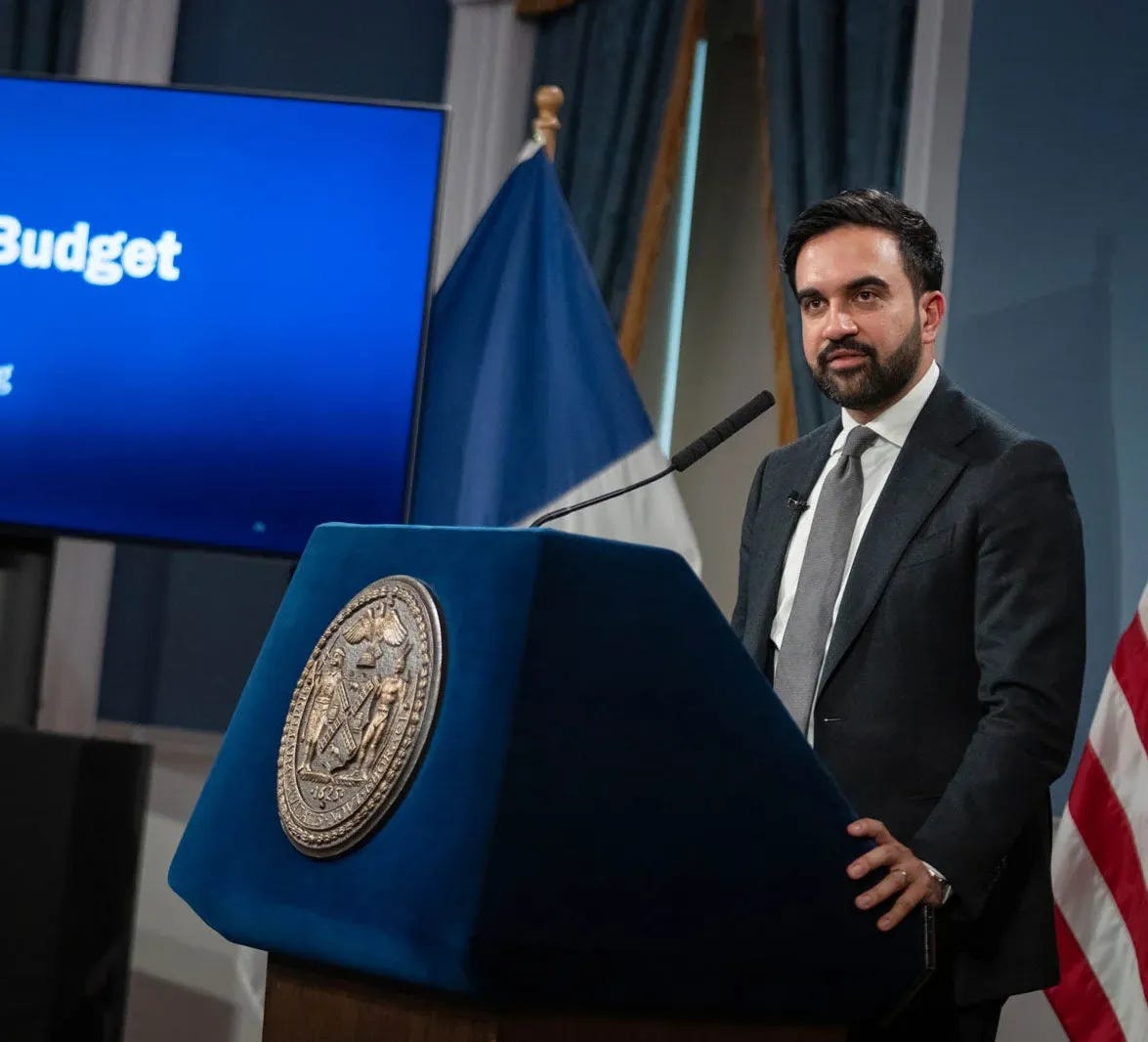
“What I would do,” Zohran Mamdani, then an upstart two-term Assemblymember running a long-shot bid for mayor that was polling below the margin of error, told the New York Editorial Board in February of last year, “is to stop playing these kinds of budget games and to make it clear to New Yorkers that they need not expend hours of labor, of time, of anxiety towards fighting for an amount of money they’ve been told is the maximum they could win, when in fact, there is a far larger pot.” Under a Mamdani administration, there would be no need for Eric Adams’s annual budgeting chicanery, because we would raise a lot more revenue through expanded progressive taxation, and then use it on big, memetic projects that meaningfully affected the lives of everyday New Yorkers.
“I believe there are enormous savings that can be had in the city budget,” then-presumptive City Council Speaker Julie Menin told the same New York Editorial Board eleven months later. “Enormous areas of potential savings. I outlined a few of them: the no-bid contracts, the healthcare savings….” Past City Councils had been too generous and indiscriminate about awarding big no-bid contracts, and insufficiently focused on auditing spending and preventing fraud and abuse, but this would all change under a Menin-led Council. Under her responsible, savvy leadership, we’d run such a tight ship that we’d have extra money lying around for new projects (Fair Fares expansion! Social programs for poor kids!), and we’d never have to deal with annual budget crises.
You can pit these visions against each other if you want to, and label one “left-wing” or “socialist,” and label the other “moderate” or “neoliberal” or “boring.” But you can also view them as complimentary tendencies, which are both necessary for effective government. That’s certainly how Mamdani and Menin talk about them. “As someone who is very passionate about public goods, I think that we on the left have to be equally passionate about public excellence,” Mamdani told Derek Thompson last June, on the need to spend government funds more efficiently. “I find these labels to be sort-of a false narrative in the sense that I have done progressive things: paid sick leave, living wage…” Menin promised. If you want to accomplish big things in a city budget, you want to be able to find new sources of revenue, and you want to identify ways to save money by cutting down on waste and fraud. And you would imagine that you need both if you are trying to close a $7 billion emergency budget gap.
But you’d be wrong! This week, Mamdani and Menin announced that they had successfully closed that gap without significant new revenue or savings. It turns out you can do it all through other forms of budgeting dark magic. Here’s how they did it:
1. Giant influx of aid from state government
Having already thrown in $1.5 billion to shrink the gap from $7 billion to $5.5 billion, Governor Kathy Hochul agreed to throw in a lot more to close the gap entirely. The exact amount of additional aid from Albany is subject to the hall-of-mirrors, choose-your-own-adventure quality of NYC budget math. NBC News is calling it $4 billion, Vital City thinks it’s “about $3 billion,” and Mamdani’s official presentation labelled only $352 million of “direct aid” vs. $3.5 billion of “state authorization.” Whatever the number is, it makes up the majority of the now-filled gap, so much so that Vital City’s Paul Francis gave his piece the snarky headline “Call It What It Is: A State Bailout of New York City.”
To counter-editorialize for a second, this is good! The state is flush with cash right now, and it’s mostly cash from New York City taxpayers and businesses. The state is bailing out the city in the same way that Yankees owner Hank Steinbrenner is bailing out Aaron Judge when he pays his salary. When you have a massive star generating an insane amount of value for you, it’s not altruistic to pay them a (relatively small) portion of that value.
2. Relaxation of upcoming obligations
The State Government has also given Mamdani license to spend a lot less than they are nominally legally required to spend on programs like CityFHEPS (discussed at length in my last blog) and the “Carter Cases” that compensate public school students with unmet special education needs. The city will also save some money from a slightly looser implementation of the state class-size mandate. This is basically “last-in-first-out” budgeting, making cuts to the most recent program expansions, like laying off the employees with the shortest tenures. It’s an arbitrary heuristic, but it solves a lot of political problems (older programs have more entrenched constituencies). Together, these are worth about a billion dollars towards the gap, again depending on who is measuring.
3. Accounting magic!
Three weeks ago, the New York Times’s Sally Goldenberg reported that Mamdani was considering “pension restructuring” to fill the budget gap. Fiscal watchdogs like the Citizens Budget Commission’s Andrew Rein found this extremely ominous, because delaying pension obligations is the municipal budget equivalent of racking up credit card debt, permanently devastating your long-term financial future in order to prop up unsustainable present-day spending.
Happily, this is not exactly what Mamdani is doing. Instead, he’s adjusting the “amortization schedule,” a 20-year payment plan the city agreed to in the wake of the 2008 financial crisis. Basically, the city took out a giant loan to meet their pension obligations, and then bizarrely, agreed to make extremely high payments towards that loan until 2032, and then start receiving a portion of those payments back from 2033 on. Under the new restructuring, they will make lower payments until 2033, and then make (smaller) payments moving forward instead of receiving money back. Basically, as shown in the graph below, we’re smoothing our repayment schedule into a more sensible, flat shape. Fiscal alarmist Comptroller Mark Levine gave this decision his blessing, telling the Times that it made sense to avoid “the big cliff in 2032.”
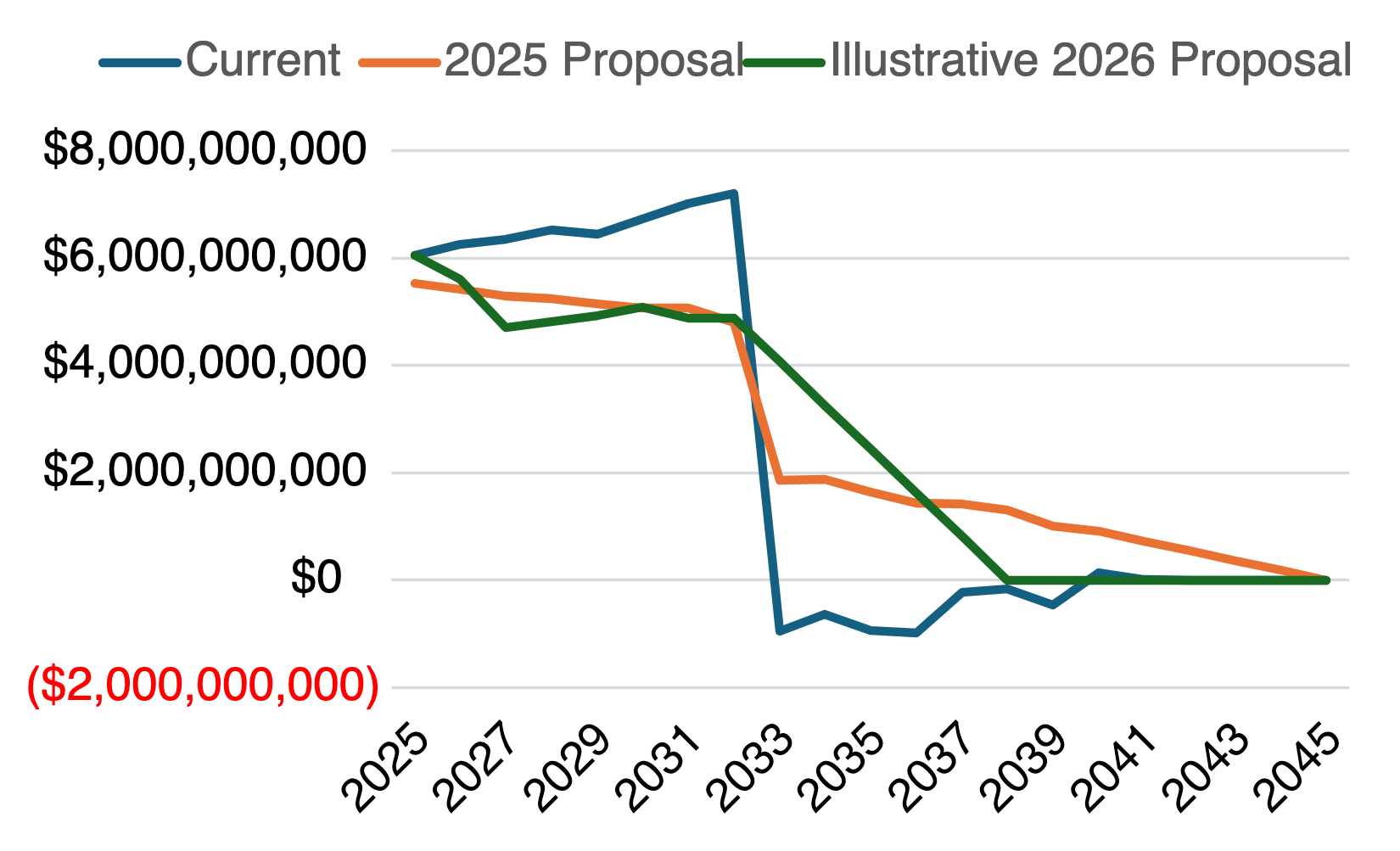
Moving from the blue line in the above graph to the green line will save the city a full $2 billion over the next two years. And it will not affect actual pensions, because this is a repayment plan for a loan, not the pension accounts themselves. It is admittedly pretty cool when you can save billions of dollars without changing anything or having any real-world impact.
4. Yes, yes, fine, a nominal amount of new revenue and some very speculative savings.
The city will generate about $500 million from the brand new pied a-terre tax on second homes worth more than $5 million. And the Mamdani comms team wants to make sure you hear as much about it as possible! The city will also aim to save $1.47 billion through boring technical adjustments to things like office space, workforce software, and other “efficiency improvements.” Here is the extremely aspirational slide from Tuesday’s budget presentation.
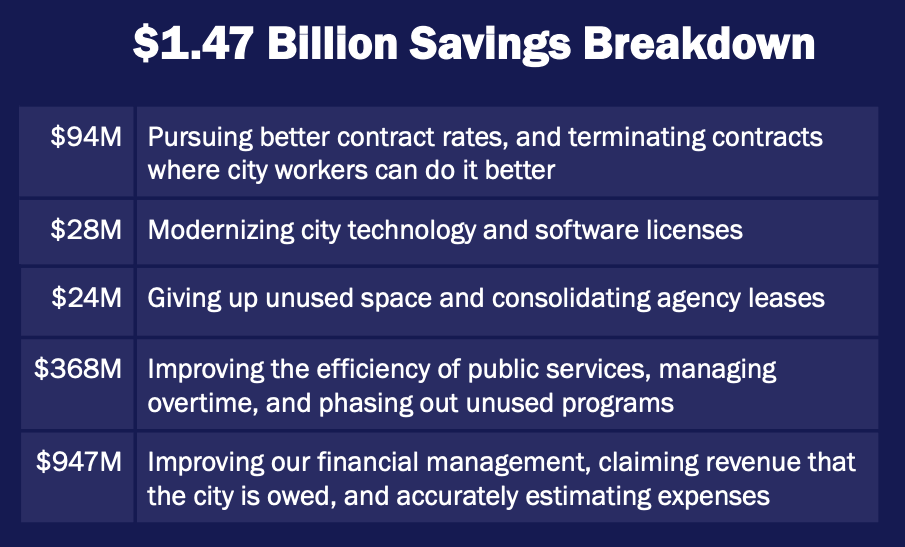
The numbers give this slide a sheen of precision that it frankly does not deserve. The city has not done any of these things. If we actually do them, we can expect to save money, and these numbers represent best guesses for how much money we (hope) to save, compared to an unknown and unknowable baseline. I too would like to save outrageous sums by pledging to spend “more efficiently” or “improve financial management.” And indeed, as best as I can tell, these aspirational savings do not actually count towards closing the gap. Which is fine, because the state funding covers it.
II.
In a vacuum, this is pretty impressive work from Mamdani and Menin. An Adams or Cuomo administration would have taken the opportunity to implement blunt austerity measures on their least favorite initiatives, and then moved on. But there will be budget gaps in the future (the 2028 gap now projects to be especially gnarly), and many of these tricks, like the pension amortization restructuring, are not repeatable. And there’s a bigger question. Shouldn’t Mamdani and Menin, who ran on increasing revenue and cutting waste, be able to actually do that? Especially at the beginning of their term when their political capital is supposedly at its apex?
This year, the answer is no. They can’t raise income taxes, because Kathy Hochul thinks that might cause capital flight, and there aren’t enough progressive state legislators to pressure her to change her mind. They can’t add a toll to the state’s Pass Through Entity Tax, because that would infringe on hedge fund partners’s god-given right to an uncapped State and Local Tax Deduction (while the plebeians who make W-2 income are capped at $40k). They can’t raise property taxes, because the city’s property tax system disproportionately burdens small apartment buildings in working-class Black neighborhoods, and no one wants rents to go up there. And they can’t reform the property tax system to make it more equitable (something Mamdani explicitly ran on last year), because that would increase property taxes on townhouses in Park Slope and Brooklyn Heights, neighborhoods that voted for Mamdani by 50 points last year.
They can’t raise revenue in other ways either. They can’t expand metered parking spots in dense parts of Upper Manhattan (“It’s not a no,” Deputy Mayor Dean Fulihan said in March, but no one has mentioned it since), because that would provoke the ire of the incredibly well-organized Manhattan car owners, who feel entitled to free plots of public land for their Subaru Foresters. They can’t add a tax on the expansion of Waymo’s lifesaving autonomous taxi pilot, because Kathy Hochul killed that pilot when human taxi drivers (and their predatory medallion owners) protested. They can’t build new mixed-income housing on publicly-owned, incredibly valuable land, because you need eight kinds of community input to do that and the community inevitably does not want new mixed-income housing.
And they can’t save money. They can’t cut overtime, or any other part of the $6 billion NYPD budget, because that might make Commissioner Jessica Tisch quit, and without her fearless, savvy leadership, the city would plunge back into a crime-ridden 1970s hellscape. They can’t merge public schools with dwindling enrollment to save on overhead, because as City Council Finance Chair Linda Lee told Ben Max last month, it’s very irresponsible to do that without getting substantial feedback from the community first (and you’ll never guess what feedback the local community gives about closing their local public school). They can’t wean themselves off billion-dollar no-bid contracts to provide shelter beds for homeless people, because it’s prohibitively expensive and politically impossible to build and operate those beds in house.
“For too long,” Mamdani liked to say on the campaign trail, “New Yorkers have been encouraged to imagine less.” He promised to change that, telling supporters in Forest Hills Stadium that they “deserve a city government as ambitious as the working New Yorkers who make it the greatest city in the world.”
But a mayor, on his own, cannot make a city government more ambitious. There are too many legal and political constraints. So far, all he and Speaker Menin have accomplished is a series of desperate, hail-mary, unrepeatable maneuvers to preserve the status quo, and freeze the 2023 budget in amber. Ambitious working New Yorkers should be encouraged to imagine more than that.
This was very clarifying. It also helps me understand where all of those people who are online screaming about Mamdani robbing pensions came from, and why I shouldn't listen to them.
On those Park Slope homeowners: didn't they vote for Mamdani knowing that they would see their property taxes go up? So shouldn't he have some room to get away with it?
"Basically, the city took out a giant loan to meet their pension obligations, and then bizarrely, agreed to make extremely high payments towards that loan until 2032, and then start receiving a portion of those payments back from 2033 on." What was the rationale behind this idea?