

“That’s what being mayor is” a fictional former Baltimore mayor tells Tommy Carcetti in The Wire’s fourth season, using a particularly graphic metaphor to describe the way that every constituency kept dumping unsolvable, no-win problems onto his desk. “You’re sitting and eating [expletive] all day long. Day after day, year after year. When I realized that, I decided that being a downtown lawyer and seeing my family every night made for a fine life.”
Not everyone agrees, of course. Eric Adams famously loved being mayor, at least in the beginning: “I say every day that I wake up, ‘When does the hard part start?’” he told the press early on. “Because it’s not hard for me. I love every moment being the mayor.” The hard part did eventually start for Adams a year later when an influx of migrants filled the city’s already-stressed shelter system, led to $4 billion of unexpected social services expenses, and permanently ruptured his relationship with the Biden administration in the process. And it continued into the next year, when a series of cascading corruption scandals eventually culminated in Adams’s federal indictment.
We’ve just reached the proverbial “100 days” mark of the Zohran Mamdani administration, and while he seems to have retained some of his jovial, energetic spirit from the campaign, you’d have to say that the hard part has started already. In his first three months as mayor, he has been handed one steaming bowl of excrement after another.
On January 25th, a historic blizzard dumped nine inches of snow onto the city. A similar snowstorm wreaked serious havoc on the de Blasio administration, and the city hall press breathlessly covered the snow as “Mamdani’s first big test.” This was all very silly. Mamdani did not clean house at the Department of Sanitation, which runs snow removal, nor any of the other highly technical service-providing agencies that manage the city’s response to snow. If they had botched their response, it would not have been because Mamdani’s team did anything differently than Adams’s would have. In the event, they did pretty well, the streets were quickly plowed, and Mamdani was happy to publicly perform his competence, energetically shoveling out a car in Brooklyn, and scurrying around for as many outdoor press events as possible.
Nevertheless, the blizzard posed serious problems, and gave critics new angles to attack the Mamdani administration. On his brand new talk radio show on John Catsimatidis’s WABC 77, Andrew Cuomo accused Mamdani of allowing seventeen homeless people to die because of his pause on sweeps of homeless encampments. The city reported that none of the deaths occurred in encampments (and therefore would not have been prevented by more sweeps), but Mamdani reinstituted sweeps anyway a week later, against the wishes of former City Council Speaker Christine Quinn, who now leads the city’s largest shelter provider, Women In Need. A few weeks later, Jessica Tisch and the police union media apparatus tried to stir up outrage after a group of teenagers in Washington Square Park lobbed snowballs at two police officers. Mamdani seems to have emerged from all of this pretty unscathed, boasting a 63% approval rating in a recent Siena survey. But for six weeks, his administration focused obsessively (and nearly exclusively) on managing a crisis they bore absolutely no responsibility for and had no easy way to fix, and they had to defend themselves from a constant stream of bad-faith attacks anyway.
Mamdani better get used to that. Another storm looms, this time emerging not from the clouds or the North Pole, but from the accounting spreadsheets of the Comptroller’s office.
II.
“Mayors make their own budgets, but they do not make them as they please,” Karl Marx very nearly said. “They do not budget under self-selected circumstances, but under circumstances existing already, given and transmitted from the past. The tradition of all past mayors weighs like a nightmare on the balance sheet of the incumbent.”
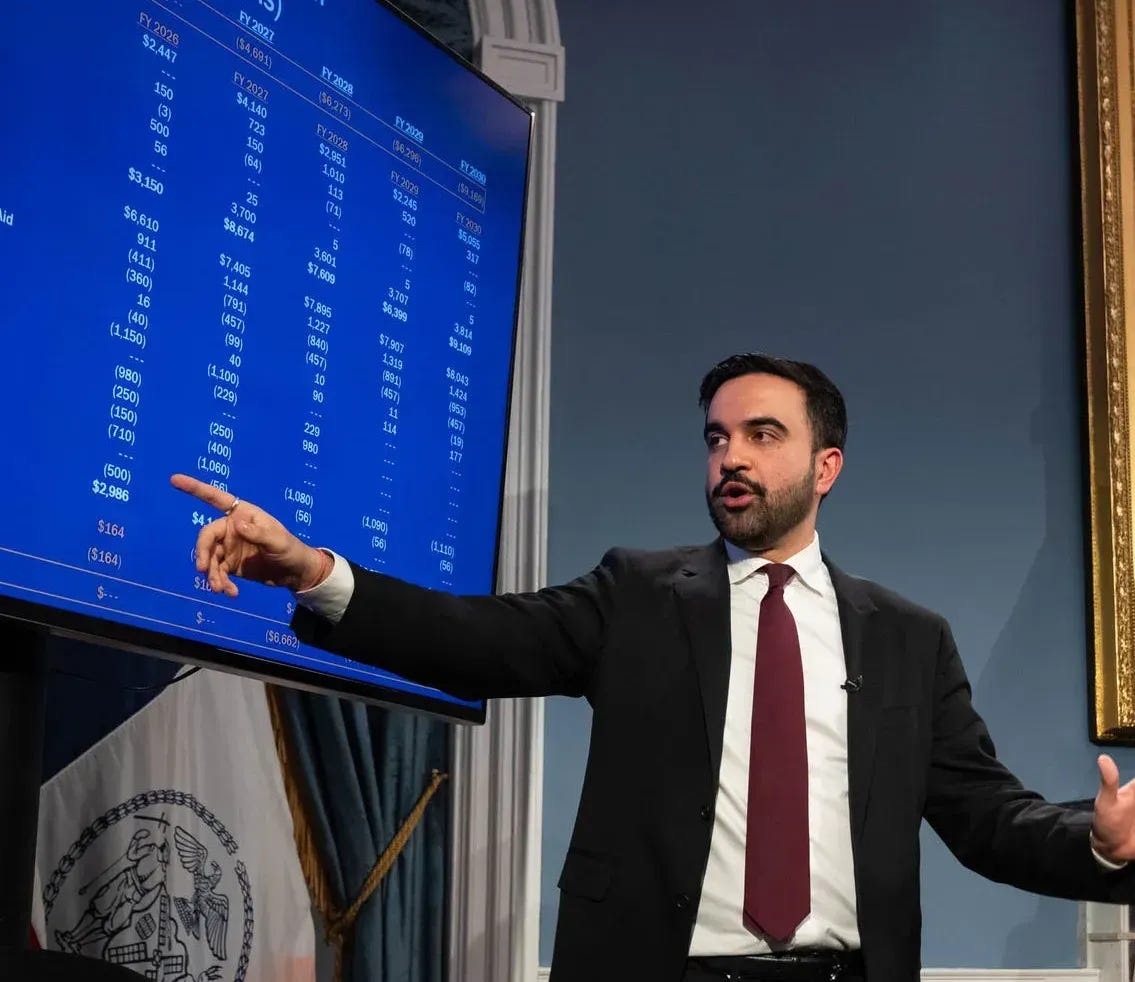
Seemingly out of the blue, the city has a massive budget gap. Mamdani first sounded the alarm on January 28th, calling a press conference to decry what he labelled the “Adams Budget Crisis,” or ABC. The flashy spectacle and memetic title are classic Mamdani comms fare, and they are in this case slightly reductive. The NYC budget is the product of negotiations between City Council and the Mayor, so the entire 2021-2025 City Council bears some responsibility as well. And some of the underlying problems predate the Adams administration. But on two key points, Mamdani was correct: He has inherited a huge problem, and it is unambiguously not his fault.
The city is legally required to submit a balanced budget every year, but ask any HBO showrunner, and they’ll tell you that budgeting is an aspirational act. You put aside the amount you’d like something to cost and then cross your fingers. Or if you’re a little bit more cynical, you calculate the amount that you think something will cost, then write down a dramatically lower number anyway, and hope that it’s someone else’s problem by the time the bill comes due. Whether because of delusional wishcasting or sinister myopia, year after year, Eric Adams and the 2021-2025 City Council budgeted dramatically less for certain uncapped expenses and programs than anyone reasonably expected them to actually cost. The city’s Independent Budget Office released a report last December on the biggest underbudgeted offenders, and the findings are eye-popping.
In Fiscal Year 2026, the city budgeted $578 million for NYPD overtime. The NYPD has gone over budget on overtime by hundreds of millions of dollars every year in recent memory, and this year will be no exception. They are currently on pace to spend $894 million on overtime in FY 2026, creating a budget gap of more than $300 million. The IBO projects that across all uniformed agencies, the city will spend more than $600 million more than budgeted just on overtime.
City Hall (at least theoretically) has direct control over the uniformed departments and their spending practices, so it could actually do something about that one if it felt like holding its supposedly-brilliant, savant-like, technocratic data geniuses who run those departments even a little bit accountable. But the city has less control on the spending side of the unfunded mandates from the state, which also balloon way over budget every year. These include the MTA’s Access-a-Ride reimbursement program (for which the IBO projects the city will have to contribute $168 million more than it budgeted in FY2026); settlements of the Department of Education’s “Carter Cases,” which reimburse families of children for their private special-education expenses if their public schools are not adequately meeting their needs ($515 million over budget in FY2026, per the IBO); and spending related to the state’s class size mandate, which will not affect FY2026, but which will force the DOE to spend $200 million more than its current FY2027 budget, and then more than $700M more in FY2028 and FY2029.
And then there’s CityFHEPS, the city’s housing voucher program for low-income families. As the city’s housing crisis has worsened, both the number of eligible families (ie the ones who are at severe risk of eviction and homelessness), and the cost of housing each one in a market-rate rental apartment, have grown significantly. The program now serves over 65,000 families, and costs over $1 billion dollars a year, despite receiving only $600 million in the initial FY2026 budget. The IBO projects that the city will spend more than $600 million over budget in FY2027. Comptroller Mark Levine has an even grimmer projection. “It was in the budget for the fiscal year we’re currently in for about $600 million,” he told Errol Louis in February. “It’s actually going to come in at over $2 billion, and the gap is even bigger for the next fiscal year.”
If you’re wondering why Levine and the IBO diverge so dramatically in their projections, welcome to NYC budget math. All of the numbers above are blurry, ballpark figures couched in many layers of uncertainty. For one thing, projections of the future are generally wrong. But even descriptions of the present vary depending on the source you look at, and what accounting tricks they decide to use. (One example: the City Council’s current budget proposal is much rosier than Mamdani’s, in part because they choose to count payroll for new hires in the next fiscal year, not the current one, as Council Finance Chair Linda Lee explained to Ben Max last week.)
When Mamdani announced the “Adams Budget Crisis” in January, he repeated Levine’s projection of a $12.2 billion budget gap. A month later, at the State Legislature’s annual “Tin Cup Day” in Albany he had a slightly different picture. “I’m glad to report that by assuming an aggressive posture on savings without compromising City services, incorporating updated revenue and bonus estimates, and using in-year reserves, we have lowered that $12 billion gap to $7 billion,” he told state legislators. Even the Mamdani-friendly Hell Gate raised their eyebrows, wondering if the initial projection had been skewed to make his pitch for tax increases seem more urgent.
But everyone agrees that CityFHEPS is dramatically underbudgeted. When you combine that with the overtime spending, Access-a-Ride reimbursements, Carter cases, class-size mandates, (and subtract $1.5 million that Kathy Hochul has already agreed to throw in from the State budget), and everything else you allegedly get a $5.4 billion shortfall, over the next two years. If you go by Levine’s numbers, CityFHEPS alone makes up a third of that.
And this is assuming the program does not expand its eligibility criteria, despite a 2023 City Council mandate to do so. Mayor Adams refused to implement this expansion, prompting Legal Aid and other advocacy groups to sue him in state court. The lower court ruled in Adams’s favor, on the grounds that because a state law authorized the city Department of Social Services to administer CityFHEPS, only the State Legislature, not the City Council, could compel a change in eligibility criteria. But an appellate court reversed this ruling last June and ordered the city to expand the program as mandated. The Adams administration refused again, and their Law Department vowed to appeal again, which drew the ire of then-candidate Zohran Mamdani. He pledged on his campaign website to drop this lawsuit when he took office, and tweeted that it was “a ridiculous waste of time during a housing crisis.”
Mamdani evidently feels differently today. Last month, he announced that he would continue to pursue the appeal, in the hope that another court might allow him to defy the City Council-mandated expansion just as his predecessor did. City Council Speaker Julie Menin, who usually antagonizes Mamdani from the right, expressed outrage, and joined progressive activists in urging Mamdani to drop the lawsuit.
There is a policy argument for continuing to fight, if Mamdani wants it. CityFHEPS is not a durable solution to our housing crisis. It helps tens of thousands of families get housing and stay out of shelters, but at a cost: in theory, at least, subsidizing demand in a supply-constrained market actually drives prices up for everyone who isn’t eligible for the subsidy. And it’s extremely expensive, so much so that the Citizens Budget Commission, a “nonpartisan” moderate think tank, controversially argued last February that it would actually be cheaper to keep people in the notoriously expensive shelter system. Women in Need’s Chris Mann forcefully refuted this math soon after, and his boss Christine Quinn reiterated the importance of the program, regardless of its cost savings, soon after, writing that the vouchers “remain the most effective path to helping families transition from shelter to permanent housing.” She’s right. As expensive and inefficient as they may be, without these vouchers, tens of thousands of New Yorkers will become homeless.
But the policy disputes may be beside the point for the Mamdani Administration. The $5.4 billion budget gap exists with CityFHEPS at its current level, pre-expansion. Mamdani and the current City Council simply cannot afford to add another billion in unbudgeted costs. The question they face is not how much they can expand CityFHEPS, but how much of it they can even afford to keep in its current form.
III.
Because cuts are coming. There are roughly three ways Mamdani can shrink this budget gap: cut costs, raise revenue, or run a deficit and dip into the Revenue Stabilization Fund, the city’s $7 billion cash reserves, to make it up. Mamdani floated a combination of the last two options in his first budget proposal in February, pairing a billion dollars of reserves with a 9.5% property tax increase. He called this the “path of last resort,” and stressed that he thought it was a bad idea and did not want to do it.
He’s right about this on the policy substance. The property tax system is the one lever that the city government can control to raise revenue immediately without state approval. But it’s a terrible lever, which passes costs directly onto renters. And it does so in racially disproportionate ways, thanks to our insanely convoluted and inequitable property tax assessment system, which punishes multifamily homes and apartment buildings and rewards townhouses in Manhattan and Park Slope. Mamdani has pledged to fix this too, but it will take many years and will require a political coalition strong enough to withstand the heat from those townhouse owners, who are extremely politically active, and who, in many cases, made up a key portion of Mamdani’s slim electoral majority last year. Without reforming the underlying system first, a property tax increase is just straightforwardly bad policy, something that Mamdani basically admitted even as he proposed it.
Raiding the reserves would be worse, because they are supposed to be for acute periods of economic crisis, like 9/11, the 2008 financial crisis, or the COVID-19 pandemic. While I will admit that the vibes are not amazing at the moment, and there have been some ominous economic indicators recently, we are still absolutely not in one of those acute periods. The local economy has been booming over the past few years, and FY2025 saw an 8% year-over-year increase in tax revenue. The reserves are often called the city’s “rainy day fund,” and it is not raining.
The substantive analysis hardly matters, anyway, because both of these ideas are functionally impossible. Julie Menin, Donovan Richards, Mark Levine, and basically every single other city elected official immediately objected to the property tax increase. It would need City Council approval, and not even the Mamdani-aligned councilors are on board. Ratings agencies, which hold the financial equivalent of a loaded gun to the city’s head at all times, swiftly reacted to the rainy day fund proposal, downgrading the outlook of NYC’s municipal bonds to “Negative.” This is the bond market’s way of telling Mamdani that if he even thinks about using reserves, if he so much as glances at the routing number of the account they sit in, they will jack up interest rates and make it impossible for him to build anything while he’s in office.
The City Council countered last week with a proposal that would close the budget gap entirely through accounting tricks. According to Speaker Julie Menin, Finance Chair Linda Lee, and the rest of the Council, the city could save a whopping $3.5 billion from “reestimating anticipated expenditures and revenues,” and hundreds of millions more by auditing city contracts and “identifying efficiencies.”
It is surprising to me that this proposal has not generated as much outrage from Comptroller Levine and the rest of the technocratic, brow-furrowing fiscal alarmists. It seems exactly the same as writing down on a piece of paper “we will find ways spend less money somehow [shrug emoji],” which is concerningly reminiscent of the delusional underbudgeting that got us in this mess in the first place. To Mamdani as well, who forcefully decried the proposal on purely technical grounds: “Double counting previously identified savings, overestimating revenues, and exaggerating debt service savings does nothing to close a deficit.”
IV.
Mamdani’s preferred solution is to raise income taxes on the city’s highest earners, and increase the corporate tax rate. He needs Governor Kathy Hochul’s approval for that, and she has told him and everyone else that she is unwilling to give it. Her stated rationale is a technocratic one: capital flight. “I am in competition with other states who have less of a tax burden on their corporations and their individuals,” she told NY1 last week. “I need people who are high net worth to support the generous social programs that we want to have in our state.”
Mamdani and his DSA allies are dubious. “I do not believe that there would be an outward migration,” Mamdani told state legislators in February. It’s notoriously difficult to project how much flight will occur when a city or state raises taxes (there is research supporting either side). But it’s an empirical question, not a political one.
On the political side, Mamdani’s side believe they are operating from a strong position. They have an Emerson poll out today that indicates that a (very slim) majority of New Yorkers would prefer tax increases on millionaires to spending cuts. They have a “Tax the Rich” rally scheduled for this weekend with Bernie Sanders to ramp up pressure. Governor Hochul had to cut short a press conference this week when protesters chanted “Tax the Rich” so loud that reporters could not hear the Governor speak.
Many on the left believe that Hochul’s refusal to raise income taxes is a loser for her politically, and that she has let her ties to wealthy donors and her conservative, upstate roots cloud her political judgement. I’m not so sure. We are currently living through a bipartisan tax revolt in this country, where voters across the spectrum have grown extremely skeptical of taxation, and not-particularly-moderate Democrats like Chris Van Hollen, Cory Booker, and Katie Porter are willing to cater to that impulse with proposals for further sweeping tax cuts. Even some progressives are on board, either because they believe that taxes are primarily spent on ICE detention centers and bombs overseas, because Instagram and TikTok have convinced them that they are much poorer than everyone else and therefore they shouldn’t have to pay taxes, or because a relentless focus on billionaires and the “Epstein class” has given them the impression that we could cut taxes for everyone else and raise enough revenue if only the oligarchs “paid their fair share.”
Can Mamdani really claim that New Yorkers are truly desperate for income tax increases in that environment? Despite the enthusiasm, he was elected with a razor-thin majority, on a platform that emphasized increased spending on ambitious new programs, and de-emphasized raising revenue to pay for them. The iconic chants and posters read “Freeze the Rent,” “Deliver Universal Childcare,” and “Make Busses Fast and Free.” “Tax the Rich,” a frequent rallying cry of Bill de Blasio’s “Tale of Two Cities” inequality-focused campaign, did not make the cut. It is entirely unclear whether he would have won on a platform of no new programs, and income tax hikes purely to maintain the city government’s status quo. Personally, I am dubious.
Mamdani could also raise revenue in other ways. In February, Eli Dworkin of the city’s nonpartisan Center for an Urban Future released a timely report on five revenue-generating policies the city could take without needing the State’s approval. They include expanding and taxing an autonomous vehicle pilot (which the human taxi-driver unions have fought tooth-and-nail, successfully delaying the implementation of this lifesaving technology), constructing a massive amount of new infill housing on city-owned land (a famously easy and popular thing for an NYC mayor to do), and instituting a universal metered street parking program in most of Manhattan (an obviously good idea that would spur Manhattan’s car-owners to violent revolution). Dworkin concedes that even if Mamdani could take all of these steps, they would only generate $1.4 billion.
The truth is that there is no politically popular and fiscally responsible way to close this gap. Mamdani, Hochul, and the City Council will muddle through anyway, and come to a compromise that includes savage cuts to cityFHEPS and other crucial social services, additional drips and drabs of state funding, vague promises to finally do something about police overtime, plenty of accounting magic, and maybe even a tiny revenue raiser or two. No one will be particularly happy, and there will certainly be no money left over for free busses or further childcare expansions. Mamdani admitted as much on Wednesday.
It makes sense that the new mayor has tried to focus his time and energy on fun, symbolic stunts instead, like generating buzzy press coverage for routine pothole maintenance, or celebrating the conclusion of a years-long investigation into a sketchy delivery company in front of adorable red pandas in the Prospect Park Zoo. The actual work of being mayor is an utterly miserable, political death trap. It’s an endless sequence of no-win bowls of crap, and Zohran Mamdani has to eat every single one.
Correction: A previous version of this blog mistakenly attributed a widely-shared meme about pothole filling to the Mamdani comms team. In fact, the DNC’s Instagram account is the original source of this meme. I regret the error and appreciate the reader who pointed this out.
unless i'm mistaken, the mayor did not himself make or post the innuendo-laden infographics (nor did any of his immediate team). it was made and posted by the DNC.
Good article on why its a lot harder to change things than armchair radicals might suggest