

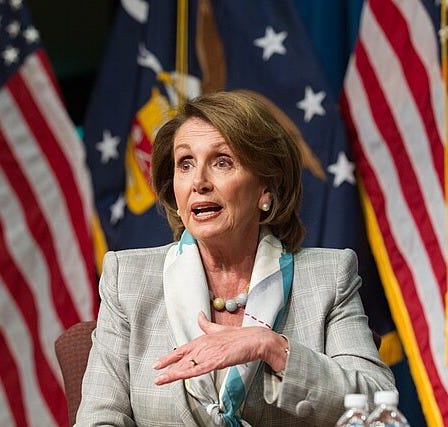
Last week, the race for the Democratic nomination for New York’s Twelfth Congressional District kicked into gear with three huge endorsements from three high-profile senior citizens. For Alex Bores, former Rep. Carolyn Maloney, who represented the Upper East Side in Congress from 1993 to 2023. For Micah Lasher, Jerry Nadler, the current incumbent who has represented the Upper West Side in Congress since 1992. And for Jack Schlossberg, Nancy Pelosi, who has represented San Francisco in Congress since 1987, and who (it feels dumb to type this) led the House Democratic Caucus for twenty years, including two stints as House Speaker.
Endorsements can give you a decent snapshot of the state of a primary race. But that’s not their main purpose. It would be hilarious if it was, if campaigns and elected officials and unions and political clubs went through this elaborate courtship process all to provide impatient politics nerds a tool to analyze and forecast a race without waiting for polling. “Eli needs something to write about this week,” Jerry Nadler might have thought to himself before telling his comms team to prepare a statement in support of Lasher.
In reality, Nadler endorsed Lasher because he wanted to give a boost to the Lasher campaign, and endorsements provide immense value. They do so in a few ways:
1. Personal Recommendation:
At the most basic level, an endorsement tells voters that a specific person thought about the election, carefully considered the candidates, and decided that this one was the best. If voters trust the endorser’s judgement on other matters, they might decide to do so on this one.
This is how we all make decisions all the time. I’m more likely to check out a new taco place in the neighborhood if my friend tells me it’s good, to watch One Battle After Another and Andor if my favorite Ringer podcasters put them on their “Best of 2025” lists, or to buy sneakers if Lebron James’s initials are stitched onto the heel. We’d like to think that every voter pays close attention to their local politics, and carefully selects the candidate who best matches their policy preferences, but who has time for that? Most people are content to ask someone else who they plan to vote for, and trust their judgment.
Okay, but that someone else is usually a friend, a relative, or a colleague, not a politician they have likely never met. I wrote last month that it was a big deal when Brad Hoylman-Sigal, former West Side State Senator and current Manhattan Borough President, endorsed Micah Lasher. But I sincerely doubt that there were a significant number of NY-12 voters who saw that endorsement and said, “well if he’s good enough for Brad, he’s good enough for me.” Hoylman-Sigal is well-respected, and won his Borough President race easily last fall, but most people have still never heard of him, and even the ones that have probably do not feel that level of devotion.
Nadler, Maloney, and Pelosi are all much more famous and prominent than Hoylman-Sigal, and there probably are a few voters who will pick a candidate based on one of their endorsements alone (more will do so based on Nadler’s endorsement than the other two.) But while Democrats in this district likely have vaguely positive impressions of all three Representatives, most will not have blind faith in any of them. For an endorsement to sway a significant chunk of voters directly, you need someone like Zohran Mamdani, AOC, or Barack Obama, a personality cult leader with thousands of obsessed superfans who would follow their leader anywhere.
2. Positive Attention
Most primary candidates start their campaigns with near-zero name recognition, especially in a race for a local office. They need to get in front of as many eyeballs as possible, and they do not have enough money to do it with advertising alone. Endorsements are helpful because they generate attention. It’s not just what the endorser says, but how they say it, and who they say it to.
If an elected official endorses you, they will probably post a picture of you on their social media feeds, which likely have many more followers than yours do. Perhaps they’ll accompany that post with a bland written statement, where they describe you as a “fighter,” and “exactly what this district needs right now.” That alone is quite good for you; your name and face have now reached a whole new audience, which will expand as local journalists inevitably reshare the post.
Depending on the prominence of the elected official, and on how enthusiastic they really are about you, they could decide to give you a lot more. They could, for example, hold an in-person press conference, encouraging journalists to write full stories about the endorsement, which they can adorn with new pictures of the two of you warmly embracing in front of a podium. They could also bypass the journalists entirely, and write their own op-ed in a publication with its own large, built-in audience and distribution network. And they could even make a vertical video for you. Zohran Mamdani probably will not endorse in this race. But if he does, the lucky recipient will get a homemade, free viral video from one of the most successful video communicators of our time, just like the ones he gave to Astoria DSA comrades AD-36 candidate Diana Moreno and and NY-7 candidate Claire Valdez.
This is not something you get when Congressional stalwarts in their seventies and eighties endorse you. The Lasher campaign tried their best with Nadler’s endorsement video, but could not get the Congressman to actually appear with Lasher in-person, on-camera, and had to settle for a voiceover recording of Nadler reading out the same press release he had posted earlier that weekend, set over a stirring slideshow of images from his three decades in office. The video has fewer than a thousand views on YouTube, fewer than 100 likes and reposts on Twitter, and has not even been posted on Instagram. Still, it’s more than Bores or Schlossberg got, as neither Maloney nor Pelosi even bothered to announce their endorsements at all. No tweets, no press release, nothing. Both politicians could have done more if they had felt like it, and the fact that they didn’t sends a strong signal that Nadler cares about this much more than Maloney or Pelosi, something voters might or might not pick up on. Either way, none of these endorsements helped their candidates gain much new or useful attention.
3. Momentum/Fundraising
Liberals like to think that they are on the side of the underdog, but primary campaigns turn them and everyone else into shameless bandwagoners. The structural incentives are just too strong. If you run a labor union or another interest group, you want to have a good relationship with your elected officials to get your members the best policy treatment possible, that’s a lot easier if you endorsed them early, and a lot harder if you endorsed their opponent. If you’re a donor (even the least transactional, most purely altruistic donor imaginable, which let’s be honest, you probably aren’t) then you want to donate to someone who has a shot at winning, so you don’t feel like you are wasting your money. And if you’re a voter, you similarly want your vote to count. In a first-past-the-post election with more than two candidates, voting for your favorite candidate is essentially the same as not voting if they have no chance of winning. You basically have to figure out which two are the most viable, and then pick the one you hate less.
Endorsements tell people which candidates are and are not viable. They help a campaign demonstrate momentum, which can be self-reinforcing. People might see the endorsement, see how viable it makes a candidate seem, and decide to jump on the bandwagon while they still can.
And if you get the right elected official to endorse you, then this kind of indirect signaling process won’t be the only way they can help you get more endorsements and donations. Nancy Pelosi, for example, has a Rolodex full of wealthy New Yorkers who like to donate to Democratic campaigns. Alex Bores’s campaign currently leads the race in fundraising with a little over $2 million, but if Pelosi decided to work the phones herself, she could probably raise that much for Schlossberg in a single afternoon. Nadler could similarly pick up the phone and get every West Side elected official to endorse Lasher, except that they all already did months ago. Well-connected endorsers can get you momentum through an endorsement’s signalling effect, and they can also use their connections directly to speed up that process.
4. Political/Ideological Commitment
When someone endorses a candidate, they’ll do their best to make it seem like they’re doing it out of the goodness of their heart, because they love the district, and they’re just so overcome with enthusiasm for this person that they simply have to tell everyone about it. This might be true every once in a while. But most of the time, when a party elite gets up and says “this is the best person for the job,” what they mean is “this person and I have reached a deal where they have agreed to give me all sorts of things that I want when they’re in office, and in exchange, I have agreed to compliment them in public.” Sometimes, an endorser messes up and says this part out loud. Kathy Hochul’s New York Times Op-Ed endorsement of Zohran Mamdani, for example, mentioned that she had “urged him to ensure that there is strong leadership at the helm of the N.Y.P.D. — and he agreed,” a pretty brazen admission that he had promised to keep Jessica Tisch on as Police Commissioner in exchange for Hochul’s endorsement.
Even when endorsers don’t spell out the terms of their deal like this, voters understand the subtext. A public sector union leader’s endorsement tells members which candidate offered them the most favorable deal terms. An elected official’s endorsement tells constituents which candidate will best use their power to support that official’s policy agenda (or reappoint that official’s chosen bureaucrats, in Hochul’s case). And even if there is no direct quid pro quo, endorsements create alliances that publicly commit people to one another, because if you gush about how wonderful someone is, it’s awkward and embarrassing if you have to turn around six months later and diss them (unless you are Donald Trump or Elon Musk, in which case you are immune to embarrassment so you can do whatever you want.) An endorsement tells voters that the candidate and the endorser plan to work together and make an earnest effort to get along.
(Obviously, none of this applies if the endorser is retired from politics, as Maloney, Pelosi, and Nadler all will be when the winner of the NY-12 primary takes office next January).
5. Volunteer Recruiting
A campaign starts out as a relatively small operation. A campaign manager, a comms person, a few people for fundraising, and maybe a few more to run social media. At some point between the launch day and election day, the campaign must transform into a massive machine, with an organizational structure to recruit and support hundreds of volunteers, so they can spend thousands of hours knocking on doors, handing out palm cards, and calling up every registered voter in the phone book. Elected officials who have won previous campaigns did so by building this machine for themselves, and can build it again on behalf of the candidates they endorse, using the same email lists and networks. Labor unions have a standing army of members who will show up in droves to canvas for their preferred candidate. And in Manhattan, political junkies who belong to no interest group but nonetheless have a deep-seated urge to knock on doors and hand out literature to strangers on the street organize themselves into local political clubs, which essentially give their endorsed candidate an entire pre-built campaign apparatus.
Micah Lasher has received endorsements from two of the three big West Side clubs, the West Side Democrats and the Three Parks Independent Democrats (he will almost certainly get the Broadway Democrats too). South of the park, he also has the Village Independent Democrats in the West Village, and both the Eleanor Roosevelt Independent Democrats and the Tilden Democrats, the two clubs that cover the 74th Assembly District (Midtown East, Stuy-Town, Gramercy Park). So far, Bores has the two main Upper East Side clubs: the Lexington Democrats and Four Freedoms Democratic Club. He might also pick up the Chelsea Reform Democratic Club sometime this week, but that’s probably going to be it. Well over half of the electorate lives in neighborhoods covered by clubs that endorsed Lasher, so he’ll start with a significant ground game advantage. Bores’s path to victory will depend on making up for that somehow, either by building his own volunteer network from scratch, by dominating on social media, or some combination of both.
No club has endorsed Jack Schlossberg, and I would be shocked if any of them do.
II.
Last month, I broke down the utterly vapid Schlossberg campaign. “There’s no shame in it,” I wrote, “But electoral politics is just not something he is any good at, and his pedigree alone is not worth enough anymore to make up for it.” Since then, he has in successive candidate forums committed himself to conflicting positions on Israel/Palestine, irritating voters on both sides and confusing everyone with his incoherence in the process. In a short piece for the Atlantic last week, Jonathan Chait skewered Schlossberg’s journalistic output from his time as a political correspondent for Vogue Magazine, writing that “it was utterly banal, but at least there wasn’t much of it. He wrote just seven short, insight-free columns.” Chait noted that this was Schlossberg’s most significant professional credential, and concluded that “to suggest that he has failed upward would give him too much credit because failing requires having been entrusted with some responsibility in the first place.”
I can’t write barbs like Chait can, but I’ll add one personal anecdote. I got a chance to see Schlossberg speak at an event a few weeks ago. Because of the peculiarities of 501(c)(3) rules, he was forbidden from talking openly about his candidacy at the event, but was invited instead to give his perspective on the state of the Democratic Party, the direction it should go in, and what policy and strategy steps it should take to get there. He was the event’s sole guest, and he spoke for about seven minutes about what the dynamics are like when his great-uncle comes to family gatherings, then added a few platitudes about how Trump is a threat to democracy, and was out of things to say almost immediately afterward. After some awkward silences, the event ended fifteen minutes early. I have no idea how he expects to convince people to vote for him if he cannot fill time at a podium in front of a large audience of potential voters.
And this is why it’s so bizarre that Nancy Pelosi has decided to endorse Schlossberg. Using the framework above, it’s pretty unhelpful. She has not done anything to get Schlossberg more followers or eyeballs (Positive Attention), and as the candidate with by far the largest social media following already, he does not need her to. Her endorsement does not signify any sort of policy deal (Political/Ideological Commitment), because Pelosi is retiring and has no policy agenda to advance anymore. She has no local political infrastructure in Manhattan, and will not be helpful in recruiting Upper West Siders (Volunteer Recruiting) to knock on doors on his behalf. And as a Personal Recommendation, she is utterly unconvincing to anyone paying attention, because Schlossberg has shown absolutely nothing to recommend, and she does not have enough of a personality cult to inspire much blind faith. All she can do is help him raise money and give his campaign an ephemeral burst of momentum (Momentum/Fundraising), presumably as a favor to his mother, who she has known for decades.
Democrats believe that they are the party of safeguarding democracy from the threat of Trump’s nakedly autocratic, corrupt impulses. Voters have shown in polls and elections that they are skeptical. It’s not hard to see why, when Democratic elites like Pelosi use their power to boost undeserving, but well-connected insiders (and to issue an obviously dishonest, borderline-Orwellian statement about how we need leaders like Schlossberg “who understand the stakes and how to deliver for the people they serve.”).
Thankfully, Pelosi is the wrong kind of endorsement to make Schlossberg a competitive candidate. In a way, that makes it more embarrassing for her. If you’re going to incinerate your credibility for personal reasons, you should at least make sure it’s actually going to have any impact first.
I’m not sure that I agree 100%. In certain big buildings on the upper east side, where residents are older, not so in the weeds on local politics but watch MSNBC, the combo of Schlossberg (Kennedy) and Pelosi could be potent.
Did you see Schlossberg endorsed notorious NIMBY Layla Law-Gisiko for the city council special to replace Bottcher? Very bizarre since Schlossberg, to his credit, endorsed the pro-housing ballot measures while Layla spoke at a rally with Vickie Paladino against them.