

This is part II of an ongoing series on the June 2026 Democratic primary for New York’s 12th Congressional District. You can check out part I here.
There is a member of the New York State Assembly, a handsome, bearded, slim, slightly-shorter-than-you’d-expect young man, barely in his mid-thirties, who strikes fear into the heart of the rich and the powerful. An Upper Manhattan native and an alarmingly recent graduate from one of the city’s most competitive public high schools, he’s almost completely unknown to most normal people even in his home city. But a certain segment of the oligarch class knows him well and they’re terrified. So terrified, in fact, that they’re deploying inconceivable sums through shady dark money vehicles with one aim: to stop his meteoric ascent to power before it’s too late.
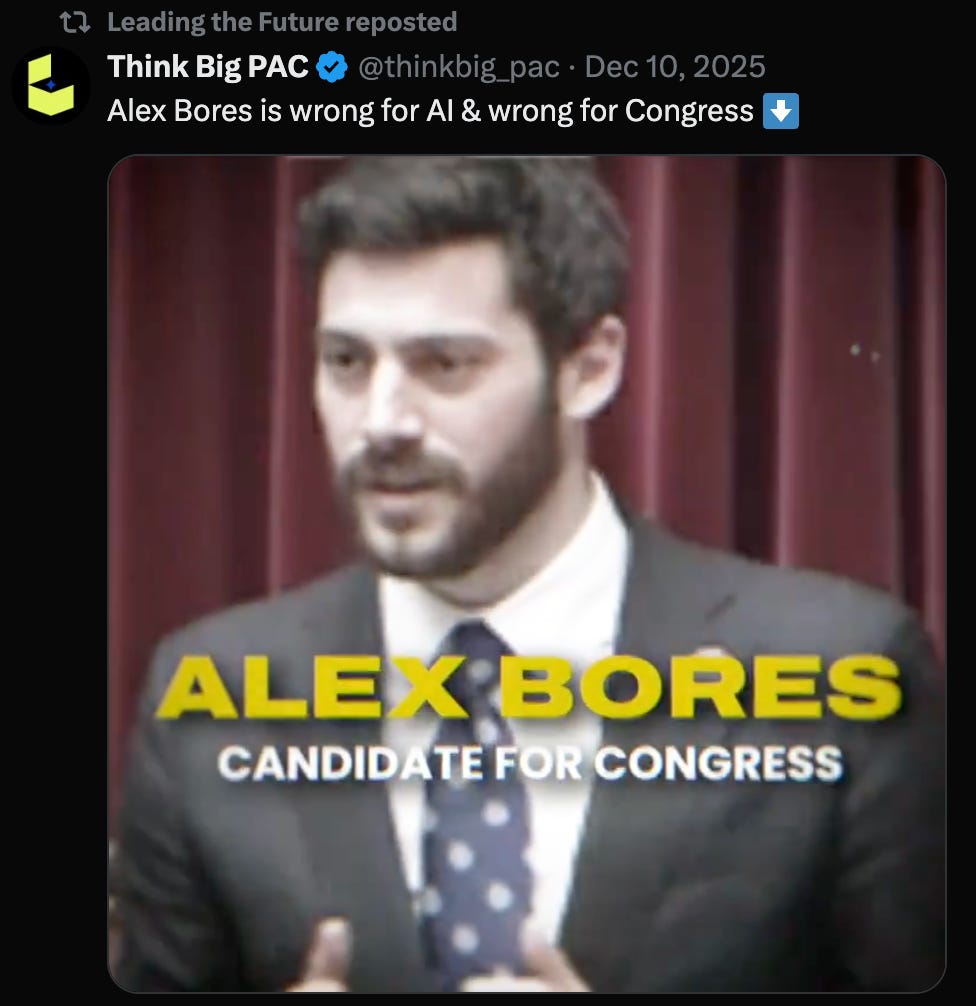
They’re trying everything. Sixty second scare ads that feature grainy black-and-white shots of the man described by a narrator with an ominously deep voice. Big ticket appearances on national manosphere podcasts where his ideas are ridiculed as absurd and dangerous. Shady backroom deals with well-positioned insiders who have “close ties to Andrew Cuomo and Chuck Schumer.”
It’s difficult work, of course, because our guy is so clever with his countermaneuvers. He has fervent support from grassroots organizations, the types who fall for his populist agenda, who are charmed by his clever short-form videos that make him seem hip and relatable. And there are concerning signs that he may be building a broader coalition. He was even invited onto Bloomberg’s Odd Lots podcast recently, where high priests of American financial capitalism Joe Weisenthal and Tracy Alloway engaged with him pleasantly, and allowed him to sanitize his radical ideas to their influential audience. Still, the oligarchs are reasonably sure the money will win out eventually, that the old rules of post-Citizens United politics still apply, that this man will eventually come back to earth. I mean, he can’t actually win… right?
No, I’m not talking about Zohran Mamdani. I’m talking about Alex Bores, elected representative of New York’s 73rd Assembly District, which encompasses the very wealthiest parts of the Upper East Side (south of 96th street, west of 3rd Ave). Alex Bores, computer nerd, Palantir alum, darling of the many Park Avenue neighborhood Democrats associations, enthusiastic Kathy Hochul fundraiser, endearingly beleaguered young parent, with a slightly nasally voice and a passion for “going into the weeds” on issues that even his fellow lawmakers find incredibly dull. That’s the guy they fear. Oligarchs like Trump-aligned venture capitalist Marc Andreessan, even more Trump-aligned venture capitalist, podcaster, and absolute menace on Elon-era Twitter David Sacks, and president of OpenAI Greg Brockman1 have raised $100 million in a super PAC, looked around the country for enemies of progress to fight, and decided that Alex Bores is Undesirable Number One.
They’ve done so not because Bores has any grand plans for tax increases or expansions to social services, nor because he is a particularly fierce critic of Trump (he’s not a fan, of course, but no more or less than any other NY-12 candidate). No, Bores provoked their ire solely by sponsoring and advocating for a piece of state legislation called the RAISE Act, which imposes some basic guardrails on the AI industry’s activity in New York State. Like, very basic guardrails. AI labs that spend $100 million or more on research (right now, that’s Meta, Google, Anthropic, OpenAI, and xAi) that target New York consumers would have to publish a public safety plan, which they all already do voluntarily. And the Attorney General would be empowered to actually hold these companies to their plans, and sue for $1-3 million fines if they violated them. That’s it. Those fines amount to speeding tickets for these labs that are backed by trillion-dollar tech companies, which are all currently engaged in one of the biggest capex binges ever. New York can (after a lengthy legal battle against the world’s most expensive corporate defense lawyers) impose nominal, self-guided fines on companies that are trying to build robot overlords that might turn us all into paper clips, and for that, Alex Bores must be crushed.
All of this is pretty hilarious, not least because it is predictably, obviously, dramatically backfiring. In a crowded primary dominated by a heavy favorite with superior endorsements and connections, all of these attack ads give the underdog Bores cycle after cycle of earned media, as well as a clear narrative for why he is different from other candidates. “Vote for me, the guy that cartoonishly evil Trump-supporting robot overlord Californians hate” is an easy sell. The oligarchs might as well have donated $10 million to Bores directly, or put up billboards with him in a superhero cape charismatically evading Mr. Monopoly. The question is… will any of this matter? Does anyone care? Or does someone else have the race already locked up?
II.
Rumors of this race already being locked up have been greatly exaggerated, mostly by me. Last September, I wrote that Micah Lasher, State Assemblyman to the 69th Assembly District and a fixture of Upper West Side politics behind the scenes for more than two decades, clearly had incumbent Representative Jerrold Nadler’s blessing, and should therefore be treated as a heavy favorite. I was so confident in Lasher, in fact, that I wondered if anyone serious would even bother to challenge him. “If two or three [competitors] enter the race in the next month, then Lasher still has work to do,” I wrote, but believed that it was possible, even likely, that no one would.
Oops. Within a month, at least ten other Democrats had declared their candidacy, including two other extremely popular, established elected officials of the Twelfth district: Bores and West Village City Councilor Erik Bottcher. By December, Lasher was no longer even the race’s only Micah, and all fall, it was practically a legal requirement for journalists writing about this race to use the word “crowded.” Superficially, all signs pointed to a brutal, chaotic melee without a clear favorite.
But Lasher’s firewall stayed strong. Within a few weeks of formally entering the race, he secured endorsements from incoming Manhattan Borough President and former Upper West Side State Senator Brad Hoylman-Sigal, former City Comptroller, Manhattan Borough President, and Upper West Side State Assemblymember Scott Stringer, sitting Morningside Heights City Councilor Shaun Abreu, and Linda Rosenthal, a former Nadler aide who has represented the lower half of the Upper West Side in the State Assembly for twenty years. A few weeks later, he followed those up with legendary West Village State Assemblymember Deborah Glick, who became the state’s first openly LGBTQ state representative when she was elected in 1991 and has held her seat ever since, by the end of the year had locked up three more former Manhattan Borough Presidents from the Upper West Side: Ruth Messinger, Gale Brewer, and newly elected City Comptroller Mark Levine. Lasher has worked for at least two of these people, and has decades-long relationships with all the others, so it is not surprising that they all fell in line. But it’s still an overwhelmingly dominant run. Every single one of these people has close ties to both Nadler himself, and his network of West Side organizations and nonprofits that make up his formidable political machine, so these endorsements send a clear signal that this machine’s might will be Lasher’s, and his alone, to wield this summer. Other candidates have certainly taken note. Upstart Rhodes Scholar and native Upper West Sider Liam Elkind, who bravely tried to challenge Nadler last summer before he announced his retirement, dropped out by Thanksgiving, and endorsed Lasher almost immediately after. The next week, Erik Bottcher announced his decision to run for an open State Senate seat instead, immediately earning endorsements from basically all of Lasher’s endorsers (Abreu, Levine, Brewer, Glick), plus Lasher, plus even Nadler himself. While nothing like this has been reported, the speed and enthusiasm of these endorsements indicated that Bottcher might have arranged a deal with Lasher and/or Nadler beforehand. Either way, Lasher has enjoyed a dominant, near-perfect opening to his campaign, “crowded field” be damned.
III.
Anti-establishment candidates do occasionally build insurgent grassroots coalitions that topple longstanding machines (though Lasher’s endorsement portfolio is looking much stronger than even Cuomo’s looked last spring). But Bores is no insurgent. He is not running on a message about how the elected officials of Manhattan have become too comfortable, how they’ve lost touch with their voters, how we need a real authentic New Yorker who understands the struggles of the common man to represent us instead of another contemptible, corrupt elite. This would be very silly, because Manhattan Democrats love their elected officials, who all do an excellent job of performing their New Yorker authenticity (Nadler brought Zabar’s to Trump’s impeachment hearing, and if you’re already sick of reading that anecdote, buckle up, it’s going to be a long six months.)
There are other insurgent lanes with more potential, though: “established elected officials aren’t progressive enough for the district’s new generation of young, energized Mamdani fans,” or “the establishment is too captured by hyperlocal issues, we need a fresh face who will say no to community boards and fight for YIMBY Abundance stuff,” or maybe “the people in office right now are too supportive/not supportive enough of Israel.” So far, Bores is not really going for any of these either. He may not have the temperament for it, as a wonky incrementalist reformer. More practically, it would be difficult to make any anti-establishment argument that doesn’t implicate himself, a popular and successful fundraiser among the machine-iest types up and down the East Side. Bores is currently in pretty good standing with Hoylman-Sigal, Levine, Brewer, and all the others. He’s giving up his Assembly seat to run, and if he loses, he’d like to be able to count on their support if another, less competitive spot opens up in the future. Torching the establishment and positioning himself as too much of an insurgent will make that difficult.
IV.
Instead, Bores’s path to victory will run through the establishment, which means it rests on at least two preconditions. First, he needs to organize the East Side Democratic Party into a fearsome political operation that is firmly united behind him and can counter the clout of the Upper West Side. On paper, this shouldn’t be too difficult. By my count, 52,755 Democrats voted in the mayoral primary from NY-12 election districts on the Upper East Side last June, only a few thousand fewer than the 55,959 on the Upper West Side. That’s not an insurmountable gap, and Bores can make it up easily if he also gets the firm support of the Midtown East/Murray Hill/Kips Bay section of the district. His current district stretches from 94th street all the way down to 33rd, so he’s got plenty of experience straddling these two regions. Add it all up, and 86,067 NY-12 Democrats voted from east of 5th Avenue, compared to only 84,546 from west of 5th Avenue, last June.
But it’s not so simple, because the West Side just has more juice. Always has. It is not a coincidence that five of the last six Manhattan Borough Presidents (all of whom have endorsed Lasher) are from the Upper West Side. West Side candidates have won borough-wide races because the organizations on the West Side, the unions, the nonprofits, the local political clubs, have had more members and a tighter grip on them than their counterparts on the East Side. They have won because West Side Democrats have been progressive, and more likely to have been Democrats for their entire lives, whereas more East Side Democrats have been Trump-era converts (In 2012, for example, Romney got more than 30% in the main Upper East Side Assembly District, but did not crack 20% anywhere on the West Side). And West Side candidates have won because they have enjoyed connections to other West Side candidates, who have been more likely to sit in higher offices like Comptroller, Borough President, or even US Congress, where they could use their clout to help their neighbors ascend.
It’s not inevitable that this dynamic will persist forever (It’s not even a particularly desirable one; despite my UWS patriotism, I ranked Powers over Hoylman-Sigal because I liked his ambitious housing plan better.) But it’s a dynamic that Bores will have to contend with. He’ll have to bring together the growing cohort of No Kings folks (Lasher’s ideal demo) east of Park Avenue, their Cuomo-supporting, Free-Press-reading neighbors, and the less organized but numerous Democrats of Murray Hill and Kips Bay, a combination of young families with finance and tech workers from Big Ten schools who voted for Mamdani in the June 2025 primary by more than seven points, but might not be politically active enough to remember why a year later. Bores will have to figure out a way to get all of these people really excited about him. And then he’ll have to convince them all to come back from the Hamptons to vote for him in the middle of June. (This is another reason that West Siders traditionally do better, though post-pandemic, they increasingly have to get their voters down from Kingston and Beacon instead.)
V.
To pull this off, Bores will also need a second precondition: a key issue of strength that gives him a reason for being in the race besides geography. It looks like this is going to be AI, so Bores needs to hope that come June, Manhattan Democrats care a lot about AI regulation, and can easily understand why Bores would be significantly better than Lasher on this issue. A few months ago, this looked like a heavy lift; Democrats were so obsessed with fighting Trump that it was hard to imagine how they could focus on anything else. This again favored Lasher, who has led the charge of “Trump-proofing” New York state law in the Assembly.
But if you’re looking for a different issue that will come to the forefront and capture the imagination of an electorate the way “affordability” did for Mamdani’s campaign last year, AI is a pretty good bet. In a recent piece, Politico’s Calder McHugh gave a dispatch from Democrats across the country as they struggle to respond to data, both polling and anecdotal, that shows a surge of populist rage against AI, a particular loathing towards the construction of data centers, and an voracious appetite for industry regulation. The polls are astounding: 80% of Americans support AI regulation, even if it will slow growth. And some of the people quoted in the piece, including Mamdani comms prodigy Morris Katz (“We’re really headed towards a point in which it feels like we will all be struggling, except for 12 billionaires in a wine cave”) and the frenzied Youtube comment section of Gretchen Whitmer’s apolitical holiday greeting video (“All I want for Christmas is legislation banning data centers in Michigan,”) might make even Alex Bores blush. A few days later, Eric Levitz of Vox poured some cold water on McHugh’s piece, pointing to a few other polls that indicated more optimism about AI among some voters, and more apathy about the prospect of regulation in most others (in one poll, only three percent of voters named AI, the internet or anything technology-related when asked to name the five biggest problems they wanted the government to fix). It’s worth reading both pieces, but while Levitz may be right that for now, AI regulation remains something of an elite, “insider” concern that the majority of Democrats don’t care much about, there is no more elite, more insidery group of Democrats than the ones that vote in NY-12.
And of course, Bores will not necessarily have to make AI the number one issue for every voter. He can probably get over the top if he can sell some version of “Lasher and I are both equally tough on Trump, so you should vote for me because of AI,” or “We need someone knowledgeable about AI to stop Trump, who is a corrupt puppet of the AI oligarchs.” or even “your children have become addicted to TikTok and it’s Trump’s fault for not enforcing the ban of TikTok and I’m the guy who will do… something.”
So that’s the path. Bores would be in an absolutely phenomenal position if Lasher drops out for some reason, or if he’s caught on camera saying something embarrassing, or if more people find out about his incredibly Trumpy 2025 Spotify Wrapped (five Andrew Lloyd Webber songs!) Short of that, Bores needs to unite the East Side, and hope that a third candidate in this oh-so-crowded field gets some momentum and splits up the West Side a little bit. Then he needs to pad his margins everywhere with a salient, coherent message about why he’s the best on a key issue that voters are obsessed with, but that no other candidate saw coming.
It could happen! It’s probably the second-likeliest outcome. To my eye, the likeliest outcome seems a lot more likely.
(a misleading title in one of corporate America’s most confusing org charts)
I think there is a very small segment of Mamdani supporters in the district who would’ve been open to Bores, even with the ideological differences, if Lasher had acted like Dan Goldman and refused to endorse Zohran while implying that he’s antisemitic.
Instead, Lasher was bizarrely the first elected after the primary to validate Zohran, endorse him and say genuinely nice things about him (while expressing reservations about Israel ofc). From my understanding, Zohran fans don’t dislike Lasher with the same ferocity so it’s very hard for Bores to polarize them unless he moves left, and ruins his chances (the district is not that left except on social issues).
Lasher will be more of the same as Nadler and basically pick up where he left off. I lived in Nadler’s old district for 10 years and he notoriously doesn’t meet with constituents. I was so excited to move to Carolyn Maloney’s district until the BoE screwed her on an admin technicality. Alex is amazing. I’ve known him for many years. He gets it and will do great things for not just NY-12, but the country.