

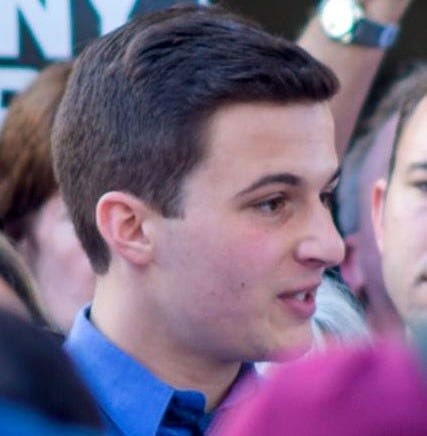
This is part IV of an ongoing series on the June 2026 Democratic primary for New York’s 12th Congressional District. You can check out part I here (Micah Lasher), part II here (Alex Bores), and part III here (why insurgent outsiders will struggle in this race.)
Of the insurgent outsiders running, 25-year old gun-control activist Cameron Kasky is the one who could actually win the primary for New York’s Twelfth Congressional District this summer. You can watch him explain how he’s going to do it in one of his recent vertical videos. “People tell me a hard left agenda can’t win in my district,” he tells us. “But guess what: I have a million people running to the right of me.” He then compares the situation to the NY-10 primary in 2022, where moderate Dan Goldman edged out multiple left-wing opponents, winning just over 25% of the vote in a six-way race. “When you look at how many people there are in this primary, you’re not going to need a high percentage to win… so donate to my campaign to help the left wing movement pull a Reverse-Goldman.”
It’s a compelling analogy, especially for NYC politics nerds who were infuriated by Goldman’s election in 2022. But I think it fails on two levels. Firstly, the 2022 NY-10 race was distinguished not by its unusually large number of candidates, (all open primaries have tons of candidates, everyone wants to run for Congress) but by its unusual lack of a clear front-runner. There were six different public servants with credible resumes (plus Bill de Blasio, briefly), and none of them ever generated any real momentum until, at the last second, the Times Editorial Board endorsed Goldman. After the race, progressives in Brooklyn and lower Manhattan blamed candidates like Carlina Rivera and Mondaire Jones for not dropping out and supporting progressive State Assemblywoman Yuh-Line Niou. But Rivera, Jones, and Niou all had different policy priorities and very different constituencies, and anyway, in real time it was completely unclear which of the three had the best chance of winning if they coalesced, or whether Goldman would win if they didn’t. This race has no such vacuum at the top: Lasher is a clear frontrunner. If Kasky starts surging in polls, and a plurality of moderate voters decide he is too left-wing for the district, they will coalesce behind Lasher easily. Perhaps this will change; perhaps Bores will gain some steam, and then moderate candidates will not know which one to unite behind, or perhaps their sparring will become so vicious that both will refuse to endorse the other out of pride, clearing the way for Kasky. I find this scenario extremely unlikely (neither Bores nor Lasher has said a single negative thing about the other one so far, and they are actively running against each other), but, you know, it could happen.
But even then, Kasky has a second problem: Is he even the left-wing candidate? Because there’s room for one in this race. In the June 2025 primary, 77,310 registered Democrats in NY-12 ranked Mamdani above Cuomo, (that’s 45.3%) compared with 77,348 who ranked Cuomo above Mamdani (also 45.3%, the remaining 9.4% did not rank either one). A candidate who wins a big chunk of the Mamdani-over-Cuomo voters will be in a very good position.
Are those voters really Kasky’s to lose? To answer that question, we need to learn a little more about who this 25 year-old prodigy actually is.
II.
On February 14th, 2018, 19-year old Nikolas Cruz brought an AR-15 to his former high school, Marjory Stoneman Douglas in Parkland, Florida, and opened fire, killing seventeen people. It remains the deadliest mass shooting at a high school in American history. Seven days later, CNN hosted a town hall in nearby Sunrise, with Florida Senator Marco Rubio. There, CNN gave a seventeen year-old Stoneman Douglas student named Cameron Kasky five minutes of airtime to confront Rubio directly. Pacing back and forth on the small stage with a hand-held microphone, Kasky stared into the middle distance with an intense, haunted look, his voice quivering slightly with nerves, adolescent voice cracks, and, most of all, barely-suppressed rage. After introducing himself, Kasky turned to face Rubio. “Senator Rubio, can you tell me right now that you will not accept a single donation from the NRA?”
The entire audience immediately erupted into a standing ovation, lasting almost thirty full seconds, an eternity on live television. Rubio tried to respond, but kept getting cut off by boos and heckles from the irate crowd. Finally they relented, and Rubio robotically rattled off his talking points; he supported raising the minimum age of gun ownership to twenty-one, and he disagreed with President Trump’s suggestion to arm teachers, but he believed in the Second Amendment, and always had. Kasky then doubled down on the NRA donations. “In the name of seventeen people, you cannot ask the NRA to keep their money out of your campaign? As a matter of fact, I bet we can get people in here to give you exactly as much money as the NRA would. I’ll do it, I’ve raised quite a bit of money so far.”
At this point, Rubio finally found some semblance of footing. “You’re right about that, there’s money on both sides of every issue in America, and where that leaves us in policymaking is to look at the issues and make a decision based on what we think is right… The influence of these groups comes not from money, but from millions of people who agree with this agenda.” Kasky got one last barb in: “I knew that was going to happen- NRA, please just keep the money out of Rubio,” to another wave of cheers. It was a clever high school debate-kid tactic. Rubio hadn’t budged from his underlying position, but in the process, he had implied that the donations were somewhat irrelevant, a dubious claim that Kasky could then exaggerate and mock.
This moment immediately went completely viral. I do not watch CNN, and was not following politics particularly closely in 2018, but I remember seeing it multiple times. Kasky’s performance would have been impressive for a professional Senate candidate, let alone a seventeen year-old who had just survived a mass shooting a week earlier. And it was incredible symbolism: the righteous fury of the younger generation swallowing up the feeble equivocating of their corrupt, irresponsible elders. In the following months, Kasky and his father would found the Families vs. Assault Rifles PAC, which raised more than $200,000 for gun-control candidates in the 2018 election cycle. “We have one focus,” Kasky’s father told Politico: passing a nationwide assault weapons ban.
The energy in the town hall clip and in the ensuing coverage had an air of inevitability to it. Every other peer country had a similar ban, it was clearly necessary, and the costs of refusing to enact it were so devastating and spectacularly obvious. The only reason the US hadn’t yet was because corrupt politicians like Marco Rubio were too beholden to deep-pocketed special interests like the NRA. With enough organizing (and fundraising), the many would inevitably defeat the money (or the good guys with more money would defeat the bad guys with less). This particular brand of gun-control politics reached its fever pitch a year later, when presidential candidate Beto O’Rourke announced on a primary debate stage that, after a mass shooting at a Walmart in his district in El Paso, “Hell yes, we are going to take your AR-15.”
We do not have a national assault weapons ban today. Gun control measures still poll well on their own, but as Nate Cohn argued a few years ago, “issue polling,” i.e. asking people where they stand on a particular issue, has a notoriously bad record of predicting actual voter behavior. “Which party do you trust?”-type tracking questions have fared much better, and they show a grim picture for Democrats on gun control. David Shor’s Blue Rose Research ran detailed, rigorous tracking surveys throughout the 2024 election cycle, and they found that guns did not rank in the top ten most salient issues for 2024 voters. Worse yet, when voters do consider guns, and are asked which party they trust more on that issue, Republicans lead Democrats by about five points. And all this in a cycle where the NRA barely participated at all, after falling into grave financial trouble because of their alleged misuse of donations. It turns out that Rubio was, unfortunately, correct. The money was not the only thing driving his priorities. There was money on both sides. And there were millions of people who agreed with his agenda, and that’s what actually had influence over him and the other Senate Republicans.
III.
There is a lively debate in Democratic Party circles about what to do about issues like this, where data shows that their position is less popular than the Republican position. The most extreme answer, often championed by moderate agitators like Matthew Yglesias, is that Democrats should simply change their position. (Yglesias often makes this argument about climate issues, he’s more ambivalent on gun control.) This is incredibly frustrating on an issue like gun control, where liberals (like myself) feel strongly that we are just clearly correct, that regular people obviously shouldn’t be allowed to have AR-15s, and that saying anything else is stupid and dangerous. “The Civil Rights Movement wasn’t popular either,” goes the most common retort.
However, it’s reasonable to expect Democrats to be aware of their position’s relative unpopularity, and to change tactics accordingly. Either they should work to lower the salience of the issue, win on other issues that they are stronger on, and then implement their agenda quickly and quietly once they win. Or they should have a targeted strategy for persuasion. Jonathan V. Last broke down what this could look like for USAID in a blog for the Bulwark last year. He argued that while USAID was generally unpopular, Democrats could make progress opposing Elon Musk’s catastrophic cuts if they could highlight individual stories of worthy programs that had to be shut down, and if they carefully picked weak opponents (like targeting Musk instead of Trump). Tactical, disciplined, strategic messaging can help you persuade people and make your position slightly less unpopular, which eventually gives you more room to make the broader, less strategic case.
Activists like Kasky hate this. They prefer to name and shame. They want to get out a big megaphone and say “hey look at this idiot! Look how wrong he is! Let me think of a clever attention-generating way to illustrate his wrongness. A protest outside his office, maybe, or a savage quote tweet. Or a charismatic, righteous takedown at a town hall on national television.” This works very well if most people agree that the person in question is wrong, but wouldn’t have necessarily found out about it otherwise. There are many issues where Republicans have unpopular views that need to be named and shamed. Medicaid. Social Security. Abortion. Gun control turned out not to be one of them in 2018, and it wouldn’t be one now either. Eight years later, gun control is no longer Kasky’s flagship issue (the pillars of his platform are “Stop Funding Genocide,” “Medicare for All,” and “Abolish ICE”). But he uses the same activist tactics he showed when he was still a junior in high school.
He owns people online. He is by far the best poster of the field, writing on Twitter with a conversational clarity that reads as “normal person having an interesting or funny thought” and not “I am Very Outraged, here’s a press release my comms team wrote about it.” Unlike his elder millennial opponents, he does not overuse the phrase “Let’s be clear:” or append custom hashtags as if it were still 2011. He regularly retweets low-follower accounts he agrees with, and (more concerningly) quote-tweets or replies to the low-follower accounts he disagrees with. He occasionally pokes fun at himself. “I don’t understand why people who hate me feel compelled to blatantly lie to make me look bad when I publicly make myself look bad with verifiable proof on a daily basis,” he wrote as a caption to a recent image post. “How tall is he?,” a user with fewer than a thousand followers commented. “5’10 but like 5’8 1/2 with my Bernie Sanders posture.” Kasky responded within forty-five minutes.
But while he has the self-deprecating humor of a seasoned poster, Kasky’s most comfortable mode remains righteous fury. He visited the West Bank last December, and wrote tweet after tweet about the settler violence that he witnessed. A week before that, he released a vertical video where he walked in Central Park and read aloud texts that children sent to their parents during recent school shootings. After an ICE agent murdered Renee Good in Minneapolis last week, Kasky quote-tweeted an outraged tweet from the official Democrats account, and replied “Correct, what’s your plan?” The next day, he outlined his own plan, again addressed to his fellow Democrats: “In case this isn’t clear enough, Democrats: ICE abolition is the new standard. There is no reforming this. There is no moderate version of fascism.”
Alex Bores and Micah Lasher quickly fell in line, forcefully calling for the abolishing of ICE. And this is Kasky’s problem. On the maximally progressive stances that are already popular among NY-12 voters (abolishing ICE, legalizing abortion nationwide, fighting the Trump administration generally), Bores and Lasher are on the same page and he will struggle to distinguish himself from them. On the ones that are less popular (Israel/Palestine), he may turn off more people than he attracts.
IV.
If you ask a Lasher (or Bores) supporter, they will tell you that Lasher (or Bores) is every bit the progressive champion that Kasky claims to be, that they agree on everything and that the only difference is that Lasher (or Bores) has a proven record of actually getting things done. I’m not sure if this is precisely true, and it’s difficult to say for sure because while Kasky has published detailed policy positions on his website, Lasher and Bores have not at this time. But if there are issues that Lasher and Bores could become out of step with the electorate on, they are local ones. Someone could attack either candidate for failing to advocate for affordable housing construction vigorously enough (they would both say they’ve tried their best), or for Lasher’s past antagonistic posture towards the city’s teacher’s union. Kasky has no experience with local Manhattan neighborhood politics, is not running with strong takes on any local issue, and would not have much credibility if he did.
Zohran Mamdani could have bashed Cuomo over and over for his ties to Trump-aligned Republicans, but instead, he was incredibly disciplined in keeping his message local: rent control, free buses, city-run grocery stores on your block. This was fitting for a race for mayor, a local office, but it turned out to be a good coalition-building strategy as well. Kasky doesn’t have this option, so he has to focus on national politics, and hope the national vibes are shifting left faster than the pros realize.
Kasky has one other major difference from the successfully insurgent, left-wing mayor: Zohran spent his entire campaign smiling. “I don’t think I’ve seen this man frown,” Pablo Torre told Lina Khan when introducing Mamdani on his podcast last fall. He has a great smile, one that takes up his entire face, and he wore it twenty-four hours a day, seven days a week, for basically the entire year of 2025. I think this was an underrated part of the appeal. He looked like he was having fun, even when he was discussing serious issues, and it both endeared skeptics and made fans want to get more involved.
Kasky has a nice smile too, but his default is a haunted, pained, withering grimace, the same one that we saw eight years ago when he eviscerated Rubio. The emotional state he presents constantly is outraged, but he also seems genuinely sad. The scale of the treachery of the Trump administration, and the feebleness of establishment Democrats, all of it seems to weigh incredibly heavily on this poor 25-year old.
A few weeks ago, his campaign posted my favorite ad of this race so far. It’s a video compilation of Kasky sitting at a table, calling Democratic donors and mostly getting hung up on, for hours. “Can we order pizza?” his campaign staffer asks at one point. “You can, I’m busy begging for money,” Kasky quips. The video is fun, with light-hearted sections from the Nutcracker playing in the background (it’s a holiday video). The joke is supposed to be that campaigning is awful, but that our hero is charismatic and funny enough to have a good attitude throughout. They almost pull it off, but at least for me, there’s one problem: Kasky looks genuinely miserable.
Agree that ad was great. Here is more about it. https://open.substack.com/pub/progressreport/p/the-ugly-truth-about-running-for?utm_campaign=post-expanded-share&utm_medium=web