

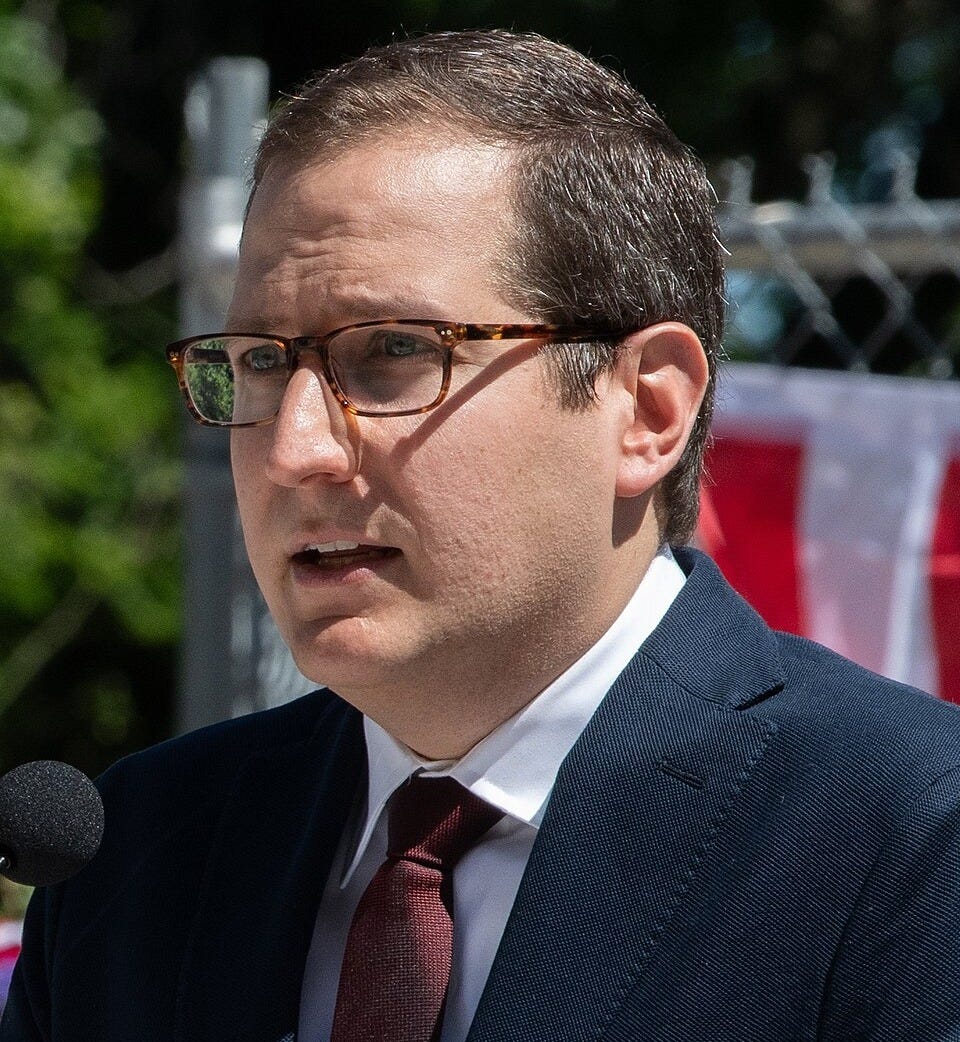
Micah Lasher’s elevator pitch is simple: Experience matters, and he has the most. He’ll also tell you he has the best ideas: He wants to gerrymander New York to keep up with Republicans in Texas and Florida, claw back tax revenue from the federal government until it stops holding up critical infrastructure projects in the state, and guarantee every new grad a job (?). But the NY-12 Democratic primary is not an ideas race. Above all, each candidate is laser-focused on developing an aesthetic of leadership that establishes trust with voters. Lasher aims to establish trust by describing his eighteen years working in government (starting when he was in high school!), and bragging about how his former colleagues and bosses Jerry Nadler, Kathy Hochul, Mike Bloomberg, Mark Levine, Gale Brewer, Scott Stringer, and Brad Hoylman-Sigal have all enthusiastically endorsed his candidacy. “The people you’ve elected and trusted and known in this neighborhood for the past twenty years all like me,” Lasher is essentially telling voters. “I am the natural successor of the West Side machine, and I will carry forward its legacy.”
The case against Micah Lasher, then, is equally simple. It’s that he is endorsed by Jerry Nadler, Kathy Hochul, Mike Bloomberg, Mark Levine, Gale Brewer, Scott Stringer, and Brad Hoylman-Sigal, would carry forward their legacy, and would be the natural successor to the West Side machine. And in its current form, the West Side machine kind of sucks.
I.
Before we go any further, I should say that at the end of this blog I will tell you that I plan to vote for Micah Lasher and I think you probably should too. With that said though, you probably don’t need me to tell you why Mike Bloomberg, Kathy Hochul, and Scott Stringer are not ideal endorsers for a purportedly progressive Congressman.
Here goes anyway. Mike Bloomberg served as the 103rd mayor of New York City from 2002-2013. He is the centibillionaire founder of the financial information company Bloomberg LP, a reluctant cuddler of Knicks point guard Jose Alvarado, and New York City’s richest man. And he is currently donating $10 million to Stand Up and Fight, Micah Lasher’s allied super PAC.
This alone is pretty gross, and Lasher was roundly attacked for receiving so much support from Bloomberg at last week’s NY1 debate. He defended himself by arguing that while he vigorously opposed the existence of super PACs, there was no way for him to unilaterally disarm in this race. Then he went further: “We should be clear. There is a big difference between Mike Bloomberg, in whose administration I served, who lives in this district, who has no agenda he’s looking for me to carry out in Congress, who’s supporting me because he thinks I’d be a Congressman, and the AI companies that have spent millions supporting Mr. Bores.”
Each part of that argument deserves scrutiny. First, should we really believe that Bloomberg truly has no agenda? Would he really be indifferent if Lasher decided to advocate for a citywide wealth tax, for example? Or pursued some kind of regulation for financial information and media companies that could impact Bloomberg LP’s bottom line? If Lasher wins, he will have to run for office again in two years. Assuming he does not succeed in abolishing super PACs before then, does he really expect us to believe he wouldn’t care whether or not Bloomberg gave him another couple million then? All political donations are corrupting; it’s not credible to pretend otherwise.
Second, assuming the endorsement has no agenda and should be taken at face value, should we really trust Bloomberg’s judgment on this kind of thing? This is a man who enthusiastically supported Andrew Cuomo over Zohran Mamdani only a year ago (funding some truly vile mailers in the process), and who incinerated more than a billion dollars on his own four-month run for Presidency in 2020, mostly because he was worried that Bernie Sanders or Elizabeth Warren might win if he stayed out. When it comes to preferred winners in Democratic primaries, this guy has a pretty awful track record.
And third, and most importantly, what does it mean that Lasher served in Bloomberg’s administration? Most opponents have gone for the haymaker; a memo that Lasher wrote for the State Legislature that declared Bloomberg’s morally reprehensible and flagrantly unconstitutional stop-and-frisk policy, and the less-discussed NYPD Gang Database to be “a proven crime deterrence method,” and “an invaluable investigative tool” respectively. Lasher has protested that he was a relatively low-level staffer at the time who was ordered to write thousands of memos, and he has forcefully denounced stop-and-frisk since. It’s hard to know quite how seriously to take this defense, but at the very least, Lasher does not seem to mind taking credit for positive accomplishments of the Bloomberg administration, low-level staffer that he may have been at the time.
But even if you put aside that memo, Lasher’s more substantive record concerned educational policy, something that has come up surprisingly little in this campaign. In his capacity as head of External Affairs for Bloomberg’s DOE, and then as the head of the education reform advocacy organization StudentsFirstNY, Lasher worked to expand the city’s charter schools, frequently antagonizing the teacher’s union UFT in the process. This rift was a big reason that Lasher lost his State Senate campaign in 2016, and presumably a factor in UFT’s decision to endorse Alex Bores this time around. Lasher has moved around on this issue a bit, but is clearly still skeptical of UFT. Last week the New York Editorial Board asked him whether he thought that the union had too much power, and while Lasher tried not to answer the question directly, he very much did not say no.
On my podcast last month, Mason Williams, a historian of NYC politics whose book on the Bloomberg administration comes out in two weeks, explained to me that Bloomberg’s attempts to create a “portfolio of options” for public school children increased metrics of success for some students, but also “replicated in a new institutional form the inequalities that have always existed in New York City public schools.” You should listen to our entire conversation, but this turned out to be a good representative of his take on the Bloomberg administration in general. A lot of energy and innovative reforms, with mixed results and, often, intense inequality that saw professional-class (white) Manhattanites come out ahead.
After Bloomberg, Lasher’s most touted credential is his work as chief policy director for Governor Kathy Hochul. He likes to brag about his (ultimately unsuccessful) NY Housing Compact and (successful) attempts to index the minimum wage to inflation. He skips over all of the other ways that Hochul’s administration has stymied the left, resisted tax increases, and repeatedly watered down the 2019 reforms to bail and discovery laws. Lasher explicitly endorsed that last move in December 2024, telling Ben Max that “the set of laws passed in Albany, particularly related to discovery,” played a role in the post-pandemic crime wave. Political strategist Adam Carlson told me that in his recent polls, Hochul and Bloomberg are both wildly popular in this district, more so even than Mamdani. The case against Micah Lasher, in part, is that I personally do not believe they should be.
II.
It’s Scott Stringer’s endorsement, however, that I believe deserves the most analysis. (He also came on my podcast, and you can check that out here.) After running Jerry Nadler’s first Congressional campaign in 1992, local organizer (and cousin of legendary West Side Congresswoman Bella Abzug) Scott Stringer was elected to replace Nadler as the Upper West Side’s State Assemblyman. At the time, he was one of the few true progressives in the ludicrously corrupt and ineffectual State Legislature, and he had some real accomplishments, including Brennan Center-endorsed reforms to the legislature’s transparency and voting practices. He also advocated for policing reform and was arrested in 1999 at a protest following the murder of Amadou Diallo. As Manhattan Borough President, Stringer championed affordable housing development across the borough, and as City Comptroller, he divested the city pension fund from the fossil fuel industry and became the first city-wide official to call for the closure of Rikers Island Jail. In 2021, when previewing Stringer’s first run for mayor, City and State NY’s Gabe Ponce de Leon adorned the headlined “Scott Stringer Has Always Been a Progressive.”
You could not write that headline today. After a lackluster second run for mayor, Stringer has quietly (or not so quietly if you follow him on Twitter) become one of Mayor Zohran Mamdani’s chief antagonists, with ties to both Westside Progress PAC and Next NYC PAC. He is also one of Dan Goldman’s most enthusiastic backers in NY-10, and frequently savages opponent Brad Lander, his successor in the Comptroller’s office. And he’s backing Stephanie Ruskay, the establishment choice in Assembly District 69, over Mamdani-endorsed criminal legal reform advocate Eli Northrup. Stringer’s biggest animating issue seems to be Israel/Palestine; he told me that he sees BDS and most other expressions of the local pro-Palestinian protest movement as “Jewish Hate” and that it reminds him of the discrimination that Muslim New Yorkers faced in the wake of 9/11. He also expressed a surprising amount of skepticism for the new wave of the supply-side housing movement, complaining that “now if you want to engage, they call you a NIMBY.” His 2025 mayoral campaign focused on combatting crime, and specifically on hiring 3,000 new cops. None of these are progressive stances by any current definition of the word.
Stringer and Lasher are different people, but they are extremely close, and Lasher ran Stringer’s 2021 mayoral campaign. More than that, Stringer is emblematic of how the politics of the Upper West Side political elite have changed over the past few decades. When Stringer first entered politics, this neighborhood was incredibly diverse, racially and socioeconomically, and dominated by artists, intellectuals, and other drivers of the city’s culture. Now, the same people (many of whom have not budged) are older, wealthier, and far more culturally conservative, at least by citywide standards. They are alarmed by their young adult children, who zoom around Brooklyn on pedal-assist Citi bikes from one DSA rally to another. They feel that the city they had such political and cultural dominance over for decades is now changing far too fast for their liking. And they’d like the built environment to stop changing so much too, which is why Gale Brewer vigorously fought the construction of a bus lane for the M96, and the pro-housing ballot measures; why Brad Hoylman-Sigal spoke at a rally to prevent housing construction on 86th and Amsterdam, on a lot with a collapsing church that actively wants itself torn down for this project; and generally why this neighborhood has built less new affordable housing than almost any other in the city.
This is the political culture that Micah Lasher has spent two decades working in and advancing. He thinks this makes him Jerry Nadler’s logical successor. The case against Lasher is that maybe these people have run things long enough, and we should try something new instead.
III.
But who then? I have already written at length about my distaste for the vapid campaigns of Jack Schlossberg and George Conway, both of whom seem to be collapsing in polls anyway. Nina Schwalbe had an impressive debate performance (Hell Gate declared her the winner) but has no chance of actually winning. Her name recognition is simply too low, and she does not have the organizational, institutional support to change that.
If you ask Schwalbe, she will tell you that her name recognition is low because the New York Times and other media institutions refuse to take her candidacy seriously. I am sympathetic, but I think this is backwards. She would get plenty of media coverage if she could articulate a differentiating campaign message, and then demonstrate that it was pulling supporters into her camp. Schwalbe’s core problem is that while she has a very different aesthetic performance of competence than any other candidate (scientific expert witness/“no-nonsense” neighborhood mom), she lacks this differentiating message. She cannot credibly argue that any of her competitors would not share her policy goals when it comes to public health and vaccines, her core issue. And she has not established any real distance on other issues, either.
She has always been one of the race’s harshest critics of Israel, brags about being willing to label their actions in Gaza a “genocide,” and recently announced her opposition to continued Iron Dome funding. But she has not prioritized and emphasized this issue early enough or often enough to get attention from activist groups like Jews for Racial and Economic Justice, or Jewish Voices for Peace, which could have given her a real activist organizer base. Instead, she prefers to lead with public health issues, and talk about how she will wear a t-shirt that says “Impeach RFK JR” on the House floor.
Her other marquee issue is fierce opposition to the RAD-PACT redevelopment of NYCHA’s Fulton Elliot Chelsea complex. When I interviewed her on my podcast, she told me that she believed that “elderly people shouldn’t have to move if they don’t want to,” that the federal government could be convinced to fill NYCHA’s $78 billion backlog of desperately needed capital repairs, and that more generally, building more housing supply doesn’t actually make anything more affordable (“We assumed markets solved problems for poor people… more supply, more supply meets demand. Supply meets demand. It’s a curve. I mean, that’s neo-Keynesian economics. And it didn’t really work.”)
All three points are completely, 180-degrees-in-the-other-direction, flat-out wrong. Elderly people have to move even if they don’t want to all the time, and especially when they live in substandard living conditions. Any alternative plan to renovate the building, and remediate the mold and asbestos in their apartments, would require a lengthy temporary relocation too. Truly committing to the idea that no one should ever move means that you never repair the buildings, and while this is essentially what has happened for the past few decades, it is not a good outcome for anyone! Congress has consistently refused to fund NYCHA capital projects, under Democrat and Republican majorities alike, for forty years. And increasing housing supply does lead to durably lower rents. Schwalbe’s housing platform betrays a certain intellectual habit that is unfortunately quite common among highly-credentialed scientific scholars: in her field, everyone needs to listen to experts and follow the science, but in other fields, wild speculation and appeals to gut feel and vibes are totally fair game.
All of which is to say, I like Nina Schwalbe (and I’m grateful that she was willing to come on my podcast!), but I would not vote for her even if she was not essentially a spoiler candidate at this point.
IV.
So that leaves Bores and Lasher, two candidates with unconvincing core closing messages, and nearly identical policy platforms. Despite the headline of this blog, I will be voting for Lasher, because I believe (unlike Our Revolution, the majority of NY-12 voters my age, and seemingly all of Twitter) he is slightly more progressive than Bores.
On June 29th, 2025, a week after the primary, Lasher endorsed Mamdani in a lengthy Twitter post, acknowledging their past disagreements, but also calling the Democratic nominee “a person not only of intelligence and integrity but with uncommon capacity for listening and growth.” Lasher was a genuine leader here; very few Upper West Side establishment elected officials had endorsed Mamdani at that point. It would take Alex Bores nearly three months before he was willing to do the same. This speaks to two crucial differences between the two Assemblymen. First, Lasher’s core base (aging liberals on the West Side) still allows him a little more flexibility to move left than Bores’s (aging liberals and moderates on the East Side). And second, while Lasher is willing to get out in front of his constituents and gently guide them towards what he felt to be the correct position, Bores is dispositionally more cautious, careful, and drawn to the path of least resistance.
This is part of what has made Bores such an effective legislator, and it has allowed him to identify and champion under-discussed issues where he can make significant impact without real pushback. I was particularly impressed by his work to increase the number of judges statewide, something that flew under the radar in last year’s session, but will make the state judiciary run much more efficiently moving forward. But finding the path of least resistance is a serious problem if you are interested in being a progressive leader while representing a lot of very not-progressive constituents.
It is also a serious problem if you want to be a leader on housing, which I still believe to be the most important issue facing this district. I do not believe Alex Bores is a secret NIMBY, or that he is insufficiently committed to the idea that a robust solution to the city’s housing crisis involves building a lot more supply. I do think, however, that on a case-by-case basis, he would be significantly more cagey and calculating than Lasher, and might slow down some projects in the process.
We don’t need to speculate: Bores and Lasher disagree, right now, on the biggest housing dispute facing the district today. Bores believes that the Fulton Elliot Chelsea RAD-PACT redevelopment did not have sufficient community engagement, that the survey that found that a majority of residents who participated do support the plan was illegitimate, and that they should do another one. Lasher believes that the redevelopment is the best and only way to give these NYCHA tenants 3000 brand new state-of-the-art public housing units, (while also adding a thousand affordable housing units and 3,000 market rate units to a neighborhood that desperately needs them), and that both NYCHA and the city are in a crisis and need to act as quickly as possible.
Lasher’s experience is not the bulletproof argument that he wants it to be. But experience in politics does develop one skill, at least for those who practice it seriously. That’s the ability to prioritize the interests of a diffuse, poorly organized majority over a concentrated, highly impacted, disproportionately loud minority. In this case, it is the ability to prioritize the thousands of Fulton Elliot Chelsea residents who want new public housing units (and the hundreds of thousands of residents of Lower Manhattan who need new affordable and market-rate housing), over the 24 seniors who don’t want to temporarily relocate (and nearby local neighborhood activists who have no stake in the conditions of NYCHA housing, but don’t like new construction within earshot of their Chelsea townhouses). In other contexts, it might be the ability to see the benefit of a bus lane that takes away a few parking spots, or a regulation that lowers prices and improves service for consumers, but negatively impacts an entrenched industry or incumbent.
If there is a stylistic difference between Alex Bores and Micah Lasher, it is that Lasher picks difficult, controversial fights, while Bores looks for low-hanging fruit. Both are important, and if Bores wins, I look forward to seeing what fruit he shakes loose. But right now, both locally and nationally, progressives need someone who is ready for the fight.
IMO there are basically two tiers of how malignant the NYC Dem establishment is.
Tier 1 (most sinister): Bloomberg, Julie Menin, Scott Stringer, Dan Goldman.
Tier 2 (still establishment, but less malevolent): Mark Levine, Brad Hoylman-Sigal, Kathy Hochul, and I think Micah Lasher.
The saving grace is that Lasher seems firmly Tier 2. His Mamdani endorsement tweet is the proof. You simply can’t imagine Julie Menin writing something like that. Goldman refused to endorse Zohran even though his district is much more left-wing, and Bloomberg funded those vile ads targeting him.
Tier 2 may still be the establishment, but they don’t give off the same dark, vindictive energy as someone like Julie Menin.
Thank you for your service in this election Eli