

On Thursday, October 8th, a dozen masked, gun-wielding men surrounded a parked silver Honda minivan on the street in Marble Hill, the northernmost neighborhood of the borough of Manhattan. One man pointed a gun straight at the windshield of the car, while another sprinted up to the driver’s-side window and attempted to bash it in. The driver attempted to pull out of the spot, turning the wheel away from both men and inching forward, but a black, unmarked sedan zoomed in from behind at a high speed, blocking the Honda’s escape. Meanwhile, the men opened fire, emptying at least seven rounds into the car.
In a saner moment in American history, this set of facts could only describe an organized crime hit, or a sophisticated operation from a foreign intelligence service. But it is 2026, so somehow this is standard conduct for a federal law-enforcement agency with a $100 billion budget. In this case, the man they targeted was Oscar Belgal, a 28 year-old Dominican immigrant, and his five-year-old son was in the back seat of the car, directly in the line of fire. Belgal was wounded and rushed by the NYPD to the nearby Allen Hospital in Inwood, while his son miraculously avoided any physical injuries.
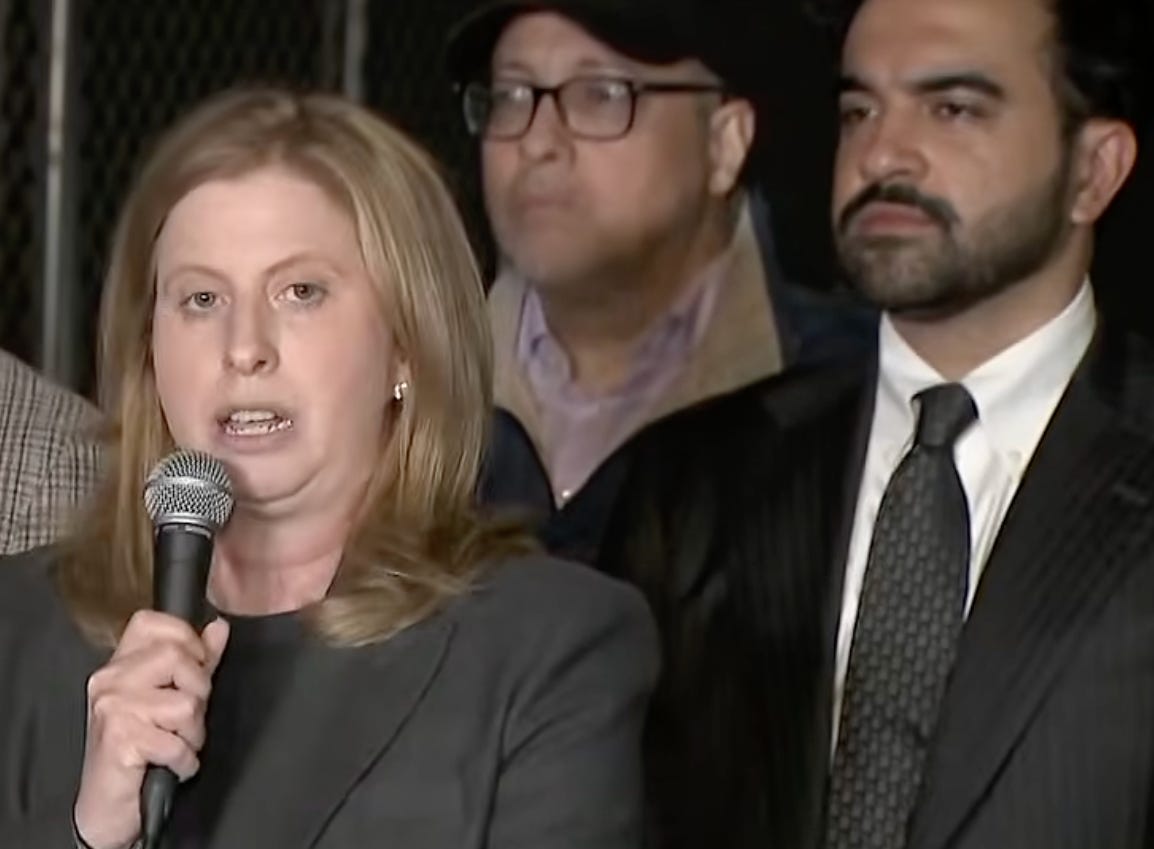
That night, hundreds of protesters gathered at the hospital, and called for an end to ICE operations in New York City. The situation quickly became unruly and chaotic, with escalating encounters between the crowd and the police. Timmy Facciola of the Judge Street Journal was reporting from the scene, and around 9 pm, he filmed a particularly dramatic encounter involving NY-13 Democratic nominee and presumptive Congressmember-elect Darializa Avila Chevalier, standing at the front lines with the protesters, and a group of police officers attempting to set up a metal barricade. His footage shows a group of protesters tugging onto the barricade while the officers yell at them to let go. A group of officers begin peeling the protesters off the barricade one by one, bringing one woman to the ground in the process. Another officer, in a white shirt, backs up and trips over the woman on the ground, falling backwards on top of her. Timmy’s footage shows Chevalier stepping forward, and bending over with her arms outstretched, as if to help the officer or physically make space for him to get up. At the same time, however, a crush of officers rushes forward from the opposite direction to surround him, and one, wearing a blue shirt, puts his hand on Chevalier’s shoulder and shoves her with force, knocking her into the air and onto her back. She pops up immediately, and screams “What the fuck is wrong with you?!” at her assailant, before turning around and telling her irate fellow protesters to de-escalate.
The police eventually set up the barricades and cleared the street. Then, they waved eight unmarked ICE vehicles through, including the one that would bring Belgal from the hospital to a federal detention center. Footage shows the police calling “98” to each other, their code to leave the scene and resume patrol, as soon as the last car goes through. They had done their job.
A little later, Mayor Mamdani arrived on the scene and gave a press conference. After fiercely denouncing the actions of ICE (“what happened today was an outrage”), admitting that he had not succeeded in convincing Trump to release Belgal, and demanding that ICE cease operations in New York City immediately, Mamdani introduced NYPD Commissioner Jessica Tisch. In her characteristically robotic monotone, Tisch read out an extremely dry statement (“I’m here to brief you on an incident that had occurred in the [sic] Marble Hill behind me.”) Most of the briefing was completely duplicative with what Mamdani had already shared (and what everyone at the site knew already, given the high-profile nature of the incident), but Tisch closed with one new piece of information: Belgal’s rap sheet. “He has two prior arrests in this city,” Tisch droned, in the cadence of a bored auctioneer. “One for robbery in 2023 in which he pleaded guilty to grand larceny in the fourth degree and received five years probation, and one for criminal sale of a controlled substance in 2025, which is still pending.”
The next morning, Darializa Avila Chevalier released a statement on Twitter. She expressed outrage at ICE’s actions. She criticized the NYPD for aiding ICE’s exit from the hospital as they transported Belgal to a detention center, accusing them of violating “the spirit, if not the letter, of our sanctuary city policies.” She decried their antagonistic treatment of protesters, noting that she was “shoved to the ground by an officer as I was trying to de-escalate.” She called for the abolition of ICE. And she demanded one more thing, which DSA leaders, aligned state legislators, and activists have all repeated all weekend: “Commissioner Tisch must step down.”
II.
One of the first big decisions that Mamdani faced after pulling off a historic upset of Andrew Cuomo in the 2025 Democratic mayoral primary was what to do with Jessica Tisch, the city’s billionaire scion, Dalton School-Harvard-HLS-educated, former Department of Sanitation chief who at the time was serving as the City’s 48th NYPD Commissioner, and Mayor Eric Adams’s fourth in as many years. Mamdani was looking to consolidate support with parts of the electorate he had not yet converted. Members of both the business community and the old guard political elite were signalling extremely clearly that they were amenable to jumping on the bandwagon, in exchange for one concession: Mamdani must pledge to retain Tisch as the NYPD Commissioner. (Two months later, Governor Kathy Hochul all but confirmed that she had extracted this specific concession from Mamdani in her Times op-ed that announced her endorsement).
Tisch had spent the previous six months on a tear through the city’s print media, receiving one glowing profile after another. She successfully created the establishment narrative that she was both an exceptionally talented technical leader and completely apolitical, with no agenda besides fixing problems and delivering results.
In a piece that I wrote in July 2025, I scrutinized this narrative, and made the case that neither claim held up. Tisch was neither a particularly effective commissioner (crime was down under her watch, but only because she had the good fortune to take over as crime dropped to historic lows all across the country, and anyway, she’d only been in charge for five months) nor an apolitical actor (she had taken public, aggressive stances opposing the state’s bail and discovery reforms and defending the NYPD’s controversial gang database, which ensnares disproportionately Black and Hispanic men with tenuous connects to crime, often with severe and unjust consequences). And while she had, unlike two of her predecessors, managed to avoid a federal indictment for brazen corruption, she had not made any serious steps towards broader reform on racial equity or accountability for misconduct. Under her five-month tenure, the Civilian Complaints Review Board had dismissed misconduct complaints its investigators substantiated at a dramatically increased rate, and on one rare occasion that they did recommend consequences for an officer, Tisch overruled them personally. The NYPD in particular, and the city’s criminal legal system in general, have long been a locus of extreme systemic injustice for the Black and Hispanic people living in poor, overpoliced neighborhoods. I made the case that if Mamdani wanted to be a serious progressive leader on this issue, he probably needed a different Commissioner.
I also pointed out that there might be understandable, if heartbreaking, reasons why Mamdani would not want to be a serious progressive leader on policing and criminal legal reform. The last two progressive mayors, David Dinkins and Bill de Blasio, both tried, and ran into fierce resistance from rank-and-file officers, their union, and their allies in government. Not only did they fail to make substantive progress on their stated goals, but the resulting fallout permanently erased all of their political capital and momentum, and left them unable to execute much of the rest of their agenda either. Mamdani had campaigned and won with a relentless focus on “affordability,” and as little discussion of criminal legal reform as possible. The logic of criminal legal reform fatalism was obvious, even to ideological allies like Ross Barkan and Hell Gate’s Christopher Robbins: Why pick a fight on policing reform that you’re probably going to lose if it’s going to make it harder to execute the policy objectives (“Freeze the Rent,” “Make Buses Fast and Free,” and “Deliver Universal Childcare”) you actually ran on?
I concluded on a hopeful note: perhaps this fatalism was outdated. Similar logic, which held that there was no path for a DSA leader to build a winning primary coalition, had just been thoroughly disproven. We were in a new era, with a charismatic, generationally re-aligning leader. Maybe he could figure out a way to make it all work.
Mamdani quickly revealed, however, that he had no interest in pursuing this kind of realignment. He did not add any meaningful criminal legal reform issues to his platform or stump speech. He made clear that his one innovation in that area, his proposed Department of Community Safety, would operate in parallel to the NYPD, and leave the police basically as they were. And on October 22nd, two weeks before Election Day, he announced that he would retain Tisch as Commissioner if he won. Notably, Tisch did not react or respond, even to say that she would accept the reappointment. He endorsed her, but she certainly did not endorse him.
In a live interview with Hell Gate later that week, Christopher Robbins grilled Mamdani on the choice, pointing out “lots of people who support your candidacy care a lot about criminal justice reform and reforming the NYPD,” and that Tisch “stood athwart” that. Mamdani argued that she had simply followed the lead of her boss Eric Adams. Things would be different under his leadership, he promised. “Everyone will follow my lead. I’ll be the mayor.”
This strained the credulity of the Hell Gate journalists. But the true answer lurked in the premise of Robbins’s question, that lots of people who supported his candidacy cared a lot about criminal justice reform and reforming the NYPD. By the fall of 2025, there wasn’t much evidence of this. The progressive liberal establishment had grimly accepted that the topic had been a liability both in the 2021 city-level elections and the 2022 midterms (Brad Lander and Zellnor Myrie both committed to reappointing Tisch during the 2025 mayoral primary; Myrie told the New York Editorial Board that he was “really impressed with I’ve seen over the past couple of months,” while Lander said he “thought highly of her.”)
And the DSA seemed equally eager to find a new approach to the issue. When Ben Max asked NYC-DSA co-chair Gustavo Gordillo about the Tisch reappointment pledge in an interview on Max’s podcast the week before Election Day, Gordillo gave a revealing answer. “There is no Democratic Socialist candidate for police commissioner that everyone would be happy with,” he told Max. “We have a very critical attitude toward… the NYPD.”
This is the kind of absolutist position that far-left activists are sometimes known for; a variant of “there’s no middle ground that we’d find acceptable, so there’s no point in fighting for the lesser evil.” But while it is the logic of a Jill Stein voter, it was certainly not how the NYC-DSA approached any other issue on Mamdani’s platform. Gordillo’s DSA did not opt out of Mamdani’s rent freeze proposal, and say that because he was not willing to abolish privately-held real estate altogether, there was no point in expecting him to appoint ideological allies to the Rent Guidelines Board. They did not say that there was no point in making buses free if the subway still required a fare. By being ruthlessly strategic and disciplined on affordability issues, and self-sabotagingly absolutist on criminal legal reform, Gordillo and the NYC-DSA expressed a revealed preference.
In the podcast interview, Gordillo did eventually come up with an incrementalist police-reform agenda for the Mamdani administration. “We have a very critical attitude towards the NYPD… and what it’s used for to disorganize and oppress the working class. And our top priority is that under the Mamdani administration, we work together to… disband the Strategic Response Group… to create a CCRB that is truly accountable to the people, and to start to build a Department that can put working people’s needs first.”
There are two noteworthy aspects of this agenda. First, it is extremely narrow, with some glaring omissions. Gordillo (and Mamdani’s official campaign platform) did not mention overpolicing neighborhoods, “Broken Windows” over-enforcement of low-level nonviolent offenses, or the police’s role abetting prosecutorial abuses and obfuscating exculpatory evidence in the discovery process. He did not mention the grotesquely inhumane Rikers Island jail where detainees are held. He did not even mention basic good government reforms to the NYPD’s chronically ballooning-out-of-control overtime budget. Instead, he focused on the Strategic Response Group, the specialized anti-terrorism unit that has often been deployed at protests, often to disastrous, violent effect.
I do not mean to minimize the abuses of the SRG, which include overuse of pepper spray, the regular use of a bicycle as a bludgeoning weapon, and the kenneling of large groups of protesters during the summer of 2020. But compared to many other kinds of police abuses, this is one category that only affects a very narrow slice of the electorate (albeit one that is extremely well-represented in the DSA): people who regularly attend contentious protests. To be sure, the protester chanting in Union Square and the Black teenager walking down the street in the Bronx are both equally entitled to constitutional rights, and equally undeserving of police abuse. But the protester, at least, chooses to protest. The Black teenager does not choose to be Black.
This brings us to the second noteworthy aspect of the DSA’s stated policing agenda: the complete omission of racial equity. Who, in the DSA’s eyes, is police reform for? Gordillo expressed concern over the NYPD’s attempts to “disorganize,” (a.k.a. disrupt protests), “and oppress the working class,” and calls for a “Department that will put working people’s needs first.” But the NYPD does not overpolice “working people.” It does not put “working people” in a gang database that it uses to justify violent enforcement tactics, more severe bail conditions, and unjust sentencing enhancements. The Data Collaborative for Justice did not find that 85% of all criminal summons from 2020 to 2022 were issued to “working people.” The NYPD’s disparities exist primarily across racial lines, not socioeconomic ones, with Black and Hispanic New Yorkers bearing the brunt of the most unjust and most dangerous outcomes. In that same DCJ report, Black people were more than ten times as likely to receive criminal summonses as White people, “working” or not.
I am picking apart the words of one particular interview, but it is illustrative of a broader point: the Fall 2025 iteration of the NYC-DSA did not see 2010s-style racial justice issues in general, and criminal legal reform in particular, as high-priority. This was partially just a response to basic incentives. They had spent the last year building a delicate coalition that combined the young college-educated professionals of the Commie Corridor with first-generation immigrant enclaves across the outer boroughs. Black and Hispanic Democrats, who make up a key plank of the city’s party establishment old guard, were the last to come inside Mamdani’s tent. It makes sense that the DSA would not gear its platform around their priorities, and anyway, it was not clear that criminal legal reform was much of a priority for them either.
By Election Day 2025, Mamdani’s choice to reappoint Tisch seemed politically savvy, if wrong on its merits. The appointment forged a bond with Governor Kathy Hochul, Tisch’s staunch ally, and created an on-ramp for members of the business community and political elite that were looking for a reason to get to yes with Mamdani. And it seemed virtually costless, because no one seemed to care. Not the progressives and liberals who had spent all of 2020 convincing themselves and each other that criminal legal reform was the single most important issue facing both the city and country. And not the DSA, purportedly the city’s radical, emancipatory vanguard. Mamdani reappointed Tisch because everyone let him.
III.
Why then, has there been such a change of heart in the last week, with renewed demands from Avila Chevalier, aligned state legislators, and many many activists that Mamdani fire Tisch?
Hell Gate’s signature Morning Spew newsletter, headlined “Is This Mamdani’s NYPD Reckoning?” proposed one answer to this question Tuesday morning: Last week’s revelation that the NYPD had allowed officer Salvatore Alongi, who shot and killed an unarmed man experiencing a mental-health crisis named Win Rozario in 2024, to retire with a full pension and circumvent the CCRB proceedings that might have held him accountable. This is not the first time Tisch’s NYPD has controversially let officers who shot and killed unarmed men of color avoid even professional consequences.
In Rozario’s case, the department claimed that they made a clerical mistake, and took the unusual step of apologizing. “When we make a mistake, we need to acknowledge it,” Tisch told the press. “We should have notified the CCRB before the Pension Board considered Officer Alongi’s disability pension so that CCRB could take whatever steps it deemed appropriate. As a result of human error, we failed to do so, and I apologize for that mistake.” This apology has not placated outraged advocates or Rozario’s family. “Mayor Mamdani, you came to our home,” Rozario’s mother said in response to the news. “You said you would be a different kind of mayor. We feel betrayed by you… It feels like you’re letting this happen.”
But there’s a problem with pointing to this incident as the inflection point that has led to the calls to fire Tisch: None of those calls mention Rozario at all. It would have been very easy for Avila Chevalier, or the DSA-aligned state legislators to throw a sentence into their statements that expressed outrage over Alongi’s retirement and demanded increased accountability for officer misconduct. They did not do so, because they do not consider routine police misconduct to be a major animating priority.
IV.
Instead, their demands for Tisch’s removal focus on another grievance, related to ICE’s shooting of Oscar Belgal. “Last night, the NYPD violated the spirit, if not the letter, of our sanctuary city policies and fueled the Trump Administration’s attempt to demonize our communities,” Avila Chevalier wrote, referring to police response at the hospital protest, and their decision to clear the street to let ICE cars through in particular. “The NYPD spent more time protecting a militia that just shot someone than protecting New Yorkers.”
The city’s sanctuary law has two primary pillars: §10-178, which forbids city resources, including “time spent by employees” from being used to assist civil immigration enforcement, and §14-154, which forbids police from honoring “detainer requests” from ICE, unless they meet certain specific criteria. These laws are not merely expressions of the progressive electorate’s bleeding-heart sensibilities. They are essential to the basic functioning of local government in a city with more than half a million undocumented immigrants, who otherwise would never report a crime, send their kids to school, use a city-run hospital, pay municipal taxes, or otherwise interact with any government program or service.
When the NYPD comes under scrutiny for failing to comply with sanctuary laws, it’s usually with the “detainer requests.” In FY2023, ICE issued 201 such requests to the NYPD, asking them to hold onto detainees longer than they otherwise would, because ICE was interested in taking them into their custody. The NYPD denied all but 10, which fell under the narrow exception categories outlined in the statute (usually a terrorism threat or someone recently convicted of a “serious or violent crime.”) Under Trump, ICE has dramatically widened the scope of these requests. In FY2026, they made 9,645 requests, and the NYPD refused to comply with any of them.
However, in December 2025, the City’s Department of Information released a report alleging five instances where the NYPD had nonetheless taken an action that had led to a detainee coming into ICE custody. One violation was egregious, involving an officer that went rogue and responded to an email from a DHS employee. In the other four, no law was explicitly broken, but when NYPD officers complied with detainer requests from other federal agencies, like the FBI, those agencies then handed those detainees straight to ICE. This creates a serious problem, because it is both practically and legally impossible for the NYPD to refuse to comply with the FBI. But these incidents were rare (even under Trump, FBI has an interest in keeping a working relationship with local law enforcement, which this seriously endangers), and the report concluded that “broadly, the NYPD has been working diligently to ensure that its policies with respect to assisting federal law enforcement agencies comply with local laws, while still permitting the NYPD to partner with federal law enforcement on criminal investigations.” (Hell Gate put a different spin on the report, with the headline “The NYPD Ignored NYC’s Sanctuary Laws.”)
Less frequently, Mamdani’s NYPD has brushed up against §10-178’s general prohibition of aiding civil immigration enforcement. In one high-profile example, after a botched raid on Canal Street that left ICE agents trapped in a parking garage and completely surrounded by hundreds of protesters, the NYPD cleared the street for them to exit, pepper spraying crowds and arresting several protesters in the process. Tisch herself reportedly called a federal officer and expressed outrage at ICE’s attempted raid, calling it “unacceptable,” but this was scant consolation to the protesters who wanted the chance to actually disrupt ICE operations. A similar dynamic occurred at Allen Hospital last Thursday, when the NYPD cleared the street of protesters to make a path for ICE vehicles to leave the hospital and transport Oscar Blegal to a detention center. In both cases, the NYPD “aided” civil immigration enforcement by at least some definition.
On the other hand, they had only one alternative: make ICE clear the path themselves. ICE agents certainly had the weapons and manpower to do it, but recent history in Minneapolis and across the country tells us that they are extremely bad at it, that they routinely act with flagrant disregard for the First Amendment right to speech and assembly, and that when it comes down to it, they have no compunction about shooting a protester or two if they feel they have to. Triggering a catastrophic encounter between armed ICE agents and hundreds of angry protesters might very well have served the long-term political interests of the anti-ICE protest movement. (Leaders like John Lewis explicitly sought out encounters like this during the civil rights movement, for example). But a local police department has an obligation to keep people safe, and to prevent obviously dangerous situations from occurring. They cannot play utilitarian games that risk the lives of a few people in the present for a speculative Greater Good.
At a protest on Friday, Avila Chevalier’s future fellow Congressmember Brad Lander raised a different concern with NYPD’s conduct. “[Blegal] is in cuffs from a lawless arrest,” he told reporter David Nunez. “So I have questions about whether [the NYPD] should honor the custody of that arrest, or whether they should cut the handcuffs off and say ‘we don’t recognize that ICE arrest.’”
Lander’s motives are righteous, and it is infuriating to watch fascist thugs abduct someone and not have any way to stop it. But the hypothetical he describes, where armed NYPD officers actively free (and then hide and protect?) a detainee from more heavily armed ICE agents, is even more dangerous than letting ICE figure out crowd control for themselves. The NYPD cannot legally obstruct ICE operations, and under the current structure of our country, there is no endgame to an armed conflict between local and federal law enforcement agencies where the local one prevails. By fantasizing about a hypothetical world where that might not be true, Lander is essentially proposing secession.
To summarize, ICE’s dangerous and appalling conduct gives the NYPD no good options, and while their response to the protest at the hospital may not have been exemplary (the officer who shoved Avila Chevalier should be suspended at the very least), they are largely not acting as a fifth column that collaborates with the Trump Administration and sabotages its own local government. To the extent that Tisch (or Mamdani) had any control over the events of Thursday night, it is hard to say what either could have or should have done differently. It is certainly hard to point to action Tisch took with regards to ICE and the city’s sanctuary city law that could give Mamdani grounds to fire her.
V.
There’s one other reason that certain activist groups want Tisch fired: she is a self-described “proud Zionist.” “[Mamdani] has kept Zionist billionaire Jessica Tisch as police commissioner, despite her vocal defense of the genocide,” a group of local yDSA chapters wrote in a statement explaining their decision to protest a October 7th vigil in Union Square, and chant that Mamdani himself was complicit in genocide. (Since taking office, Tisch has marched in the Israel Day parade, but otherwise shared very few personal opinions on Israel/Palestine). “[Mamdani] has allowed the city’s police department to continue to be led by Jessica Tisch, who works to protect Zionist interests and the NYPD’s links to Israel” wrote the Palestinian Youth Movement account on Twitter. (The NYPD and Israel do indeed have “links”, but they have no substantive impact on Israeli military policy decisions, and anyway, City and State reported that no NYPD trips to Israel have occurred since Mamdani took office). For many in the pro-Palestine movement, the symbolism alone of someone with pro-Israel politics playing any role in Mamdani’s administration constitutes a betrayal.
But Mamdani cannot and should not fire Tisch for disagreeing with him about an issue that has virtually nothing to do with her job. Replacing her with someone who has less personal sympathy for Israel (or more likely, someone who has the same level of personal sympathy but is not Jewish and therefore easier for these activists to ignore) would do nothing to make the NYPD a less discriminatory, harmful institution. Over the past two years, the ascendant NYC-DSA have demonstrated time and again that they do not prioritize the criminal legal reform movement. Today, their most radical cadre of young activists only want a leadership change to symbolize allegiance on a completely separate issue, while leaving the rest of the day-to-day operations completely untouched.
On Tuesday morning , Mamdani told reporters that he had no plans to fire Tisch. He has signaled that he will soon announce a major restructuring of the SRG (something that, as Ben Max pointed out, has been in the works for years, long before Mamdani came into office). He will hope that this is enough to placate the DSA for now. After all, he cannot force the NYPD to actively resist ICE, he cannot fire Tisch simply for being a Zionist, and without durable political support, he cannot reform the NYPD into a body that would hold officers like the ones who killed Win Rozario accountable, or pursue a criminal legal reform agenda in any other substantial way. Over the past two years, the city’s progressive movement, and DSA activists in particular, have consciously, actively deprioritized the issue. They should not be surprised or disappointed to see Mamdani following their lead.
It was an interesting read but I would contest the claim that racial targeting has nothing to do with being working class, or poverty. It’s obviously related.