


You can listen to this podcast here, on Apple Podcasts, or on Spotify. The following transcript is lightly edited for clarity, so there may be some slight discrepancies between the podcast and the transcript.
Micah Lasher, thank you so much for coming on the podcast.
Glad to be with you, at long last.
At long last. We’re speaking on Thursday morning, so it’s been just over 36 hours since the race was called for you. How have those last 36 hours been? Any particularly poignant or funny or memorable moments?
Well, this morning, I walked my daughter to school with my wife. A double parent drop-off is a rare event under normal circumstances, but it’s been quite a long time since we’ve been able to do that. And then my wife and I had breakfast, sat down at a cafe and had breakfast in the neighborhood, which was very nice. I don’t know if that’s poignant, but it’s been sorely missed, I’ll tell you that.
So let’s take a trip back to September, when Jerry announced that he was not running for re-election and this race started. What was your overarching theory of the race when you decided to join? What did you think that voters were looking for? And what was your theory of how you were going to win?
The theory of how I was going to win was record and endorsements, fundamentally. It was never about picking a lane. It was about a record that was focused on fighting Trump. I had focused all of my legislative energies because I felt that was what the moment called for, that was the value that I could add as a legislator to kind of fighting back against Trump. And so there was a feeling that was what voters were going to be looking for in a congressman at this moment, combined with support from the most trusted elected leaders and formerly elected leaders in the district from Jerry Nadler on kind of the, not the far left, but on the left to Mike Bloomberg on the center.
And that the combination of that would carry the day, with an understanding that we didn’t know what the field would end up looking like. And I certainly understood, I think, because I was his colleague, I knew from the jump that Alex would be the ultimate competition and would be a formidable and worthy adversary.
A lot was made out of Eric Bottcher’s candidacy in the fall. And when he dropped out in December, it seemed, everyone I talked to, and then I said this was a huge coup for you, that the fact that the West Side was now basically yours alone. There’s been reporting that you and Jerry and other people behind the scenes were somewhat involved in encouraging Erik to seek that as a State Senate instead of running for Congress. And you obviously enthusiastically endorsed him as soon as he did.
Now looking at the map and seeing how you did in Chelsea, do you stand by that strategy? Are you rethinking that at all? [Note: Lasher won Chelsea by only one percentage point, and lost Hell’s Kitchen by double digits.]
It’s a really good question. Obviously the race played out less west side versus full east side than people thought it would. And then I would say even we at that time thought it would. So the counterfactual in which Erik is still in the race is an interesting one.
I certainly think for a whole host of reasons, having a unified West Side, even though Alex and I basically split the 75th Assembly District, Tony Simone’s Assembly District, which is Erik’s base. So yes, I think directionally you’re right. It’s certainly not as straightforward a net political benefit as it might have seemed at the time. But I think in the end… Some of this also, what’s the experience of running a campaign, and the ability to just have a coalition throughout as much of the district as you can is just a much better way to run a campaign.
And Erik and I had a very good relationship before the congressional campaign began. We were friends. We had a lot of mutual friends. There were people who were in a tough spot having to choose between us. There was just a lot that was really good about it. They had a council race down there. Carl was running for the council. There was just a lot that was better because we were able to be on a team.
So that was like a positive development for you. What were developments throughout the race that surprised you that made you rethink your strategy or your approach, if any? Were there any particular inflection points or moments where it felt like something took you by surprise?
It’s a good question. I don’t know that there were moments that really were themselves surprising. The amount of money that came in for Alex from the AI world and the crypto world, a topic that really I don’t think has been fully given its due by the press coverage of the race. I don’t know, so that wasn’t a single moment of surprise, but I think looking back, did I think that $20 million plus was going to come into the race for Alex and three of which to attack me?
Wait, 20, that’s the number?
Yeah.
I’ve seen ten for AI. Ten was pro-Alex and Ten was against Alex.
Check out, there’s a website, an AI money tracker. I can look it up… Transformer has an AI campaign finance tracker. and I don’t even know that this is fully updated, it has 19.26 million supporting and 8.15 million opposing Alex. And that does not include the 3 plus million from Nuestro PAC, which was set up to oppose me. So that I think in the end, and a lot of that money flooded in the final week.
That leads into my next question. I think a lot of voters, and I count myself among them, have a bitter taste from the way that money played a role in this race in general. It felt like it really had a corrosive effect on the way that the conversation and the discourse happened in a lot of different parts of this race. I’m sure you agree.
Certainly.
The way that I want to point this at you is, you’re a veteran campaign manager and strategist. You’ve run other people’s campaigns. Make the case for me that independent expenditures actually do matter a lot and that it was just not really viable for you to unilaterally disarm.
Because I think that would have been like a very powerful thing. You know, No PAC Jack was like a thing that he tried to get going. And I think No PAC Micah, especially paired with your advocacy for reform to Citizens United. And I think one of the most effective attacks on you was tying you to the Bloomberg spending.
I assume you didn’t really consider unilaterally disarming and just saying you’re not going to engage in this and you’re going to forswear any IE money. Why is that impossible? What is it that IE buys you that means that if the other side is doing it, you really can’t unilaterally disarm?
I will acknowledge that I can see a counterfactual in which what you lay out works. It would have been a very terrifying counterfactual, and I think my instinct is it wouldn’t have worked. But I don’t discount the possibility of what you’re saying.
And let’s agree, it was all awful. And by the way, if there’s no outside money in this race, I think I win by a bigger margin than I did. So I think that’s an important point, which is take this race on the merits, on the assets that each of us had, excluding outside expenditures. I think I win by more than four points.
But if you take Jack’s celebrity factor, which I do think probably would have faded no matter what, and then the combined media attention that Alex, to his credit, was able to generate from the money being spent against him. And then the name recognition that gets built up because of the money that’s spent for him. I think you’d have a significant basic recognition gap. And you saw it in those early polls. The early polls are showing Jack way ahead. Then Alex kind of keeps up with him because of the media attention he gets, the money being spent against him. And I’m only able to catch up in the early phases of the race because of the first burst of outside spending on my behalf.
I think in a world in which you’ve then got polls with Jack and Alex in the mid-20s and me 10 points back, you begin to have problems raising money, attracting political support. I think it becomes a real problem. And maybe in the end, you claw your way back through New York Times coverage.
Look how many fewer opportunities I had to go on TV. You know, I would get these text messages from people being like, “I saw Jack on Morning Joe this morning. You really should go on Morning Joe.” As though I didn’t want to go on Morning Joe! Nobody was interested in me. And so...
Not nobody!
Not nobody. That’s exactly right. And that’s why we’re doing this interview. The first interview after the race.
But just from a purely… let’s agree that it’s all awful and corrosive. I do think, as I said during the debates, there was a big difference about the money that came in for me from Mike Bloomberg and the reasons for it, and the money that came in both against and for Alex, which I think had some pretty cynical motives attached to it. But it’s all corrosive. But I think I would have had at least a materially worse chance of winning in a world in which I unilaterally disarmed and there’s $20 million plus being spent for Alex and to attack me.
And I would observe, by the way, one more thing, which is none of the money that came in for me was any negative on Alex. And while Alex did have money attacking him, that was about something having nothing to do with me. And the money that was spent attacking me, I am absolutely confident when the dust settles, will be shown to have been funded by people who very much wanted Alex to win.
Yeah, on that last point, I mean, if someone else is already doing it, you don’t need to. Like I understand why…
No, but I don’t… I know now that the people supporting me were not prepared to go negative on any other candidate.
So besides the difference in IE coalitions that you guys had, when people ask me, why are you doing this? A big question that they had was, “what’s the difference between these guys? They’re both Assembly Members. They seem like they agree on most issues. They’re probably going to vote exactly the same way in Congress. Why should I really care which one of them wins?”
I had my own journey with that question and I wrote a thing and came up with an answer that I thought that on balance you were slightly more progressive in certain key ways. Can you make the case in your own words what you think the difference is and why you think it matters?
I mean, I think you basically figured it out. But you figured it out with very slender evidence, right? You had to like search for evidence. And there’s a reason for that. And the reason for that is it was definitely in my, we believed it was in our interest during the campaign as a general matter. to not have a ton of daylight substantively between Alex and me. I don’t know to what extent he had the same view. So we were not looking to create meaningful policy differences. And the reality is, as you observed, I think kind of as we generally think about ideology, we’re not that different.
But I think what you figured out, which is a longstanding personality trait and part of my political identity that, if anything, I was trying to kind of downplay during the race, is that I do relish picking fights with powerful people. And there was a riff that Alex had during the campaign when he’d be asked about bipartisanship. And the riff was something to the effect of every bill I’ve passed in Albany, I got at least one Republican vote as a demonstration of his capacity to work across the aisle. And I think if you look at every bill that I’ve passed, with maybe the exception of the fish bill that I’ve made a joking video about, which is a bill that is foisted upon you by the leadership of the Assembly. I don’t think I’ve had a single Republican vote for any bill that I’ve passed. And that’s not because I don’t get along on an interpersonal and collegial level with the Republicans. But to some extent, I’m not interested in bills that would be modest enough for a Republican member of the Assembly conference to feel comfortable voting for them. This is not the U.S. House. Things are, the Republicans are a permanent minority. Their votes on bills are actually irrelevant because nothing goes to the floor without a majority from the Democratic Conference alone. So on anything of any significant ideological consequence, you will get a block vote no from the Republican Conference. That’s what I’ve had on every one of my bills.
The reason Alex, one of the reasons Alex has such a higher bill count than I have is because a bunch of his bills are passed on what’s known as consent, which means there’s no debate. Every single bill I passed was debated on the floor of the Assembly. Those are the things that interest me. That’s where I want to spend my time. I wrote about this in my session wrap up on my substack last year, how I picked my bills. I wanted bills that were responsive to an issue or a problem that my constituents would be able to proactively tell you about, or at least that I could explain to them in 30 seconds and they would care about. And so yeah, there’s a real streak in me that is suspicious of established authority, suspicious of powerful special interests, and likes taking on those fights and feels that that’s a big part of why I do this. And I do think that is a difference.
It’s so interesting because Alex’s whole case was basically what you just said. “I am the person who can take on special interests. I’m the person who has chosen the most difficult fight out there and I’m being punished for it. All of my dirty laundry is being aired in the street and all this money is being spent against me. And it’s because I am brave enough to pick this fight.” I wrote that I had nitpicks with that narrative and thought it was more complicated than that, but I think that was incredibly compelling.
You said for reasons you didn’t, you tried to tamp this down. Why was the minute you just gave me not a key part of your stump speech? Why was that not like your closing statement at the debates? What was the strategy behind that?
Well, how many minutes did it just take me to explain that to you? It’s complicated. And also, in part because of the circumstance of the race and the RAISE Act, that was Alex. Alex had that mantle. And it was sort of along the same lines. People said to me, why don’t you talk more about AI? You have good, strong positions on AI. I did argue at some points that I had a stronger record on AI than Alex, but he had a firmed up identity. I think that, you know, the RAISE Act, you know, there’s a funny backstory on the RAISE Act, which we also didn’t really talk about much during the campaign, which was that Brad Hoylman-Sigal and I had been drafting what effectively became the RAISE Act shortly after I was one of my primary for the Senate.
In fact, he had been exchanging drafts with Brad Carson, who went on to run the super PAC that supported Alex. Brad Carson and Brad Hoylman-Sigal were together at Oxford as Rhodes Scholars, they’re old friends. And Alex came up to me at some point in the fall of 2024 and said, “I’ve done a lot of work on AI. I’m really interested in doing a bill like what they did in California. I know you and Hoylman are working on it. Would it be okay if I took the issue?” And I thought about it for 48 hours and I went back to him and said, “sure.”
And that was probably the most fateful decision that I made in the last bunch of years in terms of affecting this race. The reasons I said sure, and who knows what would have happened if I had said no, he might have moved forward with a bill, we would have had dueling bills anyway, was number one, I looked at the bill that got passed in California and I concluded, and Newsom had vetoed it, and then they ended up doing, I think, a softer version through the budget in California or through executive action in California. And my view was even the bill that got vetoed was not going to have an actual impact on AI safety, that it was an important symbolic victory over those that didn’t want more guardrails and regulation, but it actually wasn’t going to change the trajectory of the issue. And we weren’t going to get a bill in New York that was materially in a meaningful way, stronger what they passed in California. And it would have been all I was able to work on of consequence to the entire legislative session.
And Alex did have relevant expertise. And so for all those reasons, I said yes. And whether or not that ended up being a political mistake or not was something I thought about a lot during the campaign. Obviously, everything worked out. But I think that the substantive reasons for that decision were borne out. And again, this became obscure during the campaign, which was we got a version of the bill that was as a practical matter, the same as I think what ended up going into law in California. So which by definition did not really move the needle.
But just on that, a big reason that it had a sort of tortured journey through passage was that it ran into, you know, it was sitting on Governor Kathy Hochul’s desk for many, many months. And she dithered about whether or not to sign it and there was a lot of...
Sure, but I would argue that the entire boundaries of the conversation about the legislation in its strongest form, both in California and in New York, I don’t really think, frankly, is going to mean a big shift on the issue of catastrophic risk. Everything being dealt with in this legislation is basically about self-policing and some amount of audit transparency. It’s certainly not about government regulation or approval of the release of AI models. And so I just think these issues are, they’re very big and I don’t, I think these bills are, they’re worthy efforts, but I don’t, and they get, they attract all this fighting because these companies are trying to discourage or encourage regulatory efforts. So I’m not diminishing the importance of them as a sort of political topic. But in terms of the substantive impact of these bills on the development of AI models and the risks that they pose, color me skeptical.
And I do think had I done the bill, it would have crowded out a whole bunch of other worthy work that we did. I think the consumer protection bill that I passed last year, frankly, will have a much more significant impact on New Yorkers than the RAISE Act, well, again, not diminishing the impact of the RAISE Act, and was vigorously opposed. It was the second most lobbied against bill in the entire legislative session. The first most was the Plastics Recycling Act that Deborah Glick was pushing. Every banking and insurance industry in the state fought like hell to kill my bill. But it wasn’t as sexy as the RAISE Act. And then, of course, it didn’t generate the OpenAI action that Alex’s bill did.
Yeah. I mean, a million follow-up questions about everything you just said...
Make this a two-parter. My team will be even more thrilled.
Part of my case was that not just that you had a streak of being more of a fighter, picking tougher battles. I also just thought that made you slightly more progressive. And I think that’s a bit of a term of art, but the progressive history of the Upper West Side is something that you shouted out in your victory speech.
I want to show you a graph I’ve made. Terrible podcasting to show graphs, but so this is on the x-axis is the margin that Mamdani won in the final RCV round. And this is the margin that you won.
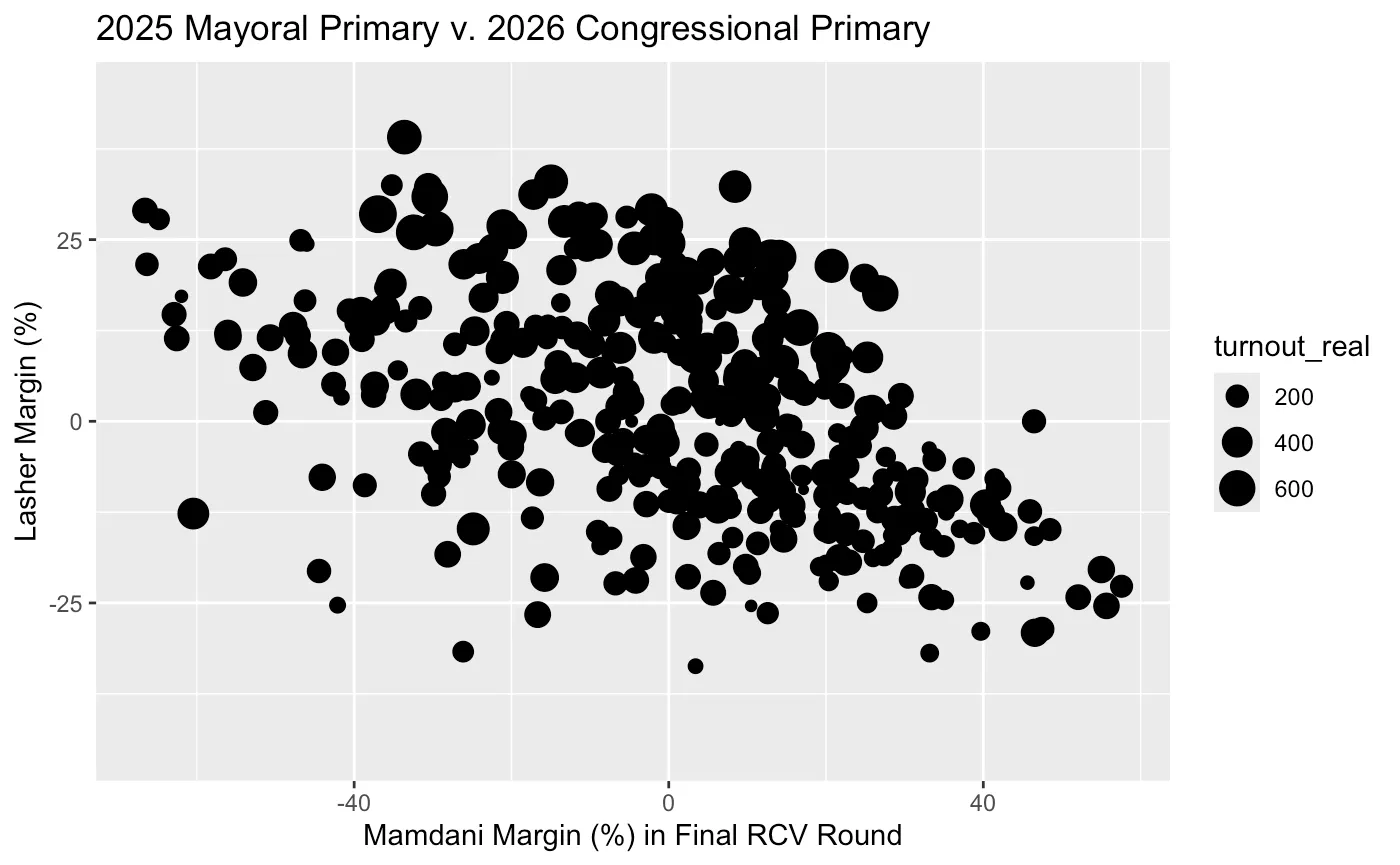
It’s not an amazing correlation. If you’re a nerd about it, the R-squared is about 0.25. But it’s an immediately noticeable correlation that you did a lot better in districts that voted for Cuomo. And the more they voted for Cuomo, the better you did. And vice versa. On the bottom right, the best districts for Mamdani are Alex’s best districts.
When I look at that graph, what I see is that the voters in this race disagreed with me. I said that you were more progressive and they had a different opinion. Should I be concerned?
Look, first off, the only question I’d ask on that graph and that correlation in general is, the driver of that ideology or is it age?
Eli Miller
Okay, but if you’re the candidate that is favored by [older voters] which is also true….
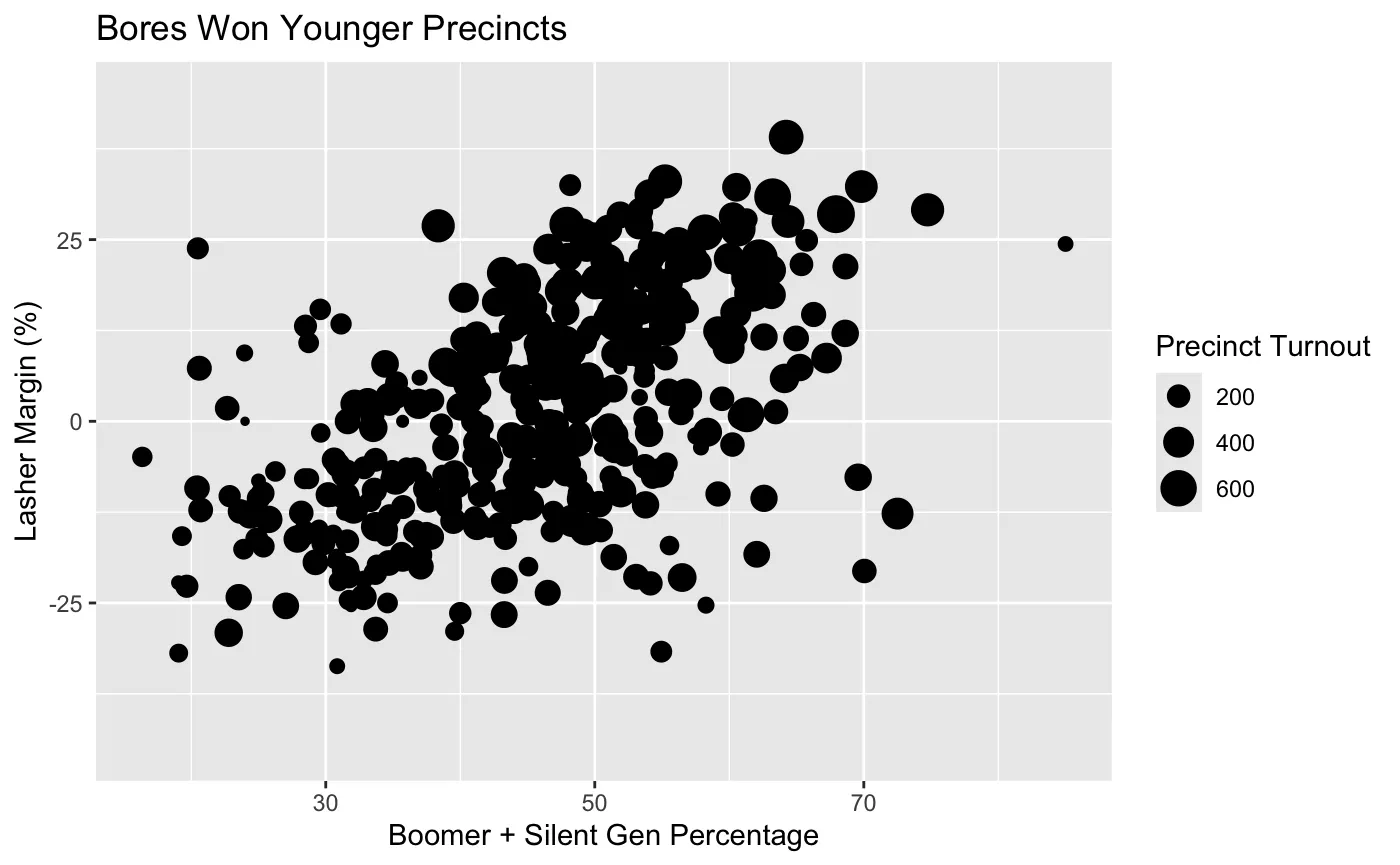
I think there’s probably a stronger correlation with age. But then, I have the same exact question.
Yeah. Look, I think that there’s no question that there was a bit of an ideological sorting that happened toward the end of the race. I think I’d argue, though, that was more about vibes than anything else. And the truth is, I think, and again, I don’t know how Alex thinks about this, but he and I were engaged in kind of a prisoner’s dilemma throughout much of the race. We were both trying to hold on to as much of the electorate as we could. I represent a more progressive district and was trying to hold on to my base while also winning the votes of folks on the other side of the park. And he was trying to do the opposite. He represents probably the most conservative district. assembly district within the congressional district, and he was trying to hold on to his base while attracting more progressive voters. And that was a challenge for both of us. And I think that, take us both out of this, out of context of this race. I think we both, neither of us fits the profile of a revolutionary. But I think in the race to some extent, because I had support from not just Jerry Nadler, but Mike Bloomberg and Kathy Hochul, who are folks that are very much signified as moderates. And in the absence of that, he was sort of freer in a way to define himself.
He did have Our Revolution, which I do think cost him real support in his base. He is 10 years younger than me. I think that was a real thing. He definitely ran much more of a digital forward campaign than we did. So I think there was this sort of vibes-based sorting on both age and ideology that exceeded certainly any real mapping ideologically in reality.
Yeah, that makes sense. But I also… I asked Scott Stringer this when I had him on, but you mentioned in your speech that this is the district of Bella Abzug and of Ted Weiss and of, history of Vietnam protests and all sorts of things. And, when Scott Stringer, he told me like when he started in the Assembly, he was really the leader of the progressive movement in the State Assembly.
This district, it’s very hard to make the case that that’s where we are right now, especially in the context of the city. I mean, I was going to ask for this later, but this is maybe a good time to bring in the fact that there were three other big races in the city and they all went the same way.
Do you still see that this district is the bedrock of a certain kind of progressive politics and that you’re on the vanguard of something? Do you want it to be that? How do you think about that?
I think it’s complicated. I mean, I think all this stuff is complicated, which is sort of the story of my life. If I wrote a memoir, it might be called It’s Complicated.
We’re getting into the weeds.
Yeah, into the weeds, exactly. By the way, like, you know, if there’s a core value of mine, it’s like, let’s not discard the idea that complexity has value in politics, and let’s not associate complexity or conflate complexity with moderation. That is one of the things that drives me nuts about the politics of the moment, that we equate progressivism with reductionism. And I think that’s a terrible thing. And I think to some extent, to people that don’t see me as progressive, I think some of that comes from my insistence on acknowledging the complexity of issues. And you can have very progressive objectives and recognize that sometimes stuff is complicated. So that’s, I think it’s just important. That’s a part of who I am.
And look, the district was combined in 2022, the West Side District and the East Side District. I think it’s fair to say that certainly the Upper East Side portion of the district is more to the center than the Upper West Side portion of the district. And all of the district has shifted on a relative basis, or some combination of the parts of the city have shifted to the left around it, and as it has become a more and more expensive place to live, it has become a more moderate ideological place. I think that’s true.
Having said that, Jerry Nadler certainly, I think, fits squarely in the tradition of a progressive fighter who speaks with moral clarity on issues. And I hope to continue that tradition as well.
So that leads to my big question for you, which is how do you make decisions? And specifically, how do you make decisions when you do have this complicated and changing coalition behind you that has a lot of very loud, organized, constituencies that are going to be in your face with strong opinions? How do you balance those voices with the interest of a more diffuse majority?
And also when you’re balancing those dynamics, where does your own opinion come in? When you think that one side is being more reasonable than the other side, but the other side… there’s more of them, or they’re louder, how do you balance all of this when you’re an elected official?
This is going to sound trite, but I really just try to do what I think is right. And I probably pay, frankly, a lot less attention to the various pressure points than the average- I would like to think that I pay less attention to the various pressure points than the average politician. And I think that some of that comes from my time, both working for Jerry and working for Mike Bloomberg, who in different ways and for different reasons were in positions to be able to do what they believed was right and not be particularly preoccupied with who was shouting at them.
And that you can do that if you are, as I think I am, a good fit for the district. That gives you latitude and if you make sure you have enough political strength. And I think if you’re too dependent on a narrow set of people or groups that support you, then you can’t afford to **** them off. But if you have a fairly broad swath of support that supports you not because of a transaction, not because of any one issue, but because there’s a relationship of trust and they believe you to be someone of integrity and they’ll forgive you some disagreements and they’ll stick with you, that gives you the freedom to do the right thing.
When you’re running in a competitive primary, you are at your weakest political moment, because you feel like everything you say, everything you do can be the difference of a vote, which could be the difference of a race. But that’s not necessarily true. And to some extent, what all the groups that make endorsements and the voters are trying to do during a primary is they’re saying, “we’re trying to figure out… Once this person’s in office, we’re going to have a lot less control and power over them. So how are they going to behave in office?”
I think if you look at the people that endorse me, they are people who know me really well and they represent this district. That was a big difference in the endorsement list that Alex and I had. And I think at the end of the day, all those people, it’s not that I’m going to agree with them on every issue, but they know I’m going to do what I think is right.
So let’s test that out a little bit. I have a little game for you.
Oh, great.
It’s called Concerned Constituent. So we’re going to role play. I’m going to be a concerned constituent, and I’m going to have unreasonable concerns, and you’re going to have to use the trust that we have to...
I don’t know that I like this game.
Here’s one that you’re guaranteed to get 10 times a day: “Congressman, I hear there’s a new bus lane going up on 34th Street. I hate these stupid bus lanes. They make it really difficult for me to park my Subaru Outback and, you know, all the drilling. It’s going to be really loud. It’s going to be really annoying. You got to do something to stop this.”
Okay, can I just pause for one second on this role-playing? Which is, I don’t actually go around trying to piss off as many people as I can. So I’m going to answer these questions with how I feel about the issues. But, let’s not, I don’t want to make myself out to be Larry David here.
Oh, no, I would imagine your strong impulse is going to be- where, you know, I’m on the phone or I’m confronting you at Zabar’s or whatever- is that you want to tell me you agree with me, right?
Well, I think I would say there’s somewhere in between these two things, which is, I think it’s really important on controversial issues to speak to people in a way that they have a shot of hearing you. And I struggle with this too, by the way, because I do sometimes have an instinct to just tell people what I think in an unvarnished fashion. But there’s a balance between pandering and just telling people they’re wrong in a way that they shut down on you. Like part of the job of an elected official is to educate and inform and persuade. and bring people along with you. And to do that, you have to be able to speak to people in a way that they will hear you. That takes time, and I know we’re on a clock. So I will just respond to these issues on the merits, and you can translate.
Well, give me an empathetic answer, then. Give me something that I might hear, even if we only have two minutes, we’re in Zabar’s, but give me, you know…
Listen, you and I both know how hard it is to get around this city, including by car. And that’s because we have so many cars on the road. We do need to get people onto mass transit. We need to be able to make mass transit work. And bus lanes are an important part of that.
And on the relative value between losing some small number of parking spaces, and by the way, you and I both know you’re going to be circling for 1/2 hour to find a spot, whether or not those spots go away. There’s enormous value in making sure our buses can get across 34th Street before my kids graduate from college. And so, yes, we need to make sure that the bus lane is as minimally disruptive as possible, but I think it’s a really important thing to achieve.
Great. “Congressman, I live on 100th Street, and they’re trying to build this massive, ugly, luxury condo. And it’s going to be really disruptive. It’s going to take them three or four years to build it. It’s on this land that’s a beautiful library that I love going to. They’re going to rip it up. They say they’re going to build a new library, but I don’t know. Why should we build fancy luxury housing on 100th Street in Amsterdam?”
The median rent in Manhattan just costs $5,000 a month. We have a 1.4% vacancy rate in this city. The reason it is so expensive to live here is because we don’t have nearly enough housing to meet the demand. And we’ve got to start building housing. And I’m not telling you that one building is going to solve the housing crisis. But every community has got to be a part of the solution. And I believe and I will work to make sure that it is as minimally disruptive as it can be, that we get as much affordable housing as we can. Certainly that the library stays open and is made even stronger as a result. But we have to build, we have to start building housing in the city again. And sometimes that’s going to require some sacrifices by all of us.
All right, this one I’m not going to role play, but I do want to just hear about how you’re thinking about-, towards the end of the race, you got a lot of endorsements from rabbis, especially Orthodox rabbis. There are people who live in this district, I’m sure you’ve noticed, who have quite extreme views on unconditional support for Israel. And I know that they make that known to you and have strongly disagreed with lots of stances that you’ve taken. How are you going to keep them in the coalition when you want to take any step, however small, that means to curb Israel’s violation of international law?
I think there are a lot more people in this district than the political discourse credits that actually have a roughly shared set of views about Israel. And may have different points of emphasis, but basically agree with the following proposition, that Israel, as a homeland or refuge for the Jewish people, deserves safety and security, that safety and security is not a foregone conclusion and requires ongoing attention and protection. Also, that Bibi has been a disastrous leader for Israel and has dramatically worsened the plight of the Palestinian people through both what’s happened in Gaza and what goes on in the West Bank, all of which has made it much harder to see a path toward long-standing peace. And that both of these things can be held in our hearts and our heads at the same time.
That’s what I believe. I think there’s increasingly a pressure on people in public life to kind of reject one of those ideas. And I didn’t do it during the campaign, and I’m not going to do it as a Congressman.
This is probably where I should ask you a little more detail about Claire and Darializa. Have you spoken to them? Do you know them personally?
I know Claire. She’s a colleague of mine in the Assembly. I don’t know Darializa. And I’ve not spoken to them since the election. I have, as a practical matter, not spoken to a ton of people since Tuesday.
And are you, is there something you’re excited about to be part of a freshman class that has all this energy behind it and has a lot of firepower behind them, to come into Washington and make change? Or do you see this mostly as like- you are an ambassador of the establishment and these people just upset a lot of people who you might be close to?
I think it’s a really complicated moment. I think that a lot of what has driven the ascendancy of the left in the city is a frustration with the failure of the established political system, including the Democratic Party, to respond to people’s economic needs and concerns. And so voters are, I think, showing that frustration in these electoral upsets. I don’t think primarily these elections are about Israel and issues related of particular concern to the Jewish community.
At the same time, I think that there is a really troubling rise in anti-Semitism on both the far left and the far right. It has become an animating fuel, I think, in the politics of the far left and the far right. And I’ve talked to some people, again, haven’t talked to a ton of people generally, but in the last 48 hours, who are deeply troubled by that. I am troubled by that. And how we, how I’m going to kind of reckon with that, I haven’t really had a chance to wrap my head around it.
All right, let’s do a little bit of a lightning round to wrap up. One question that I was dying to ask you after the New York Editorial Board interview with Alex was what your personal P-doom is. What’s the likelihood that you think that superintelligent AI is going to literally destroy the world?
Look, I… at one point, there was a very widely read essay some years ago, really before, well before the AI boom. What was the name of the website? This wasn’t it, but it was something like “not when, but why” or something like that. [Editor’s Note: I’m pretty sure the essay in question is “the Fermi Paradox,” by Tim Urban on WaitButWhy.com from 2014]
There was a big essay basically arguing that the reason that we haven’t found other intelligent life forms is because all civilizations, once they reach a certain amount of sophistication, either obliterate themselves through with nuclear weapons or climate change. I think that was basically the idea, that basically life ultimately destroys itself. And I thought that was a fascinating and somewhat persuasive argument. So I guess throw AI into the mix, but I don’t know what my p-doom is.
It doesn’t seem like it’s something that you wake up every morning and go to bed every night thinking about.
No, but I think it’s very real. I think that this is going to be the most significant technological change in my lifetime. You know, when crypto hit the scene and there were all these crypto heads who were saying, this is going to change our world, I kind of always rolled my eyes about that, more than rolled my eyes about it, frankly. But I think that’s true with AI. It is going to be the biggest technological change in my lifetime. And we in government do have to reckon with it, both the potential for catastrophic risk and the economic upheaval and so much more.
All right, real quick, do you know what caucuses you want to be on?
I want to join the Progressive Caucus.
And what committees do you want to be on?
What I said during the campaign was that I’d like to be on Transportation and Infrastructure and also Financial Services in no small part because housing runs through Financial Services. That was also in part based on an understanding that I had about what was and was not feasible for a freshman to get. It has been more recently suggested to me that Financial Services is actually a very tough get for a freshman and that Oversight, which I had been under the impression was also a very tough get for a freshman, might be more achievable. So at this moment, those are three that are on my mind, but I also already hear myself saying this and sounding like a completely presumptuous freshman who’s going to get put on some completely random committee that has no relevance to my district, so I’m going to shut up now.
Well, if Hakeem is listening….
I was going to ask you, I think that one reason that I care about this race is that I think that you, or whoever won this race, becomes one of the most interesting endorsers for 2028. It is obviously June of 2026, so I don’t expect you to know who you want to endorse for President, but tell me a little bit about what you, people are going to start knocking on your door and saying, “I’d love to chat with you and tell you my vision.” Rahm is going to dial your number if he hasn’t already. What is your philosophy on making that decision?
Eli, I got to say, I have no idea.
You have no idea who you want to be President of the United States.
No, two different questions, you asked two different questions there. The question of how I would make the decision of who to endorse, I have not given that an ounce of thought. I have thought about the question of who I would like to see be the Democratic Party’s nominee, and I genuinely do not have a strong view of that at that point. I think there are a lot of potential candidates that to me seem to have real appeal. But I really don’t have a fully formed view. And I will say that I’m, as I am on so many things, what I do know is that I’m not particularly doctrinaire about it. It’s not that I would rule out or rule in certain people based on where they are perceived to fall on ideological lines.
So you wouldn’t be ruling out, for example, a certain Congresswoman from New York City who may or may not run for President.
I’m not ruling out anybody.
The last thing I wanted to ask you is just on a personal level, this is obviously a culmination of your very long career. You started out in your first like 15, 20 years... You were always the assistant. You were the campaign manager. When did you decide that you wanted to be the elected official? What was the evolution there?
It wasn’t really, it’s not quite the way you just cast it. I mean, it’s certainly true. I spent a lot of years as a staffer, but also I ran in 2016 for a State Senate seat, lost, ran again for Assembly two years ago, and this obviously. And I think that reflects the reality of my own kind of path here, which is my interest in actually running and being an elected official has ebbed and flowed over the years.
It generally was at a low point when I was in a position as an appointed official or staffer to make a big difference. The years I worked at City Hall and the Bloomberg administration was definitely a low point in my interest in running for office because I felt like I could have so much impact and be at home at night. And in fact, the council seat on the Upper West Side opened up in 2013 and it didn’t cross my mind to run for it at that point because I was just not interested. So it’s been an up and down thing.
I will tell you that I have always had a pretty ambivalent relationship with being a candidate. And that has increased. I really struggled with it during this campaign. And I think a lot of the things that are appealing to people, a lot of people who work as staff who then run for office, there’s a, if you think about the Venn diagram between being a staffer and being an elected official, there’s a bunch of stuff that you do in both jobs. And then there’s a bunch of stuff that you do as an elected official that you don’t do as a staffer. And I think that stuff is what is appealing to a lot of people who run for office. And as I have gotten older, it is increasingly the pieces of the job that I like the least. Not all of it, but a lot of it, and that I have a very ambivalent relationship with.
We’ll close with this, something I’m sure you’ve noticed. It has to do with the Venn diagram thing and the people who are drawn to this.
People get into this world and it messes with their judgment.
Yeah, totally.
And it messes with their sense of the, like, power is very corrupting. And I have noticed in my limited time doing this, there are some people that I’ve talked to that I can just see have become, on a personal level, kind of unpleasant people because of how much they’ve given to this and how intensely they’re clinging to the power they have. To flatter you for a second, your reputation is not that.
Thank you.
But you’ve also never had this much power before. So how do you stay grounded? How do you keep perspective when you’re in this world and you have real, you know, it’s not paranoia if everyone’s truly out to get you and the air is thin when the altitude is this high and all the other metaphors you want to do.
It’s not that high. I’m going to be a freshman Congressman from a safe seat. But I take the point.
Listen, I am an incredibly blessed person. I love my life much more than I love politics. I have an amazing wife. We have great kids. We love spending time together. I got a great mom who lives in my building, as Matt Flegenheimer outlined in great detail in the New York Times. I have great in-laws who were out campaigning for me in the final days of this election. And I’ll always be happier hanging out with them than doing politics.
I’m very proud to do politics and government more than politics. And I think it’s a really important thing, and I’m proud to do it, and I hope I can make the world a better place through it. But I don’t need it. And my life is going to be fine, maybe even better, without it. And in the low moments of the race, the way I would calm myself down is I would actually visualize what my life would be in the event that I lost. and I would have a sense of calm because it was clear that it would be better. And so you just try to hold on to that and you try to be as normal as you can.
I’m 44. It’s also, I think, one of the things that’s good about being a little older and having seen a few things. And I’ve had power in my appointed jobs. Maybe in some respects, more than I will as a freshman Congressman. I don’t love the pomp and circumstance. I don’t love the performative aspects of being a politician. I don’t love the title and nonsense and the puffery and all of that. And I don’t think that’s going to change.
Well, condolences on losing out on that vision of calm tranquility. But congrats on winning, obviously. Thank you so much for coming on the podcast.
Thanks, Eli.
If you liked this project and want to support us, you can buy me a coffee. Please do not do this if you know me personally (just text me!), or if you work for a campaign or an elected official (Don’t bribe journalists! Shame on you!). Thanks so much!


