

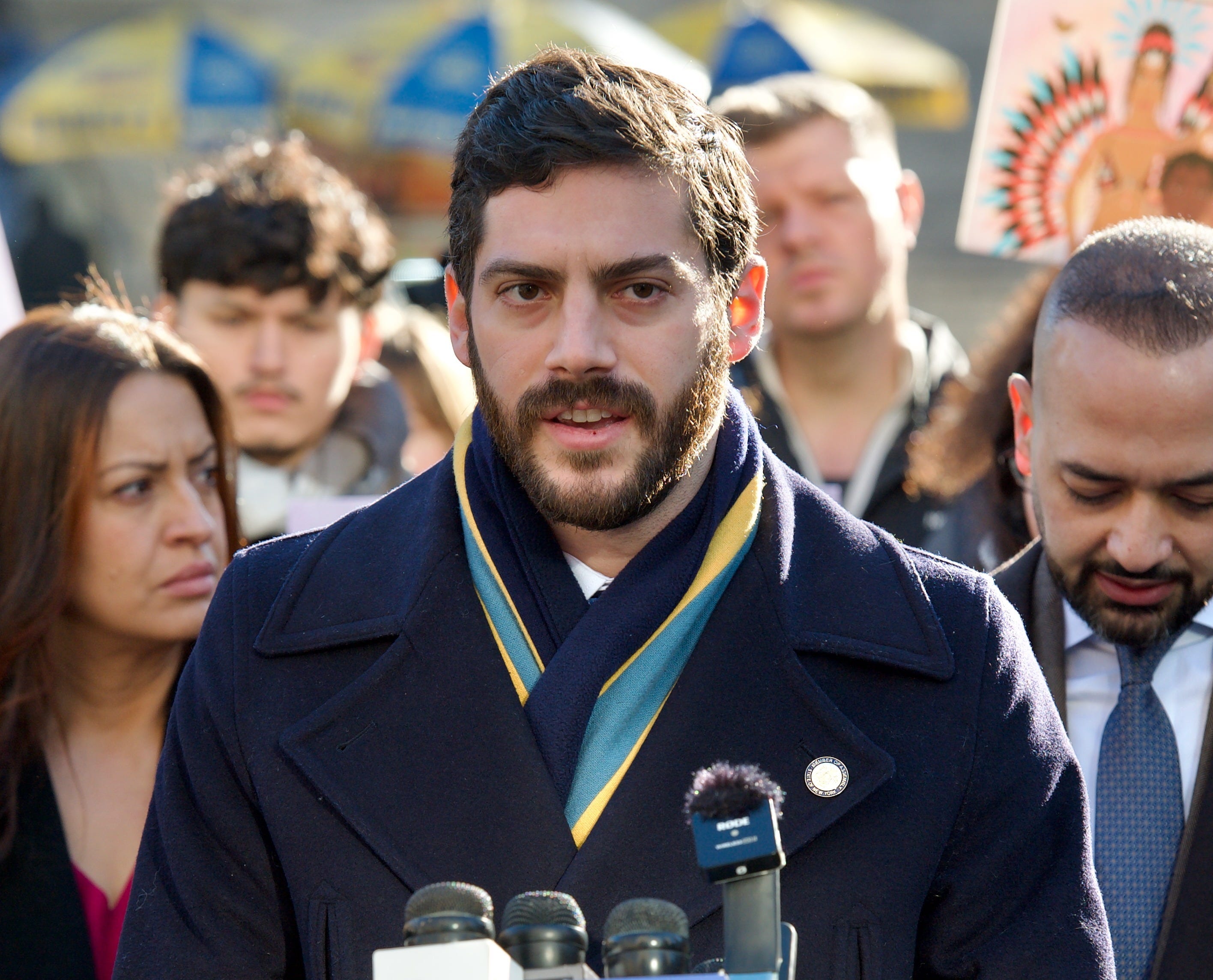
Programming note: This is the Case Against Alex Bores. I plan to publish the Case Against Micah Lasher sometime this week. When I do, I’ll hyperlink it here. Then, I will close with a direct issue-focused comparison, and finally, an endorsement.
Alex Bores has two closing messages, and they’re both incredibly compelling. The more straightforward message, the one he used with donors across the country, is best encapsulated on his website in the introduction to his signature AI Policy Framework. “Artificial intelligence is transforming America.” He wrote. “And we need leaders in Congress who actually understand the technology enough to ask tough questions, close dangerous loopholes, and make sure innovation doesn’t bulldoze families, workers, and our democracy. That’s me.”
Bores goes into (some) detail about how exactly he wants to regulate the AI industry in that memo. But you’re not going to hear about that in the final weeks of this campaign. That’s because Bores has a problem: He’s running in the wrong district for elaborate warnings about the dangers of artificial intelligence. Voters across the country are increasingly furious about the rise of AI, but comparatively less so in NY-12, an aging district with few soon-to-be-obsolete tech workers, and one of the only places in the country where it is physically impossible to site a data center. It is no coincidence that as of January, Bores had raised more money from Berkeley residents than from Manhattan residents.
Bores’s second message, the one that he’s closing debates with, printing on every flyer, and proclaiming from every campaign podium, fits NY-12 voters far better, because it ties AI to the issue they actually care about: Trump. “Trump mega-donors are trying to buy this election. They’re trying to steal it from you. Don’t let them.” Bores urged at last month’s candidate forum at the 92nd Street Y. He elaborated further in his closing statement of the PIX-II debate last Thursday night: “The A.I. oligarchs who are rigging our economy are scared of me... they named me their No. 1 enemy and said they would spend at least $10 million to defeat me.”
Those oligarchs are OpenAI’s President Greg Brockman, Palantir co-founder Joe Lonsdale, and venture capital firm a16z’s co-founder Marc Andreessen, and according to recent federal filings, their political arm Leading the Future has spent only $6.2 million in independent expenditures in this race (though they may clear $10 million by Primary Day, June 23rd). What Bores says is superficially true. They are all billionaires, they all donated millions to Donald Trump’s 2024 campaign, and they all fiercely oppose Alex Bores.
When I first previewed Bores’s candidacy in January, I wrote that Leading the Future’s strategy made no sense, and even at that point, it had already backfired dramatically. As the East Side candidate, and especially as one with far fewer local institutional endorsements than West Side Assemblymember Micah Lasher, Bores entered the race at a severe disadvantage. Recent history tells us that in a normal, boring race, the West Side candidate crushes the East Side candidate. His only hope was to come up with a compelling narrative, something stronger than “I’m your local elected official, you know me, you trust me, I’ve done a good job.” Something that could ratchet up the urgency of the race, excite the imaginations of Democrats on both sides of the park, and make standard, hyperlocal concerns like bus lanes and scaffolding seem quaint. By flooding mailboxes in January and February with cartoonishly overwrought attack mailers, Leading the Future did more than just raise Bores’s name recognition (he was a two-term State Assemblyman; most people had no idea who he was at that point). They gave Bores’s campaign that narrative, on a silver platter. This, I wrote then, helped Bores way more than the mailers themselves could possibly hurt him. It was essentially an in-kind donation.
The next six months have borne this out. In a race with two celebrities, it is Bores who has dominated with the kind of earned national media that is worth solid gold in a district like NY-12. Because of Leading the Future, Bores was able to book an interview with Ezra Klein, with the headline “Why are Palantir and OpenAI Scared of Alex Bores?”, an interview that to a first approximation, every single NY-12 voter I know listened to. Because of Leading the Future, Bores has been the subject of lengthy magazine profiles in The New Yorker, Politico Magazine, and even Vanity Fair. Because of Leading the Future, the one story about this race in last weekend’s print New York Times, a week before the start of early voting, bore the headline: “A.I. Companies Don’t Know What to Do With Alex Bores” (Bores enthusiastically retweeted the story.)
“Judge me by the enemies I have made,” a famous resident of what is now NY-12 once said. Bores has asked voters to judge him based on his three deep-pocketed, utterly hapless enemies, and so far, voters seem to find this an extraordinarily compelling argument. It comes in three forms. There’s the competence angle: If these people are spending so much to stop him, Bores must be really good at AI regulation, in a way that no one else could be. (“They’re scared of me because I win,” Bores told supporters at a rally two weeks ago). There’s the precedential angle: If we don’t elect Bores, it will send a loud, clear signal to officials across the country that it’s too risky and perilous to regulate AI. (“They’re looking to make an example out of me,” he likes to say.) And there’s the real prize, the anti-Trump, anti-corruption angle. Big Tech oligarchs oppose Bores, so he must be the most anti-oligarch, anti-Big Tech candidate. Trump donors oppose Bores, so he must be the toughest on Trump, the one that Trump himself least wants to see in Congress.
All three arguments are worthy of scrutiny. The case against Alex Bores is that none of them really hold up.
II.
We can dispense with the “make an example” argument first. To the extent that Leading the Future is making any kind of example out of Bores, it’s a positive one. “If you run afoul with us,” they have said, “we will strike back clumsily, make you look like a badass man-of-the-people superhero, and you will be way more viable than you otherwise would have been.”
This would not be the first time that Bay Area billionaires have spectacularly failed to purchase elections. In his 2023 book Going Infinite, Michael Lewis chronicled the saga of Carrick Flynn, a pandemic policy expert who crypto billionaire Sam Bankman-Fried decided to support in his candidacy for Congress in Portland, Oregon. Bankman-Fried was new to local elections at that time but flush with cash, so he poured $10 million in independent expenditures, deluging the small media market with the same 30-second ad over-and-over. In Lewis’s telling, this (predictably) did not endear voters to Flynn. (Bankman-Fried also donated to Bores’s State Assembly campaign that same cycle; more on that later). This incident, and many, many others (see Tom Steyer, or 2020 Presidential candidate Michael Bloomberg) illustrate that when deployed clumsily, money alone cannot make a candidate win or lose.
And it’s not even clear that making Alex Bores lose is Leading the Future’s goal. When I spoke to Politico’s Calder McHugh in April, I asked him why these billionaires were so dead-set against Bores but had not poured similar resources into opposing Scott Weiner, a California state legislator who had passed nearly identical AI regulation in California to Bores’s RAISE Act, and who is currently running to fill Nancy Pelosi’s Bay Area seat in Congress with the exact same AI plan as Bores. McHugh told me that according to his reporting, Leading the Future had looked at Weiner, and decided that he, unlike Bores, was a heavy favorite, and that they would look weak if they opposed him and he won anyway. “They’re engaging in NY-12 because they believe Bores had little chance of victory… They felt like their money could be better spent against this guy who already had all these local dynamics stacked against him.” When I spoke to The New Yorker’s Gideon Lewis-Kraus, who has reported extensively on Bores, OpenAI, and Anthropic, he told me the same thing about Leading the Future: “They’re in this race [and not Weiner’s] because it seemed easier for them to claim a scalp. …They thought Bores was going to lose anyway.”
To recap: While Leading the Future would like everyone else to believe that they have the power to swing elections with their money and destroy their enemies, even they do not believe they have that power, and anyone who considers crossing them in the future will see that crossing them might have no effect, or might lead to outrageous success. This is well established at this point. We do not need to actually elect Alex Bores to drive it home.
Of course, there might be another reason why an elected official might emulate Bores’s platform, on pure campaign finance terms: there’s even more money on his side. The same federal filing that reported Leading the Future’s $6.2 million in opposition independent expenditures, also showed that OpenAI’s main competitor, Anthropic, had spent $6.5 million in independent expenditures supporting him. This also pierces the third argument, that Leading the Future’s spending casts Bores as an anti-oligarch crusader for the common man. In fact, some of the very richest AI oligarchs, the ones who own massive chunks of a company that is expected to IPO at $1 trillion sometime this year, are desperate to see Bores in power.
Why are they so desperate? And is it so bad if they are? In the last week, both Lasher and Schlossberg have hammered Bores for receiving Anthropic’s support, as if this alone makes him a captured hypocrite. But does it? After all, Anthropic are the good guys! They are the responsible company, the one that’s obsessed with safety, that was founded on the premise that Sam Altman and OpenAI were dangerous and needed to be stopped. They’re the people who heroically stood up to Pete Hegseth and the Trump Administration earlier this year, because they were concerned that AI agents might be given autonomous control over lethal military operations. Right? To truly evaluate the case for Alex Bores, we need to understand who Anthropic’s leaders are, what they want, and whether or not someone they’ve allied with could be the right person to regulate the industry.
III.
And to understand that, we have to take a big step back and consider the Effective Altruism movement, something that does not loom particularly large in the consciousness of Manhattanites, at least those who live north of Houston Street. But they’re going to have to learn in a hurry, because Anthropic is the dominant Effective Altruist company, the spiritual successor to Sam Bankman-Fried’s cryptocurrency exchange FTX and trading firm Alameda Research, and Alex Bores is the Effective Altruist candidate of this race, and one of the most successful EA politicians nationwide.
A brief primer (check out my conversation with Gideon Lewis-Kraus if you want a slightly less brief one): Effective Altruism is a philosophical movement founded in the early 2010s by an Oxford graduate student named Will Mackaskill, based on the work of utilitarian moral philosopher Peter Singer, among others. Its fundamental tenets are straightforward: 1) people have a moral obligation to make a reasonable effort to do the most good that they can; 2) people are similarly obligated to rigorously measure the impact of their attempts to do good, so they can maximize that impact; and 3) once people do that rigorous measurement, and learn that they can literally save a life by donating a few thousand dollars to the right charity, they should take the utilitarian implications of that finding at least a little bit seriously.
To the right kind of person, someone who loves math, logic, and being a contrarian, the sheer epistemic power of this argument is kind of intoxicating. I am in many ways exactly this kind of person, and I remain an adherent to this form of EA. I set up a monthly donation to GiveWell as soon as I graduated college and had a steady income. I think more people should do this too.
Somewhere down the line, the focus of the EA movement shifted slightly, with the thought experiment that is sometimes referred to as “Pascal’s mugging.” The idea here is that if you truly care about doing the most good, you should be willing to think about lives in expected value terms. Sam Bankman-Fried famously told Tyler Cowen that he would flip a coin that would double the well-being of all humans if it came up heads, and cause human extinction if it came up tails, as long as the coin had a 51% chance of coming up heads.
Furthermore, this theory goes, if you truly care about maximizing expected lives, you should be most concerned with preventing catastrophes and extinction-level events, even if they are vanishingly unlikely. So buying malaria nets and nutritional supplements for actual babies is good, but preventing the next global pandemic (or even making it a fraction of a percentage less likely) is better, and reducing the probability of a mass extinction event by .00001% is best of all.
As Lewis-Kraus explained to me, this kind of logic led the Effective Altruist movement into a tough spot, because it created some perverse psychological dynamics. Suddenly, the marker of an adherent was not how much they gave, or how much they cared about maximizing impact, but how committed they were to these counterintuitive logical conclusions, the kind that would sound absolutely crazy to a normal person outside the Bay Area, but would be recognized as true and virtuous to a fellow EA member. This, in my opinion, is how you get a cult.
There’s nothing intrinsically wrong with cults, but by 2022, this particular one, and its cult leader Sam Bankman-Fried, had an enormous amount of money and power, and a catastrophic inability to wield them responsibly (or impactfully). By the end of that year, SBF was indicted for essentially stealing billions in FTX customer funds, and deploying them not on Robin Hood-esque altruistic programs like malaria nets, but on private planes, flashy Super Bowl ads featuring Tom Brady and Larry David, extravagant political donations to Joe Biden, Mitch McConnell, and dozens of lower-level aspiring elected officials (including Alex Bores), and to investments in venture-backed startups, including a San Francisco-based, EA-aligned, AI startup called Anthropic. He was able to spend all this stolen money in such a decidedly un-altruistic way because by that point, the EA movement’s logical mode had become so elaborate and impenetrable that you could use it to justify anything. Buying that Super Bowl ad, SBF would explain, was the most efficient and altruistic use of his money, because it increased the number of FTX users, which in turn increased the amount of money he personally expected to have, which in turn increased the amount of future donations he could make towards pandemic prevention and AI safety.
Though they sometimes try to deny it, Anthropic is founded and run by co-founders of the Effective Altruism movement. They decided to start Anthropic because they believed that their former employer, Sam Altman’s OpenAI, was not taking its commitment to AI safety seriously enough, and that they needed to build a competitor that would. They are obsessed, as virtually everyone in the EA community is these days, with the idea that an unaligned superintelligence will one day seize control over our systems of power, and use them to kill every human on the planet. And they too, believe that the best and only way to prevent this is to do something (in this case build Anthropic into the dominant industry leader) that will make them hundreds of billions of dollars personally.
Bores has no equity in Anthropic, but he shares their existential outlook, recently telling the New York Editorial Board that he believed the probability of this AI extinction event (“p-doom” in EA parlance) to be about 10%. His supporters do too, the army of employees from Anthropic (and Jane Street, and other EA-aligned finance and tech institutions). Here is the case made by one such supporter, an AI researcher named Eric Neyman, who walks through the utilitarian case for making a maximum $7,000 donation to Bores’s campaign. In this 8,400-word blog (more than double the length of this one), Neyman comes up with precise, probabilistic answers to questions like how many marginal expected votes $7,000 should buy Bores, (about 20, apparently), how much greater Bores’s impact would be if he one day became a cabinet secretary (twice as much as a Congressman), and ultimately, how much existential risk could be reduced if Bores was elected (1-in-5000!) He concludes that this is “this is the best currently-existing political donation opportunity, by a factor of 2-3 or so.”
Alex Bores knows better than to talk in these terms in Manhattan, but this is the world that he comes from, this is the language that he speaks, and these are the terms with which he has managed to raise nearly $3 million in direct donations from tech workers in the Bay Area and across the country.
IV.
As I said above, I have great admiration for the Effective Altruism movement. I think people should care far more about the impact of their actions, philanthropic and otherwise, than many seem to. And I believe the movement has helped shine a light on many exceedingly worthy, under-discussed causes, including global health initiatives, pandemic prevention, and yes, the growing risks of unaligned AI.
But in its worst moments, this movement has also been categorized by a cocktail of concerning defects, including a fetishization of contrarianism, a set of rhetorical epistemic tools that can be used to justify absolutely anything, an alarming propensity for herding and groupthink, and a wildly irresponsible tolerance of, or even preference for, extreme risk. I do not know whether these qualities make for good inventors of frontier technology, or wise executives of a unicorn tech company. I do think that they make for bad public policymakers, and I do not want people with these qualities (in this case, Anthropic’s soon-to-be-centibillionaire leaders) holding any kind of power over my elected officials, as virtuous as their intentions may be.
More narrowly, if they are going to hold power with elected officials (and they seem determined to do so), I do not see why it is of profound moral importance that they hold power with MY elected officials specifically. It makes perfect sense that someone like Scott Weiner, who will represent a Bay Area district that is chock-full of young Effective Altruist tech workers, might lead on the issues that Anthropic wants him to. At the rate that Anthropic is spending, he will surely be joined by a bipartisan crop of Anthropic-friendly Representatives before long. The Upper West and East Sides do not have the same base of local Effective Altruists.
Bores wants Manhattanites who don’t know or care about EA to vote for him anyway because he’s opposed by the three billionaires of Leading the Future. He argues not only that they are emblematic of the Trump-supporting oligarch class, and that if he loses they will have unchecked power because no one else will dare challenge them, also that their opposition is what proves that he would be the best person to regulate the AI industry.
But it is impossible to separate Leading the Future’s opposition of Bores from Anthropic’s support of him. I have taken this long dive into the history of Anthropic to demonstrate that I do not agree that an Anthropic supporter would speak for the general public, and or that their chosen representatives would be the best and only people to regulate the AI industry.
There may be other arguments for electing Alex Bores to Congress next year. I plan to address those in a blog later this week. For now, you should know that the core argument that he’s closing his campaign with, the one he wants you to hear most, simply does not hold up.
Excellent analysis once again.
Dying for your endorsement