

Last Thursday, I went to the News Building on East 42nd Street to watch PIX-11’s NY-12 Primary Debate in their media spin room. A televised debate down the stretch of a contested campaign only ever conveys one lasting message to voters. It’s kind of tragic when you think about how much work goes into them. Teams of producers anxiously wheel around sophisticated, expensive equipment to make sure everyone looks and sounds perfect. Moderators spend hours researching and editing their questions into their clearest, most provocative form, and then practice reading each one aloud in the mirror so they approximate a tone of relaxed, conversational curiosity. And the candidates and their teams hole up for days, carefully memorizing every 60-second segment, brainstorming lines of attack and deflection, and deputizing staffers to role-play as their opponents. All that for one hour of TV, which is then reduced down to one fifteen-second soundbite or five-word headline. Our collective attention spans can’t handle more than that. At the end of the day, there’s a lot going on, and most normal people find politics pretty boring, so one takeaway is all you get.
Both Jack Schlossberg and Micah Lasher walked into this debate with the goal of making that takeaway the same thing: Alex Bores Is Secretly Evil.
Sensing that this had become the race’s most contentious topic, moderator Dan Mannarino decided to open the race with a question about AI regulation, Alex Bores’s favorite issue, and directed it to Micah Lasher first. Lasher spent about ten seconds describing his plan to guarantee jobs to new grads, and then pivoted, and went straight at Bores, who had not spoken yet. “Unlike Alex, who’s backed by millions of dollars from Anthropic and crypto companies, I won’t be beholden to anyone but the voters.”
And then they were off. Lasher attacked Bores for being “the most pro-crypto candidate on this stage.” Schlossberg jumped in, threw in a criticism of how Bores’s AI Dividend Plan would be a “dream come true for the biggest AI company in the world, which has given you millions of dollars,” and then added a twist: “I put Alex’s AI plan into AI to see if it was AI-generated, and the results would interest you.” Mannarino eventually pivoted to a question about income inequality, but Lasher and Schlossberg stayed on message. “Voters should ask why a crypto billionaire is spending three-and-a-half million dollars to help Alex… he has an A-Plus rating [with the crypto lobby],” said Lasher, while Schlossberg stressed that “the people funding [Bores’s] campaign are also funding MAGA Republicans across the country.” But it was a few minutes later, when the conversation moved to immigration and ICE, that the knives really came out. Schlossberg attacked Bores’s years working for Palantir with a savage (almost certainly unintentional) Freudian slip: “I know Alex says ‘I quit ICE,’... I mean, ‘I quit Palantir’.” And when Bores defended himself, arguing that he “resigned in protest,” after Palantir started taking contracts with ICE, Lasher lobbed a grenade. “Usually when you resign from protest… there’s a protest. In the Bloomberg News reporting on your departure, reporting that you had received a warning about sexual harassment five days before you left, facts that you did not dispute… your own campaign said you left because you had another job lined up.”
I have no idea how this played to voters watching at home, especially those just tuning into the race now. But from my perspective, these attacks fell flat. Bores has weathered eight figures of opposition spending, which stuffed mailboxes with precisely these points for six months now. So far, voters do not seem to be buying them. I don’t understand the strategy of repeating the exact same attack lines again, over and over, to his face, and hoping that somehow this will get voters to change their minds.
The network cut to a commercial break immediately after, so Bores did not have a chance to respond to the sexual harassment attack (he responded at length in his interview with Ezra Klein, and in his account, the conduct in question seems pretty unobjectionable). For the others, he seemed calm and unbothered, brushing them off with cocky one-liners about how “these vague attacks are just desperate, desperate attempts to dissuade Americans from seeing what’s right in front of them,” and how it was “disappointing to hear Micah repeat disinformation from Trump megadonors,” and even a cheerful, almost Trumpian “they’re so feisty today!” Again, it’s hard to know whether a majority of viewers found this suave and charming, or irritatingly arrogant. Who knows how many voters even watched the debate! For the ones that did, though, the one sentence takeaway was not that Alex Bores was Secretly Evil. Instead, it came from a different Bores one-liner, early on, after a particularly brutal round of attacks from Lasher and Schlossberg: “It’s clear they know who the frontrunner is.”
I.
Can Alex Bores really be the frontrunner in this race? If you’ve been reading (or listening to) my coverage for the past nine months, then you’ll know that I have been skeptical. History would suggest that the deck is stacked against Bores; NY-12 voters care deeply about local endorsements and institutions, Lasher has absolutely dominated in that area, and most critically, the West Side always beats the East Side. More voters, more Democrats, stronger organizations. But these are just anecdotes and narratives, and at this point in the race, you deserve data.. So I pulled the voter file, and for the past week, I’ve taken a deep dive into the demographics and electoral history of each of the nearly 400 precincts in this district, to figure out just how big the West Side advantage is. Here’s the default scenario (a comfortable Lasher win), and five ways Bores could close the gap.
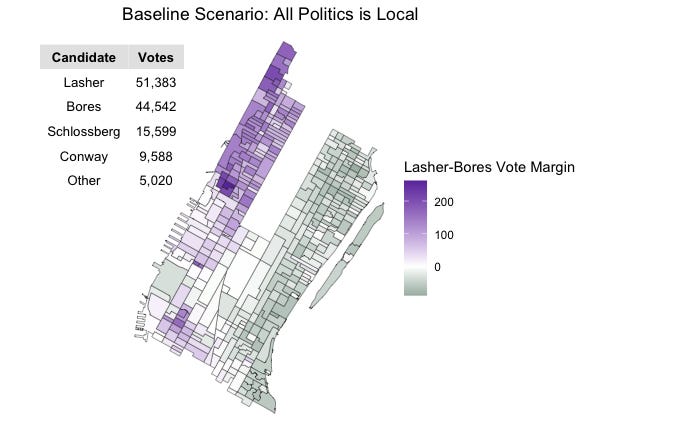
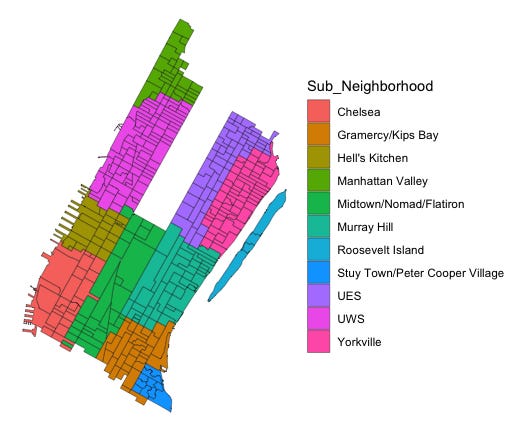
It’s not a fair fight. We have two recent comps in this district for a race between a popular, well-credentialed West Side elected official and a popular, slightly-less-credentialed East Side elected official. They are NY-12’s Nadler v. Maloney in 2022, and the Manhattan Borough President race between Brad Hoylman-Sigal and Keith Powers last June. Hoylman-Sigal won in NY-12 precincts by a 56-40 margin, and Nadler rinsed Maloney 55-24. But this didn’t really sink in for me until I went into the voter file. There are about the same number of registered Democrats on each side of the district (~156k, if you were wondering), and they turnout at similar rates. But when there’s a local on the ballot, West Siders are just much more loyal than their East Side counterparts. With some extremely basic assumptions based on every voter’s prior voting propensity, I project West Siders to outnumber East Siders by about 1,500 in this race. But in this baseline scenario, I project the Lasher to dominate the big West Side neighborhoods by more than twenty-five points, while losing the East Side neighborhoods by only ten or so. This would lead to a comfortable, five-point win for Lasher, which would be the worst showing of any recent West Sider (Hoylman-Sigal won many Chelsea and Hell’s Kitchen precincts with over 70% of the vote, while Nadler touched 80% in Manhattan Valley). If this were a normal, boring race between normal, boring elected officials, this is about as well as the East Side candidate could hope to perform.
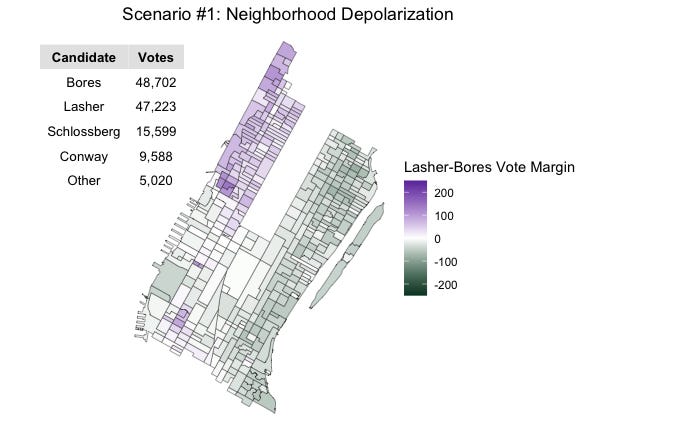
Alex Bores knows this, of course, which is why he’s trying so hard to make sure this race feels neither normal nor boring. One of my favorite lines of this election came from Maeve Buckley Andersen a few months ago: “Alex Bores is the candidate of the East Side, and trying very hard not to be so.” Bores wants to nationalize this race, and to make the stakes feel existential. In this scenario, he pulls it off, reducing polarization on both sides of the park by half, and then squeaking by with a miniscule swing of persuasion. To be clear, reducing polarization by half seems absolutely insane to me. Ask any NY-12 resident whether they’re from the East or West Side, and in their response, you will immediately learn that these people are extremely polarized. So Bores will not win on depolarization alone, as envisioned in this scenario, but the closer he approximates it, the less he has to rely on the rest of the scenarios. And they don’t get easier.
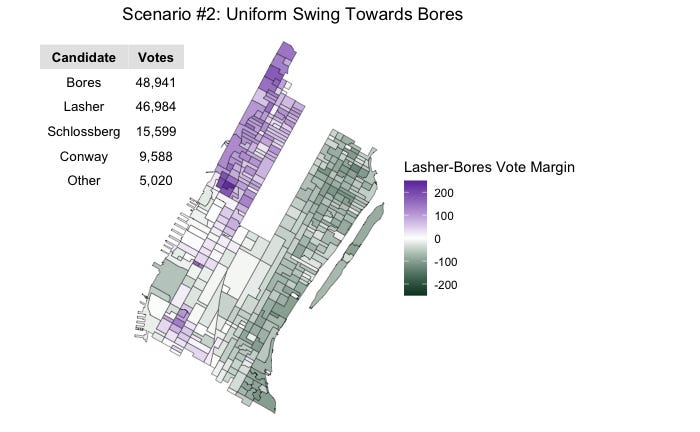
In this scenario, the two sides remain as polarized as ever. But Bores’s closing message about AI, about standing up to the evil Trump mega-donors who have filled your mailboxes with hate and lies, about freeing ourselves from the yoke of our future robot overlords, it all hits in a big way. Neighborhoods remain polarized as ever (Lasher performs nearly 40 points better on the Upper West Side than on the Upper East Side), but in every precinct, Bores convinces a dozen or so extra people to vote for him instead of Lasher. When you put it like that it doesn’t sound so hard! Of course, you have to do it in a district full of older voters, few of whom work in tech, and even fewer of whom actually know or care that much about AI. It would help if the electorate wasn’t quite so old…
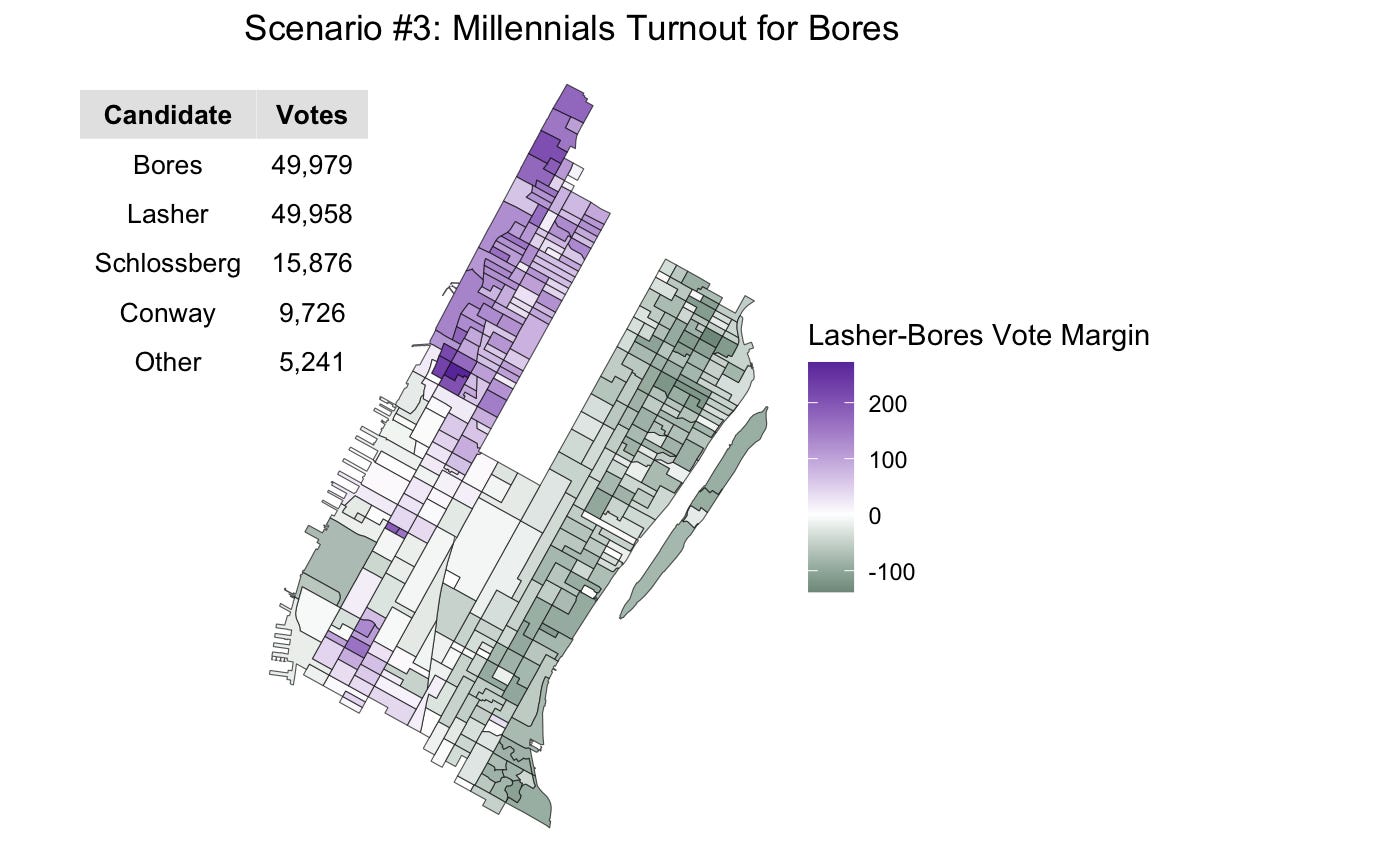
As Michael Lange pointed out to me, NY-12 has a lot of Millennials. I project 31,650 of them will vote in the baseline scenario. But what if he boosts that number up a bit, to 36,000 or so? And what if he absolutely dominates with this group, even more than I project him to in the baseline scenario? At 44, Lasher is technically also a Millennial, but his target demographic is older, Boomer and Silent Generation liberals who have lived here for decades, and have longstanding relationships with Jerry Nadler, Scott Stringer, Kathy Hochul, and all the other aging Democrats that Stringer has worked for. Millennials are much more likely to see the 35-year old Bores, the new parent who put baby-cam footage in his first ad, with a relentless focus on making sure their jobs don’t get automated out of existence, as one of their own. In the baseline scenario, Bores wins Millennials by a few thousand votes. In this one, he gets them at a 2-1 clip, banking a 10k vote lead that Lasher can’t quite close with the rest of the electorate.
I think it’s really hard to convince an extra 5,000 Millennials to come to the polls, and it’s even harder to get them to support you at a 2-1 clip. But Team Bores will certainly be trying.
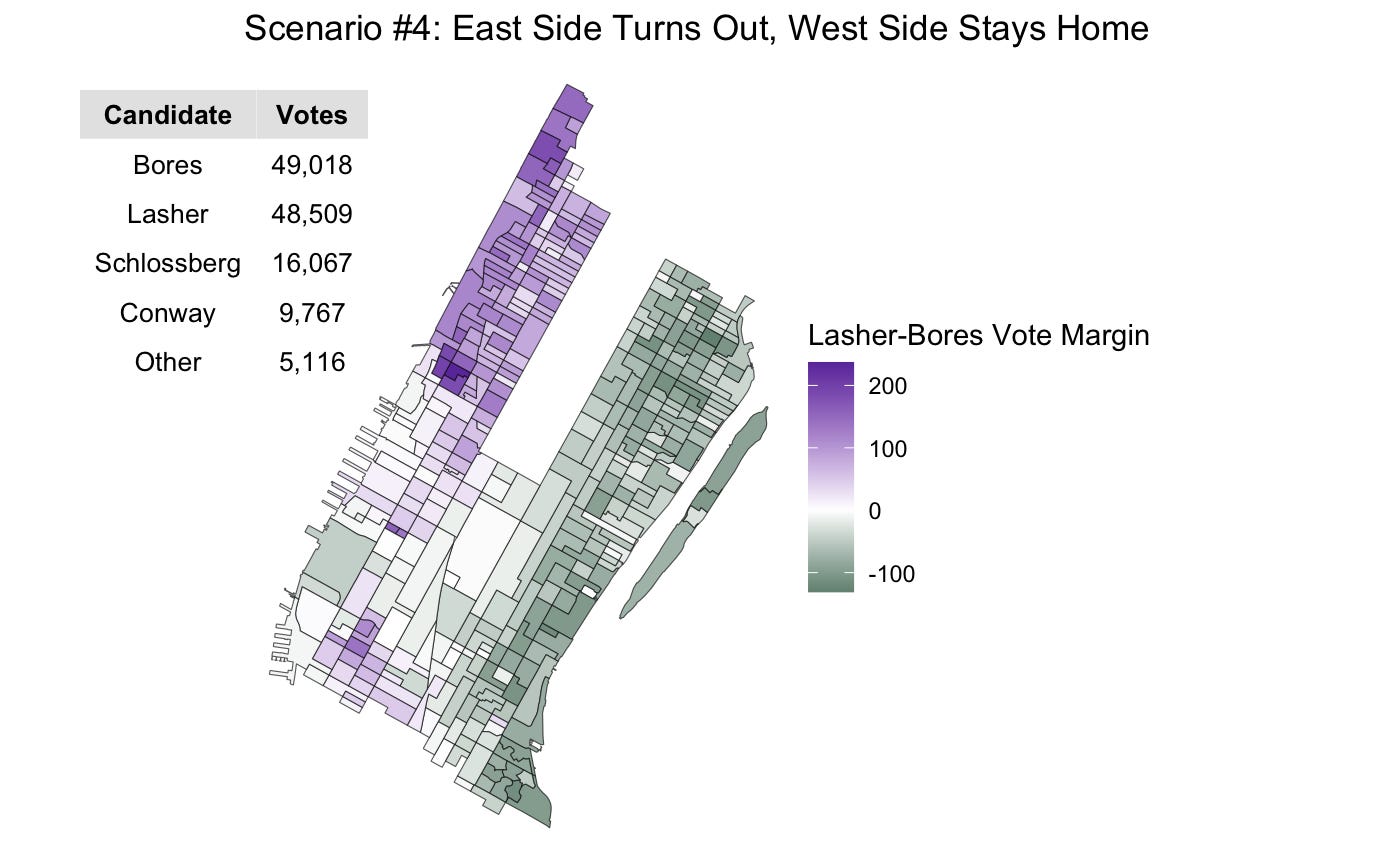
That’s because the last two scenarios simply aren’t plausible. In this one, Bores persuades at the baseline level, Millennials don’t do anything crazy, and everyone stays polarized. Instead, he closes the gap on geographic turnout disparity alone. Up and down 2nd and 3rd Avenue, Democrats are driven to the polls as if this were a mayoral race between Andrew Cuomo and Zohran Mamdani. Meanwhile, on Riverside Drive, they treat it like an off-cycle City Council race. This would be an organizational triumph for Bores, and it would be a tough one, because Lasher has all the best organizational endorsements. Either the Bores’s union endorsements end up mattering more than they usually do, his campaign has secretly recruited hundreds of young, active volunteers (anecdotally Lasher seems to be leading in this department as well) who will knock on doors twelve hours a day DSA-style, or there’s a Hampton Jitney strike the week of the election, trapping all of Park Avenue in Manhattan. Short of that, I just can’t see Bores making this kind of a dent with turnout alone. But this is what it would look like if he did.
If you’ve made it this far, you may be wondering why Jack Schlossberg and George Conway have not played more of a role in these scenarios, and have been stubbornly parked below 15% of the vote. It’s quite simple: I don’t think either of them have much of a shot.
Conway does not seem like he’s even trying, especially after a sloppy, unfocused debate performance where he did not even dominate the conversation during the section on impeachment, his delusional pet issue. Schlossberg is absolutely still trying, but he’s trying way too hard, swinging for the fences at every pitch, and my sense is that most voters are pretty sick of it. While it did not contain any truly damning revelations, the Fandos piece seems to have been something of a death knell for Schlossberg’s hopes of Being Taken Seriously, and NY-12 voters think of themselves as a Serious bunch. If Schlossberg were gaining traction, by this point you’d start to hear about some prominent NY-12 residents (and there are a lot of them) who were excited enough about his candidacy to go on the record about their support, the way Hollywood’s most famous reactionary moderates coalesced behind Spencer Pratt last month. Where is Amy Schumer’s Schlossberg endorsement? Why haven’t the West Village Girl influencers flooded my feed with content about No PAC Jack?
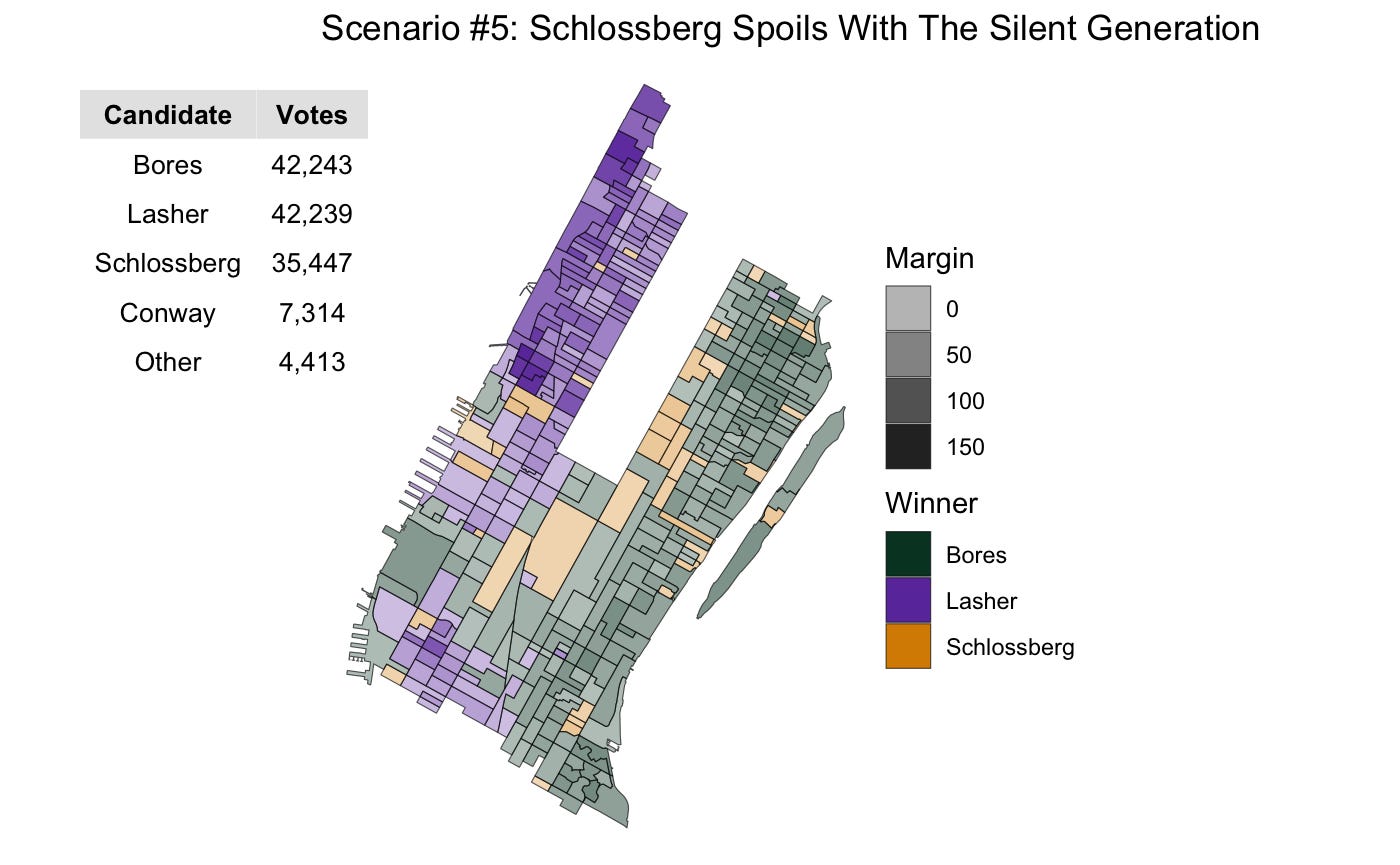
I think he’s toast, but if there’s one group that Schlossberg might still be able to win over, it’s voters over 80 years old. This is a bit of an ego hit to a candidate like Schlossberg, whose whole raison d’etre is his social media fluency, and ability to get a new generation excited about politics. But at this point he’ll take what he can get, and what he can get are voters who can actually remember the Kennedy Administration, don’t know what social media is, don’t follow local politics particularly closely, and watch a lot of television.
In the baseline scenario, he does okay, but not great with this group (they do read the New York Times after all.) In this one, he goes nuts, winning an outright majority of Silent Generation voters in many precincts. Is this enough to get him a plurality overall? Nope! But it’s enough to shake things up for Lasher and Bores. Specifically, it tips the scales ever so slightly to Bores, because Lasher does a bit better than Bores with Silent Generation voters in my baseline scenario. Geographically it looks like Schlossberg is taking more from east than west (look at Oligarch Alley!!) But it turns out he’s taking more Lasher votes than Bores votes even in those precincts, and when everything’s counted, Bores squeaks through with a 2022 Dan Goldman-esque narrow plurality. A hilarious result befitting a “clown car” race.
To me, this is Schlossberg’s absolute best case scenario. It feels absurd, and I expect him to do much worse. Bores’s other winning scenarios, in their most literal form, are also pretty absurd. It’s much more plausible that he gets over the top with some patchwork combination, where there’s a little bit of neighborhood depolarization, Millennials turn out slightly more than expected, the East Side turns out slightly more than expected too, and then he closes strong and wins a few hundred more late-deciders than anyone else.
Looking at the NY-12 electorate, I still think Lasher has the advantage, about a 60% chance of winning. But if Bores were to pull off an upset, and bring East Side Democrats the glory that they’ve been deprived of for so long, that’s probably how he would do it.
Well done !
31,650 Millennials projected to vote in the baseline. If Bores gets them at 2-1 like this analysis suggests is possible, that's a 10k vote lead Lasher can't close. Young voters: this race matters for your future.