

This weekend, I spent many hours Citi Biking around Manhattan, going from one early voting poll site to the next. The weather was absolutely perfect, and these poll sites are a blast. Teams of canvassers in matching branded shirts fanned out in every direction, often in extremely close quarters with counterparts from opposing campaigns. Everyone seemed cordial (at one poll site, I saw one candidate’s mother cheerfully chatting with an opposing volunteer), honorable (everyone rigidly respected the imaginary “100-foot line” from the poll site entrance), giddy with excitement for their candidates, and charmingly self-aware about how little the passing civilians seemed to care for their solicitations (“You made it to the end of the gauntlet! High-five!” one volunteer cheered to a beleaguered pedestrian, at the corner of a particularly frenzied section of Columbus Avenue outside Frank McCourt High School.) It was a great scene, and after spending months behind a laptop, writing blogs and watching grainy live-streams of candidate forums, it felt so gratifying to see democracy in action in real life, out in the world.
The only thing missing was the voters.
At multiple points throughout this week, I tried to exit poll various early voting sites, as I did for last November’s mayoral election. It proved impossible, because there simply were not enough voters to poll. I don’t think I ever saw more than ten in an hour. Borough-wide early voting data backs this up: early vote was down more than 45% from 2025’s Democratic Mayoral Primary in Manhattan. “It’s been really slow,” nearly every volunteer admitted to me when I asked about turnout (although they always added some sort of optimistic spin, like “but the energy is great,” or “it’s gonna pick up this afternoon,” or “people are probably still hungover from the Knicks parade”).
All caveats apply! Maybe voters spent the long weekend out of town (Juneteenth was a Thursday last year, making it more difficult for in-person workers to flee to the Hamptons the weekend before Primary Day), but will turn up in greater numbers on Tuesday. Maybe turnout is slow in NY-10 and NY-13 (also Manhattan), but just as robust as ever in NY-12. Maybe I scared off some voters with my intimidating college-ruled notebook and nosy questions. But if turnout remains down 45% from 2025 on Tuesday, it’s not difficult to say what that means for the race: This would be great news for Micah Lasher, and very bad news for Alex Bores.
Two weeks ago, I modeled five ways that Alex Bores might be able to close his East Side structural deficit, and pull off an upset. If turnout is down 45%, the “Millennials Turn Out In Droves” scenario, the one that the Bores camp finds most narratively satisfying, seems basically dead, as does the “East Side Turns Out, While the West Side Stays Home” scenario. Brigid Bergin’s reporting in Gothamist, based on voter-level early vote data (not publicly available), found that at least through four days, the early vote trends old and west. The “Uniform Swing for Bores” scenario, where everyone across the district simply votes for Alex Bores at higher-than-expected rates, is still on the table, as is the “Neighborhood Depolarization Scenario,” where voters cast aside their petty regional differences and vote for the candidate they like best on the national, existential issues of the moment. But these are narrow paths, with very little margin for error.
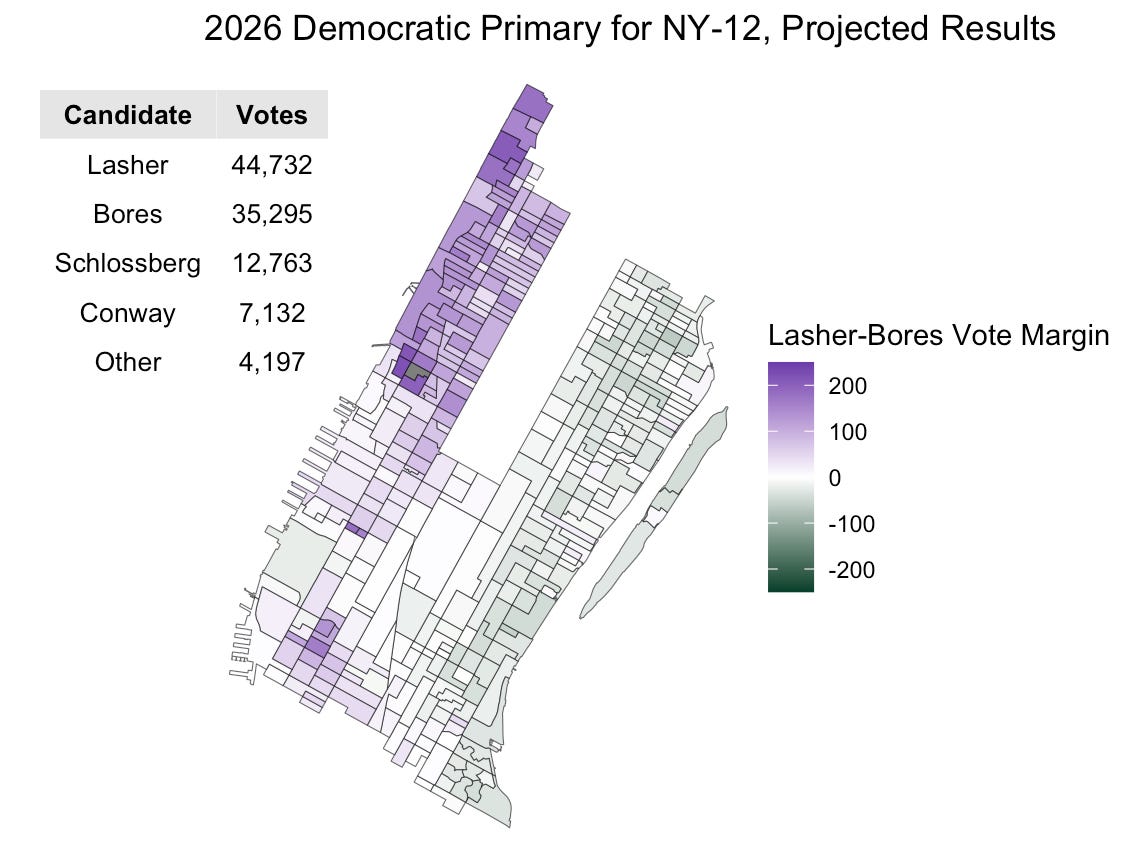
What follows is what I project to be the modal outcome, the most likely result. It is not meant to be the median result (if I had to set a betting line for the margin, where the probability of the vote coming in above and below were the same, I’d probably set it around Lasher +6.5. I personally do not bet on politics, especially on not anything I’m covering). My projection is based on a close examination of the voter file, and the voting history of each precinct over the past five years. There are no public polls, so it is also, almost entirely, based on my gut. I think I’ve been covering this race as obsessively as anyone, and have a decent track record making similar projections (I’m one-for-one), so if you’re going to trust someone’s gut, it might as well be mine. But I have no special information. Proceed at your own risk.
I’m a novice with voter data, and I’m grateful to Adam Carlson and Michael Lange for their advice and support throughout this project. With that said, this forecast is mine and mine alone. Lange’s own NY-12 forecast should be out this morning; it will be interesting to see how far apart we are.
And one more thing: If you think I’m wrong, that I’m underestimating your favorite candidate’s chances, that I’m a horribly biased propagandist, you are of course free to tell me so in the comment section or on Twitter. I will take your critiques far more seriously if they come with your own prediction, down to the percentage point. Lastly, I would just say that I have no more power over this election than anyone else, and if you don’t like what I predict, you have 36 hours to go out there, knock on some doors, get out the vote, and make me look stupid.
Okay enough preamble. Here’s what’s going to happen on Tuesday, by neighborhood.
Midtown/Flatiron/Nomad
Dimensions: 14th to 59th Street, 5th to 8th Avenue.
Turnout: 5,410 (5.2% of total)
Projected Lasher-Bores margin: 12.2%
Breakeven Lasher-Bores margin: 3.1%
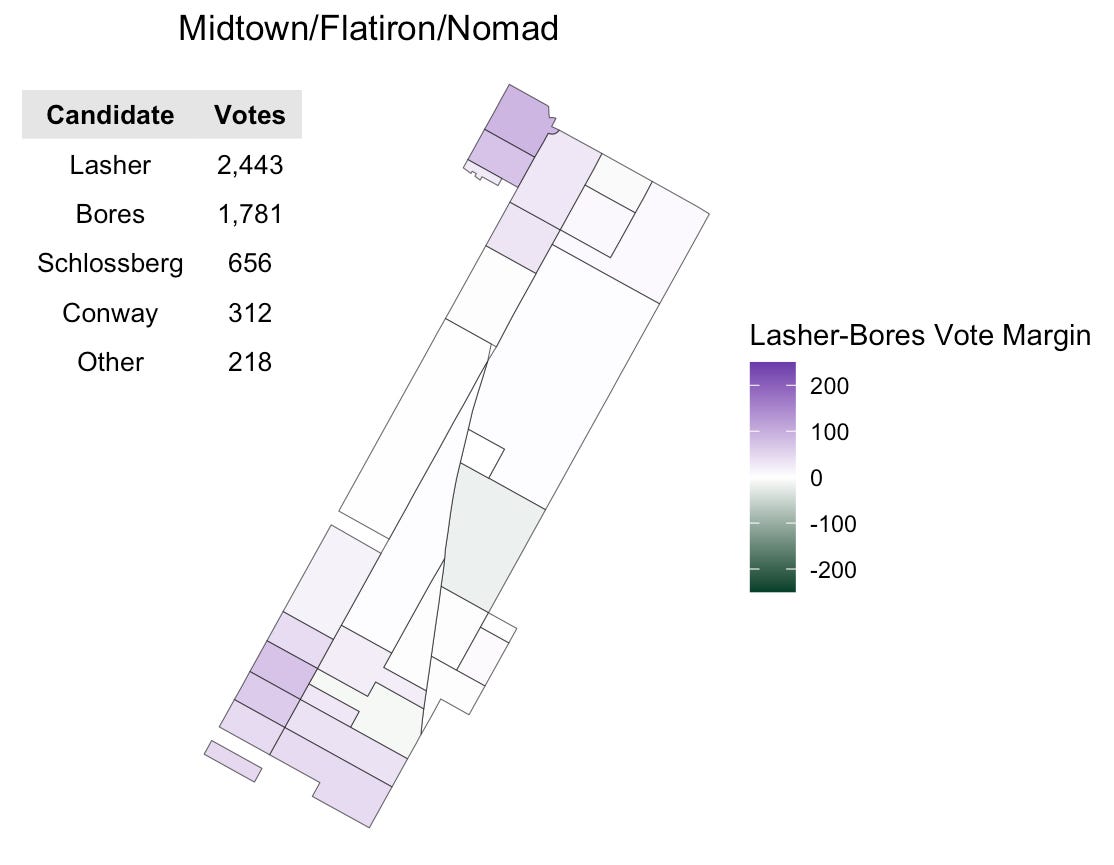
Here’s your daily reminder that land doesn’t vote. This zone is perhaps the densest concentration of business, media and cultural power anywhere on earth. Within this narrow two-mile strip lies Broadway, 30 Rockefeller Center, Carnegie Hall, the Empire State Building, the newsrooms of the New York Times, the New York Post, the Wall Street Journal, and the offices of virtually every major law firm. This zone is where Ryan Seacrest drops the ball on New Year’s Eve, and where OG Anunoby tipped in the game-winner to complete the 29-point comeback only twelve days ago. It has everything. The one thing this zone lacks is residential real estate.
There’s some, especially if you venture far enough south. If you want to get super nerdy, you can have a fight about which precincts feel more like Chelsea, and which deserve their own monikers (“Nomad,” or “Flatiron,” perhaps). But I wouldn’t sweat it. I project about 5% of the electorate to come from this zone, even though it makes up about 20% of the map. Please remember to ignore this zone accordingly on Tuesday night.
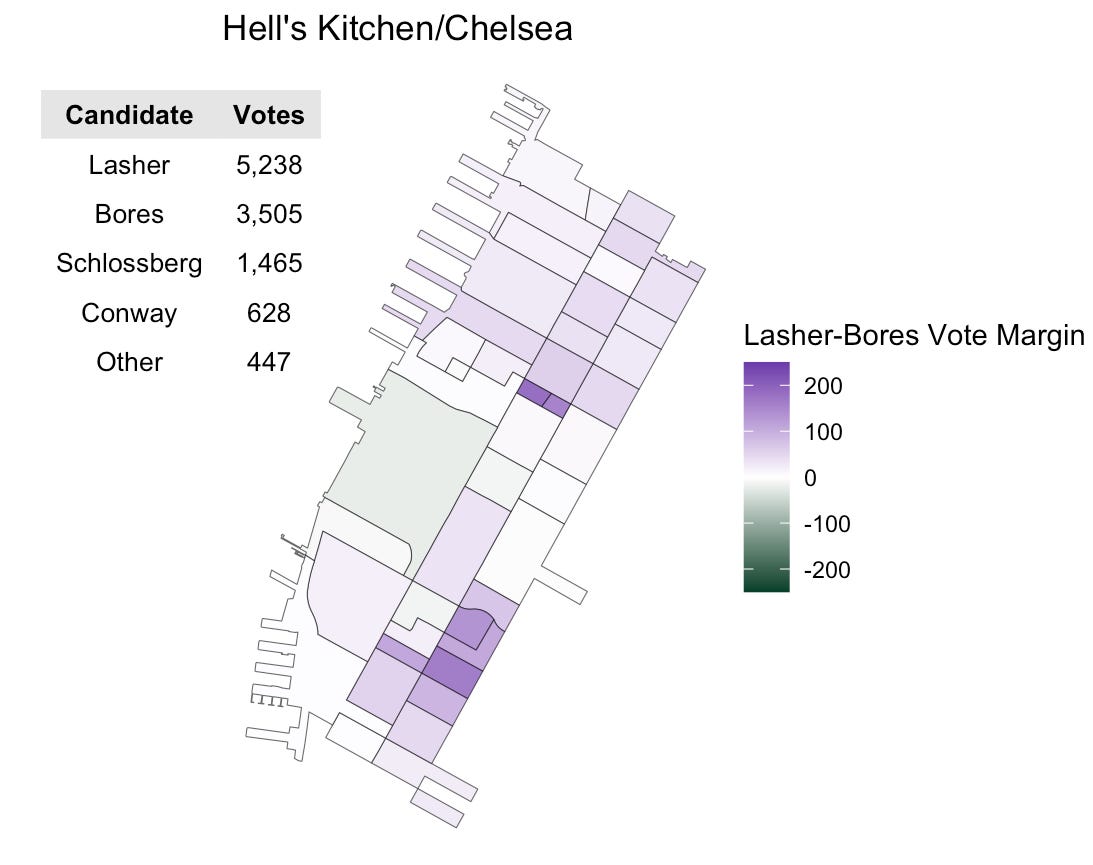
Hell’s Kitchen/Chelsea:
Dimensions: 14th to 59th Street, West of 8th Avenue.
Turnout: 11,283 (10.8% of total)
Projected Lasher-Bores margin: 15.4%
Breakeven Lasher-Bores margin: 6.3%
The single biggest inflection point of this race came on December 22nd, when popular Chelsea-based City Councilmember Erik Bottcher announced that he would drop out of the NY-12 race, and run for State Senate instead, immediately receiving every major West Side official’s blessing, including that of Gale Brewer, Mark Levine, Deborah Glick, Jerry Nadler, and of course, Micah Lasher. Bottcher returned the favor six weeks later, endorsing Micah Lasher for NY-12, and the coup was complete: Lasher had united the two West Side machines, and would be competing with the full might of every local club and organization west of 8th Avenue.
But how much do machines really matter anymore? Especially in an area with so many Millennials and young families, who turned out for Mamdani in impressive numbers this time last year? Our one 2026 test-case for this question came on April 28th, when Bottcher protege and Chelsea/West Village machine darling Carl Wilson Jr. faced off against progressive, Mamdani-endorsed activist Lindsay Boylan. Wilson won easily, and the race had jarringly low turnout, especially considering the intensity of the media coverage that the special election had received. Will Bores-friendly, machine-skeptical Millennials turn out like it’s June of 2025, or April of 2026? In this forecast, I land somewhere in between, but if team Bores is going to really prove me wrong somewhere, it could be here. The voters exist, if he can get enough of them to turn out. And Bores will have the help of his one West Side club endorsement, Layla Law-Gisiko’s fiercely anti-development Chelsea Reform Democrats Club, although Law-Gisiko herself seems increasingly friendly with Jack Schlossberg, who has supported her crusade against NYCHA’s Fulton Elliot Chelsea redevelopment with more enthusiasm than Bores.
Technically, Chelsea should be Schlossberg’s home turf, especially the parts of it that house Gen-Z’s infamous West Village Girls. Conventional wisdom suggests that this demographic does not turn out to vote very much (though the Brock Coylar piece hyperlinked above complicates this reductive narrative), and a big underlying assumption of my forecast is that the Schlossberg campaign has pretty much tanked. However, I do expect Schlossberg to get some votes in precincts 75064 and 75061 (Fulton Elliot Chelsea), though he will be competing with Nina Schwalbe and Alex Bores for those votes, and anyway, conventional wisdom suggests that NYCHA doesn’t turnout in Congressional primaries very much either. We’ll see.
Overall, I project Micah to clean up in the older, voter-rich parts of this district, for Bores to keep it close in much of Hell’s Kitchen, and for Bores to pull out a narrow victory in 75057 (Hudson Yards).
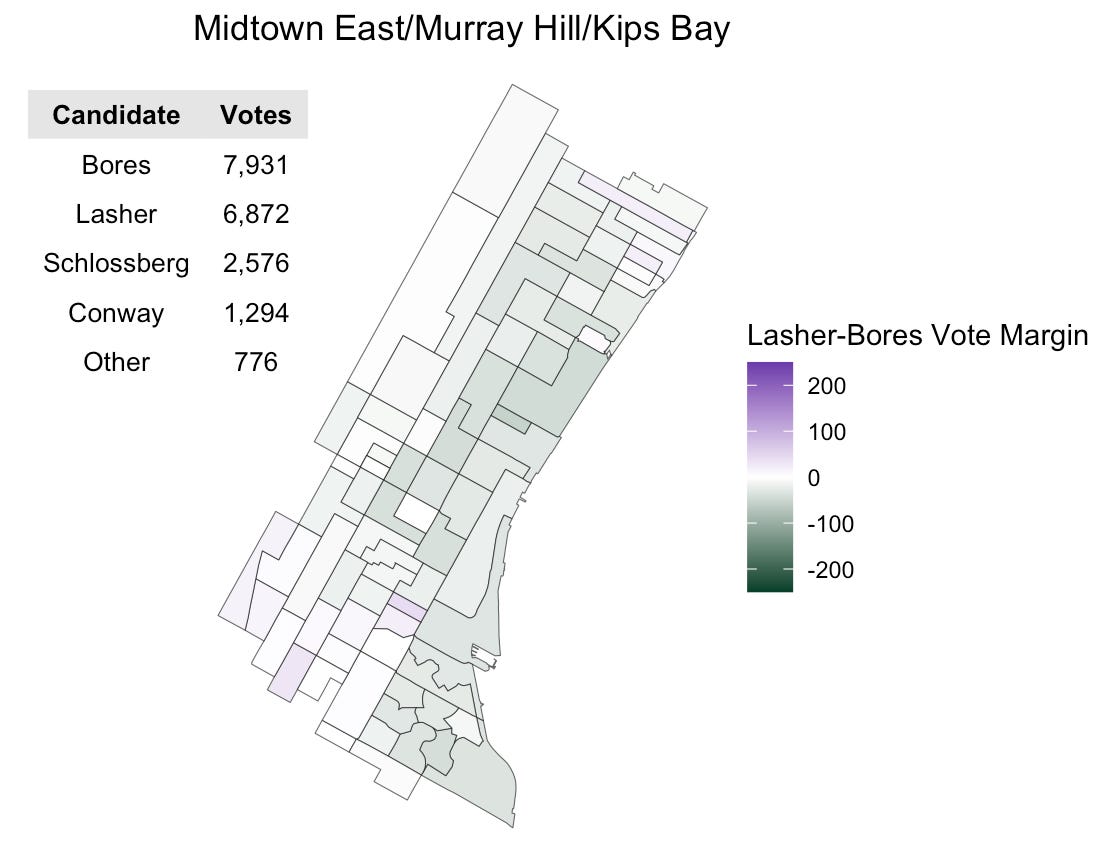
Midtown East/Murray Hill/Kips Bay:
Dimensions: 14th to 59th Street, East of 5th Avenue.
Turnout: 19,449 (18.7% of total)
Projected Lasher-Bores margin: -5.4%
Breakeven Lasher-Bores margin: -14.5%
I have far too much respect for my Gen-Z brethren who live in Murray Hill to make any sort of comment or judgment, but here how Vulture’s Jackson McHenry described the neighborhood, in his review for Mindy Kaling’s Murray Hill-based new show Not Suitable for Work: “The southern neighbor of Midtown East is best known for being the home of some of Manhattan’s most — and this is a gender-neutral term — basic bitches, from just-out-of-college frat boys to aspiring influencers who don’t necessarily have the trust funds to support life as West Village girls.” Are these fine people Schlossberg voters? Bores voters? People who haven’t changed their registration yet, and/or aren’t super invested in local politics? Only time will tell.
What we can say now, however, is that while the demographics (younger) and longitude (east) of this district favor Bores, many of the institutions favor Lasher, including both the Eleanor Roosevelt Independent Democrats and the Tilden Democrats of the 74th Assembly District. Conspicuously, the 74th Assembly District’s Member Keith Powers has not endorsed his fellow East Side Assemblymember. Former City Councilmember Dan Garodnick and State Senator Brian Kavanaugh both support Lasher.
I expect the demographics to win out here, but the margin matters a ton, especially in Stuy Town and Peter Cooper Village, where some of the world’s most diligent, politically active voters reside. I expect this tiny complex to deliver nearly 4,000 votes, and both campaigns will fight tooth-and-nail for every one. If Lasher can fight to a draw in Stuy Town and PWC, it’s probably game over. If Bores wins it by double digits, the rest of the map starts to look much less intimidating for him.
Upper East Side:
Dimensions: North of 59th Street, East of Central Park.
Turnout: 31,557 (30.3% of total)
Projected Lasher-Bores margin: -7.2%
Breakeven Lasher-Bores margin: -16.3%
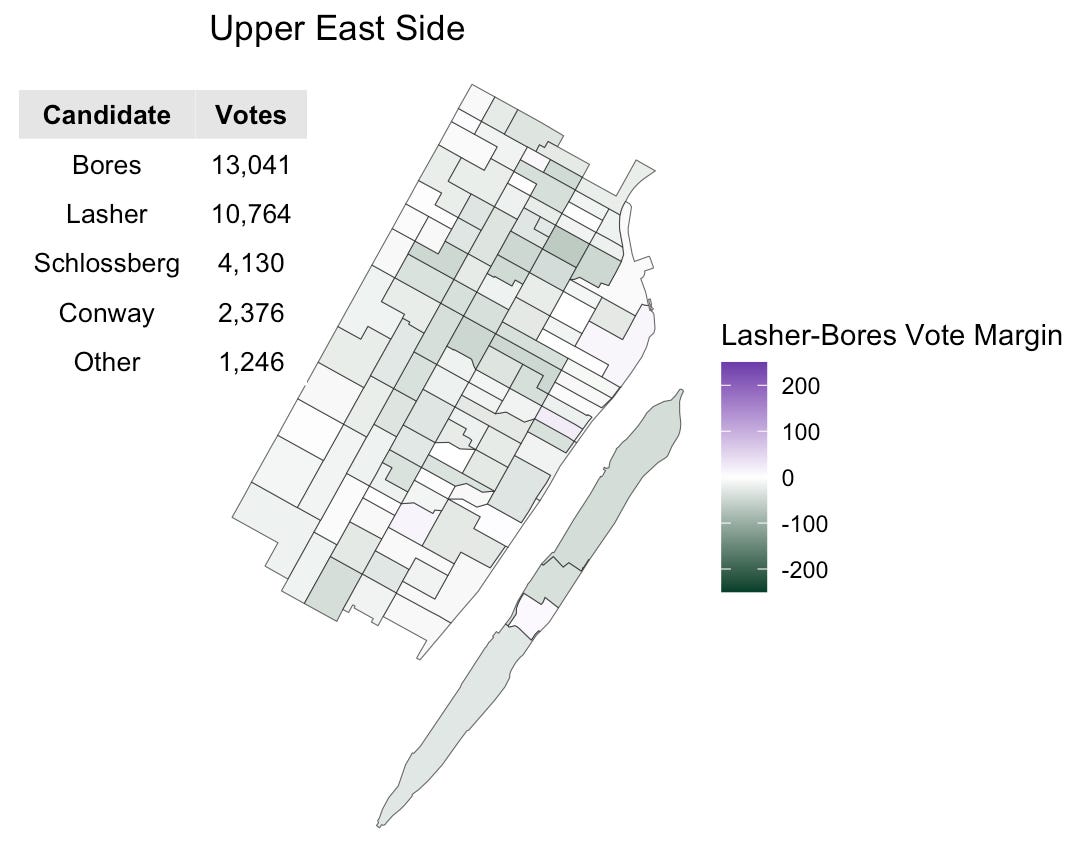
Bores represents the 73rd Assembly District (5th to 3rd Ave, what Michael Lange calls “Oligarch Alley,”) but his political home is the Four Freedoms Democratic Club of the 76th Assembly District (Yorkville, East of 3rd Ave.) “Yorkville,” Four Freedoms’s Jaime Berman told me in January, “is for the girlies.” Young, professional class workers with cute small dogs, a few years into their careers in a prestigious, high-paying field, perhaps including software engineering. This bloc is Alex Bores catnip, and the only question, again, is how many of them he can get to turnout. Which is a big question, because the voter file is not super flattering to voters east of 3rd Ave.
It’s far more flattering to the triple primes of Park Avenue, the moderate, establishment voters over 65 who dragged Cuomo over 40% citywide nearly single-handedly last November. Here is perhaps the hottest take of my forecast: I think West Sider Micah Lasher will do just fine with this group. He won’t win, but he does not need to, especially if George Conway can take a slightly bigger-than-expected slice. Frankly, I have a hard time imagining that anyone will vote for Conway anywhere but here, but this is the one area where he might break fifteen or even twenty percent. This would limit Bores’s upside in this area considerably.
On the other hand, maybe these voters are loyal East Side institutionalists, who like their Assembly Member and want him to succeed. And maybe they are all coming back from the Hamptons in droves to vote for him. Once again, only time will tell.
I project Lasher to win only a handful of Upper East Side precincts, none by very much, but amusingly, one of them is 76044, where loyal Democratic voter Mr. Zohran Kwame Mamdani resides. He refused to say who he voted for, and I have no sources, but based on his connections with Morris Katz, his roots as a Morningside Heights resident, and his personal connection with his parents’ Assembly Member, I feel quite confident that he ended up voting for Lasher.
Upper West Side
Dimensions: North of 59th Street, West of Central Park.
Turnout: 36,420 (35.0% of total)
Projected Lasher-Bores margin: 28.5%
Breakeven Lasher-Bores margin: 19.4%
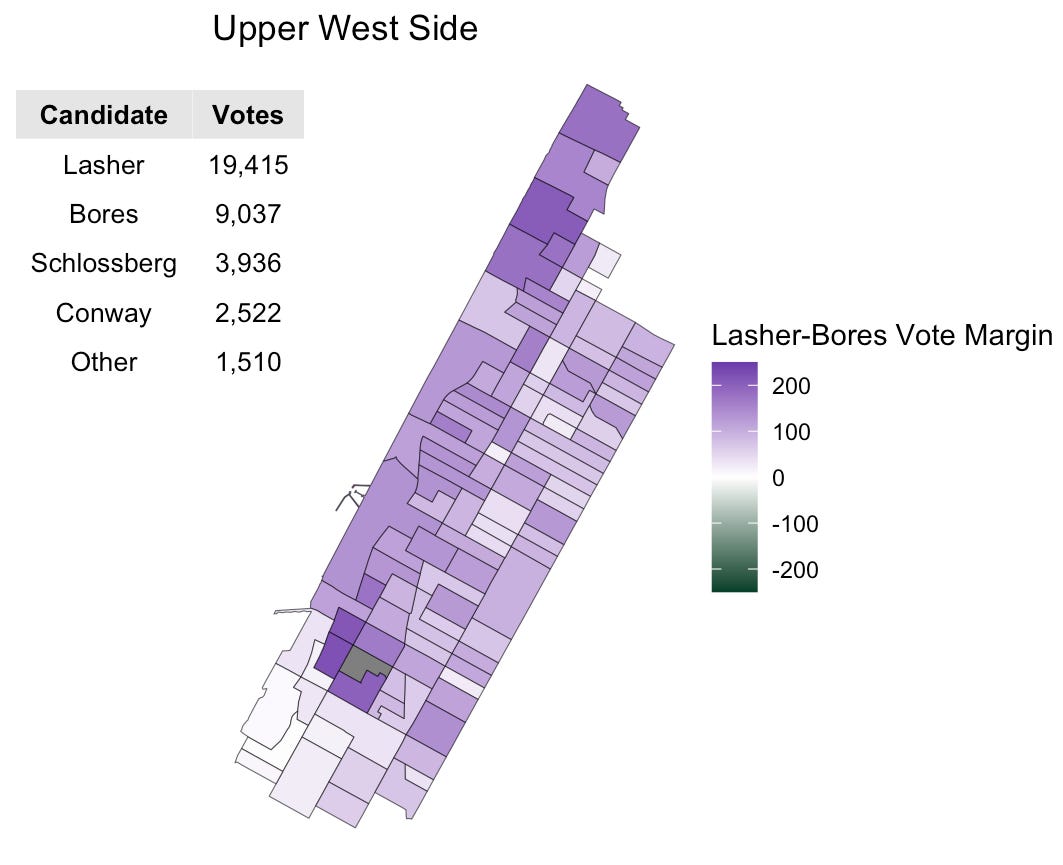
As I wrote two weeks ago, it’s just not a fair fight. If you take a look at some of the dark purple precincts on Riverside Drive north of 86th street, you will see Lasher running up 30-40 point margins in the highest-turnout precincts in the city. You should know that I have spotted Bores 35 PERCENTAGE POINTS from the 2022 Nadler-Maloney result. That year, Jerry won these precincts by 70. Alex Bores has run an extremely impressive campaign, has received glowing national media coverage, and has shaped much of the race’s conversation around AI regulation, his strongest issue. But has it really been more than 35 points better than fifteen-term Congresswoman Carolyn Maloney’s 2022 campaign? Is such a feat even possible? Elsewhere on the Upper West Side, viewers should pay special attention to precinct 67039, The Lincoln Towers on West End and 69th Street. I project this complex of high-turnout seniors to break for Lasher by more than 40 points, and deliver him 263 votes on net, so many that it breaks my data visualization above. Jerry won it by 68, and netted 441 votes. It’s not a fair fight.
Of course the higher you’re projected, the farther you have to fall. If Bores simply loses some of these precincts by 20 points, he’s in business, and if he loses by only 10, he’s in the driver’s seat. And there’s a real narrative path for him to get there, one that involves the Boomer dads of this district, who love Ezra Klein and Matthew Yglesias, enjoy engaging in philosophical thought experiments about AI, and view themselves as independent thinkers who want to be ahead of the curve and don’t want a machine to tell them what to do. These dads exist in numbers on the Upper West Side. They are my people, in many cases they are my readers, and I love them dearly.
I am relying almost entirely on my gut here when I conclude that I do not believe Bores got all the way there, with enough of them, to make the Upper West Side interesting. Instead, I think the local institutions will do what they always do on Tuesday, and deliver a convincing, comfortable win for Micah Lasher.
A few questions:
1. When I showed up at the corner of 85th and Columbus to do poll site visibility for Eli Northrup (who is running for AD-69), I was blown away by the number and enthusiasm of the Alex Bores volunteers. I thought to myself "he is making a serious play for the UWS." Do you think that could impact the results?
2. I have been struck by the bitter feelings left over from the last AD-69 primary, and have encountered people who were adamantly opposed to Micah based on that. Do you think that will be a factor?
3. How will Conway and Schlossberg impact the results?
E : You re good —- can we talk ? HCYourow@msn.com