
How Micah Lasher Won
Six Charts On Lasher's Surprisingly Narrow Victory

“I am overwhelmed to see this beautiful village here” Micah Lasher told the assembled dignitaries onstage in front of the rapturous crowd at Jacob’s Pickles on Columbus Avenue a little after 10:30pm Tuesday night. Lasher had just been declared the winner of the NY-12 Democratic Primary, and looking across the stage, one couldn’t blame him for being overwhelmed. There, from left to right, stood Chelsea City Councilmember Carl Wilson, Governor Kathy Hochul, former Comptroller Scott Stringer, former Department of City Planning Commissioner Dan Garodnick, West Side State Senator Erik Bottcher, West Side State Assembly Member Linda Rosenthal, former Manhattan Borough Presidents Ruth Messinger and Gale Brewer, and City Comptroller Mark Levine. “I thank you all so very much,” Lasher told them, and for good reason; each one had loudly, publicly, enthusiastically supported Lasher, and had wielded their considerable platforms and political machines to his benefit.
Lasher’s broad elite support has been locked in since this race began last fall, and I have written more than once that I expected it to carry him to a relatively easy victory. This district, I wrote, runs through its political clubs, organizations and elected officials, and poses an especially formidable challenge to outsider insurgents. In past Manhattan elections, consolidating even slightly more than half of the support of the party elite was enough to coast to a double-digit victory. Surely a candidate who had consolidated virtually every single party elite would do the same.
Instead, Micah Lasher beat Alex Bores by only four percentage points, or about 4,300 votes. That’s five points less than what I predicted last weekend. More importantly, it’s ten or fifteen points less than I would have predicted at the onset of this race. That “beautiful village” onstage that Lasher thanked, the collective weight of the entire Manhattan political establishment, they all pulled the rope in the same direction, every day, for months, and it barely budged.
It budged enough though. Here’s how Micah Lasher eked out a narrow victory, in six charts.
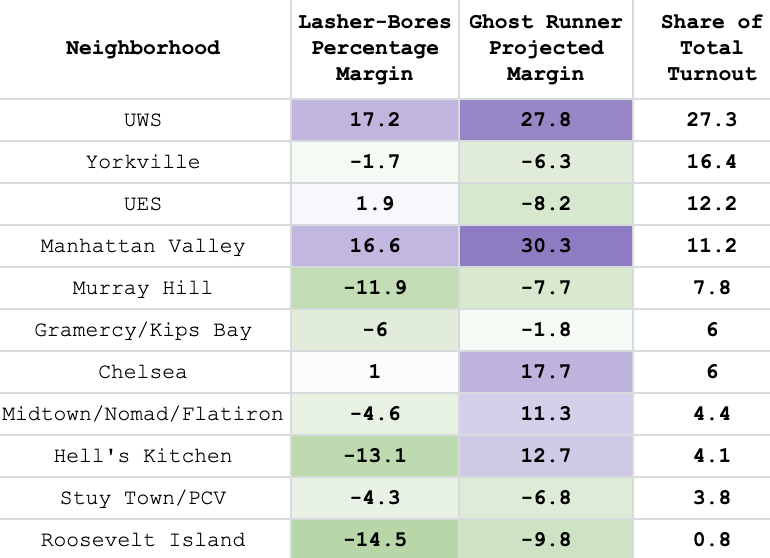
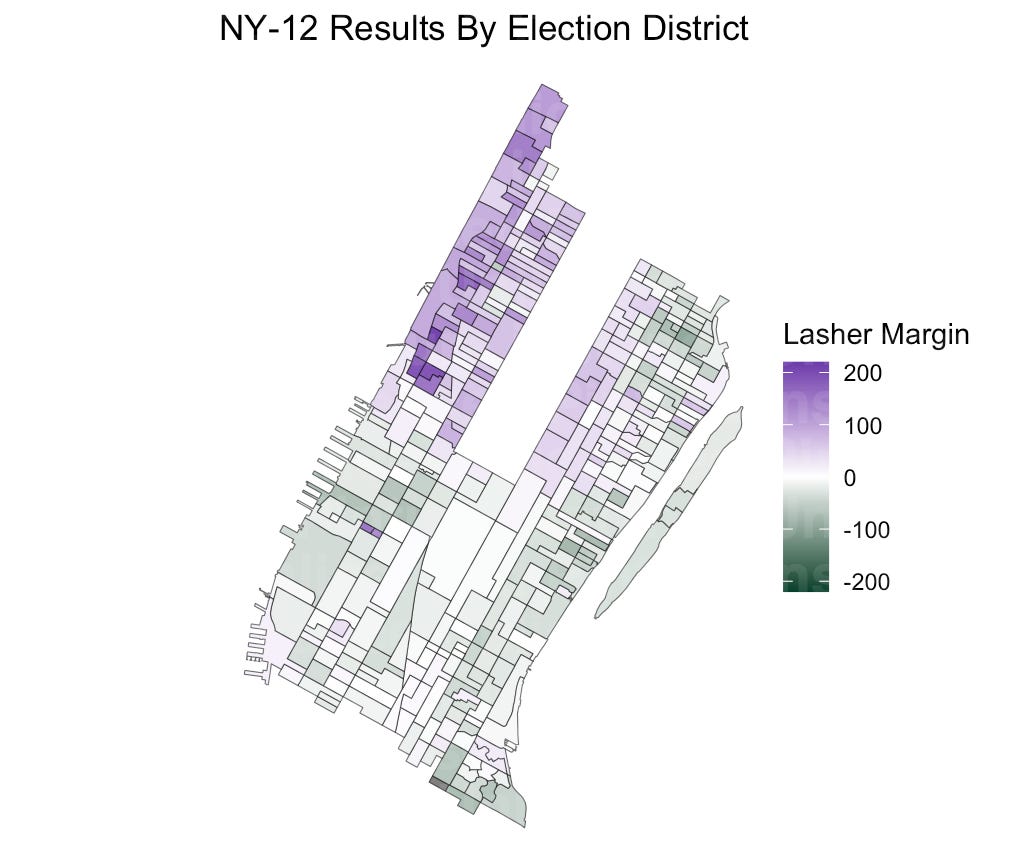
Alex Bores beat my projection by partially executing two of my five “Bores Scenarios.” First, he achieved dramatic geographic depolarization. In the 2022 race between Jerry Nadler and Carolyn Maloney, there was a ludicrous 50-point gap between the margins on the Upper West and Upper East Sides. I predicted that it would shrink to a 30-point gap in this race, due to the Bores campaign’s efforts to “nationalize” the conversation, cast aside petty local squabbles, and focus on big, existential issues that matter to everyone equally. Instead, it shrank to only 15 points. Bores lost Lasher’s home base of Manhattan Valley (which I define as north of 96th street on the West Side), the highest-turnout neighborhood in the city, full of political obsessives whose kids played on Lasher’s West Side Little League team, by only 17 points. Lasher lost Bores’s native Yorkville, where the Bores’s Four Freedoms Democratic Club has been diligently organizing the area’s software engineers and Big Law associates for years now, by fewer than two points. Bores fought Chelsea to a draw, despite Lasher’s enthusiastic endorsements from Erik Bottcher and Carl Wilson, only two months after Wilson flexed the West Side Machine’s might in that neighborhood by crushing progressive challenger Lindsay Boylan in the special election for his City Council seat. And most shockingly of all, Lasher pulled off a two-point upset on the Upper East Side, a neighborhood wholly contained in the 73rd Assembly District that Bores represents, and won every single precinct that touches the east side of the park. The neighborhoods mattered, but they mattered less than they ever have.
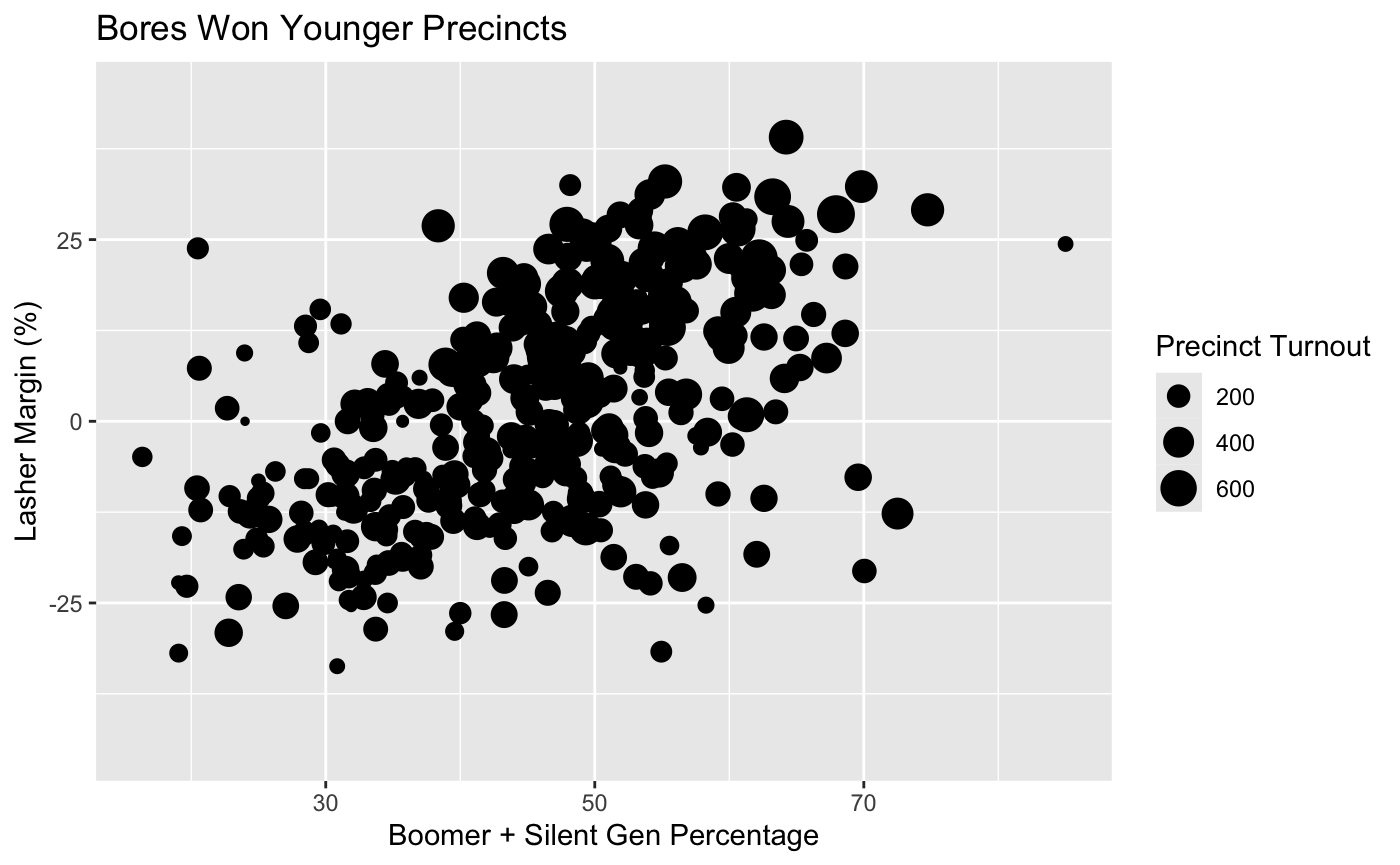
Second, Bores dominated in precincts with more Millennials and fewer voters over 62 years old (Boomers and Silent Generation).
In order to fully realize the Millennial strategy, Bores would have had to pair it with a surge in turnout. This did not transpire, and in fact, younger voters turned out even less than I expected when I projected Lasher + 9 last weekend.
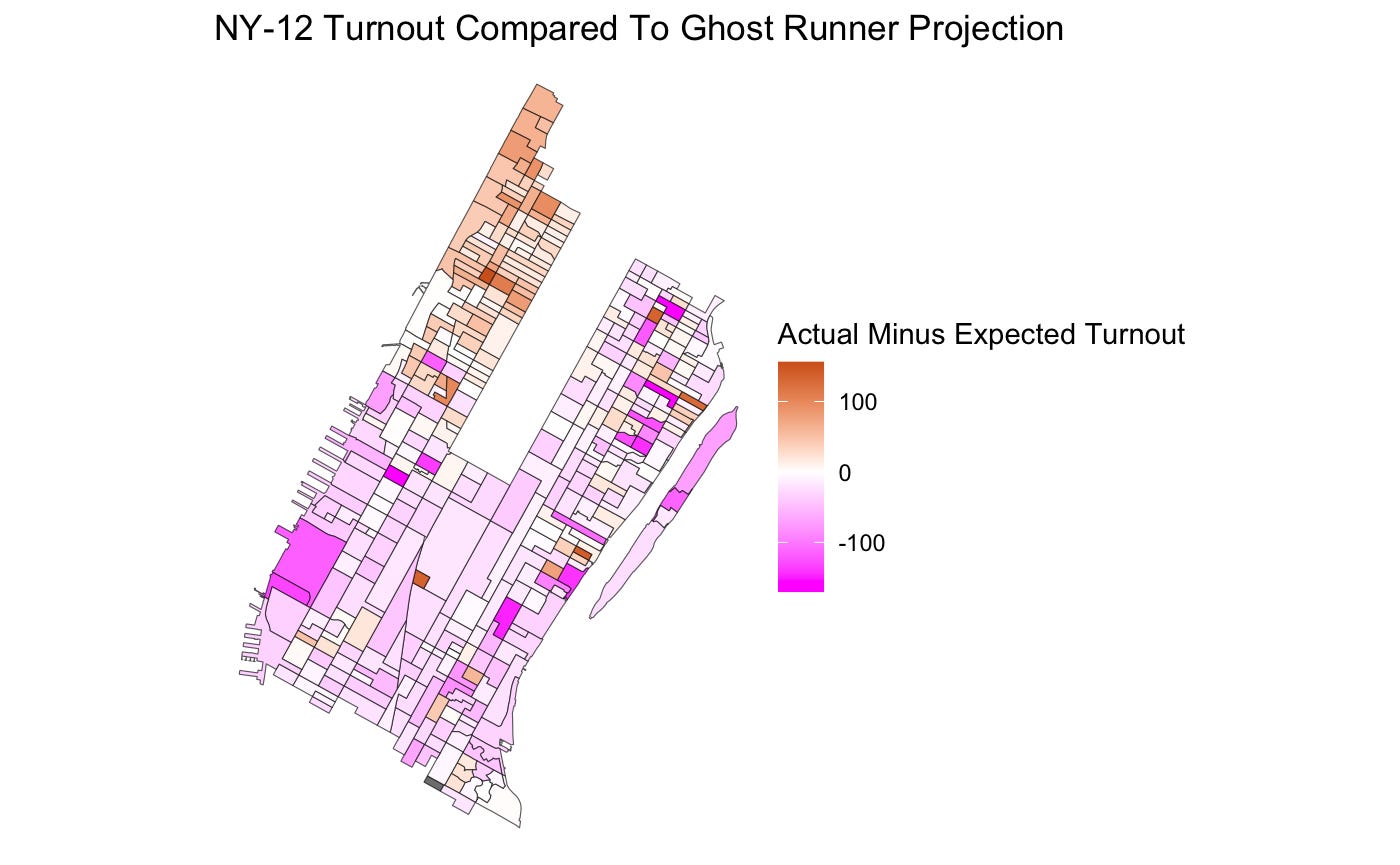
As the map shows, the only precincts with more voters than I expected were in the Upper West Side and Manhattan Valley, two naturally occurring retirement communities (and where most of my readers reside, so I should really be less snarky to them!) The Millennials of Hell’s Kitchen, Yorkville, and Murray Hill, by contrast, turned out even a little less than I projected, and I projected that they wouldn’t turn out very much.
Putting it all together, by depolarizing the geography of the district, and winning over younger voters, Bores achieved two big preconditions to an upset victory, but was unable to pair it with the Millennial turnout surge that would have pushed him over the finish line.
You can stare at a map like this forever, and keep finding amusing new narratives. For example, there are two tiny purple dots in Hell’s Kitchen and Chelsea amidst a sea of Bores green. They are Manhattan Plaza, the federally subsidized artist housing complex on West 43rd Street, and the co–op complex of Penn South between 25th and 28th Streets. Together, Lasher won these precincts by 343 votes. He lost the other 17 precincts of Hell’s Kitchen by almost 900 votes, or well over 20%.
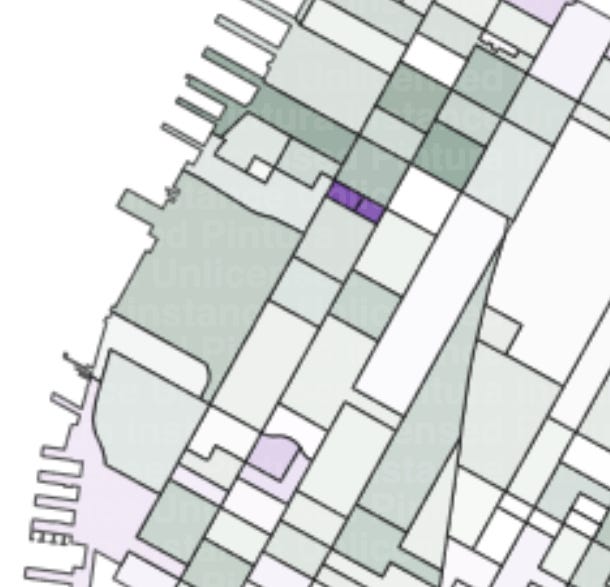
On the flip side, Bores achieved a local surge in the precincts between Amsterdam and Central Park West in the lower 80s, possibly because of his team’s extensive canvassing operation all around Frank McCourt High School on 85th and Columbus, the district’s highest-turnout early vote site. Bores himself spent much of Election Day and the Early Vote period camped out in front of Frank McCourt, and you can see the fruits of that labor right there on the map.

The big story, however, is the East Side Lasher surge. In the waning days of the race, Lasher made a big push there, particularly with older Jewish voters and their local leaders, winning the endorsements of rabbis like Chaim Steinmetz of the massive Orthodox congregation Kehilath Jeshurun. Bores had accepted endorsements from Bernie Sanders’s Our Revolution (but not Sanders himself), and CUNY’s PSC union (which vocally supported pro-Palestinian campus protests last year), but did not actually move left on any Israel/Palestine policy position. At the time, it seemed like a savvy move, expanding his coalition without angering his base. In retrospect, it may have accomplished neither. A substantial chunk of his base may have been angered, and there is not much evidence that he achieved much left-wing or pro-Palestinian consolidation (instead, a serious chunk of those votes coalesced behind Nina Schwalbe, who rode a strong debate performance to an impressive 7% finish, despite receiving virtually no local institutional support and no outside spending).
This dynamic proved beneficial to Micah Lasher. But the coalition he won with makes this progressive more than a little queasy. As shown below, there was a weak but statistically significant correlation between Lasher’s margin last week, and Cuomo’s margin in the last round of ranked choice voting in last summer’s mayoral primary.
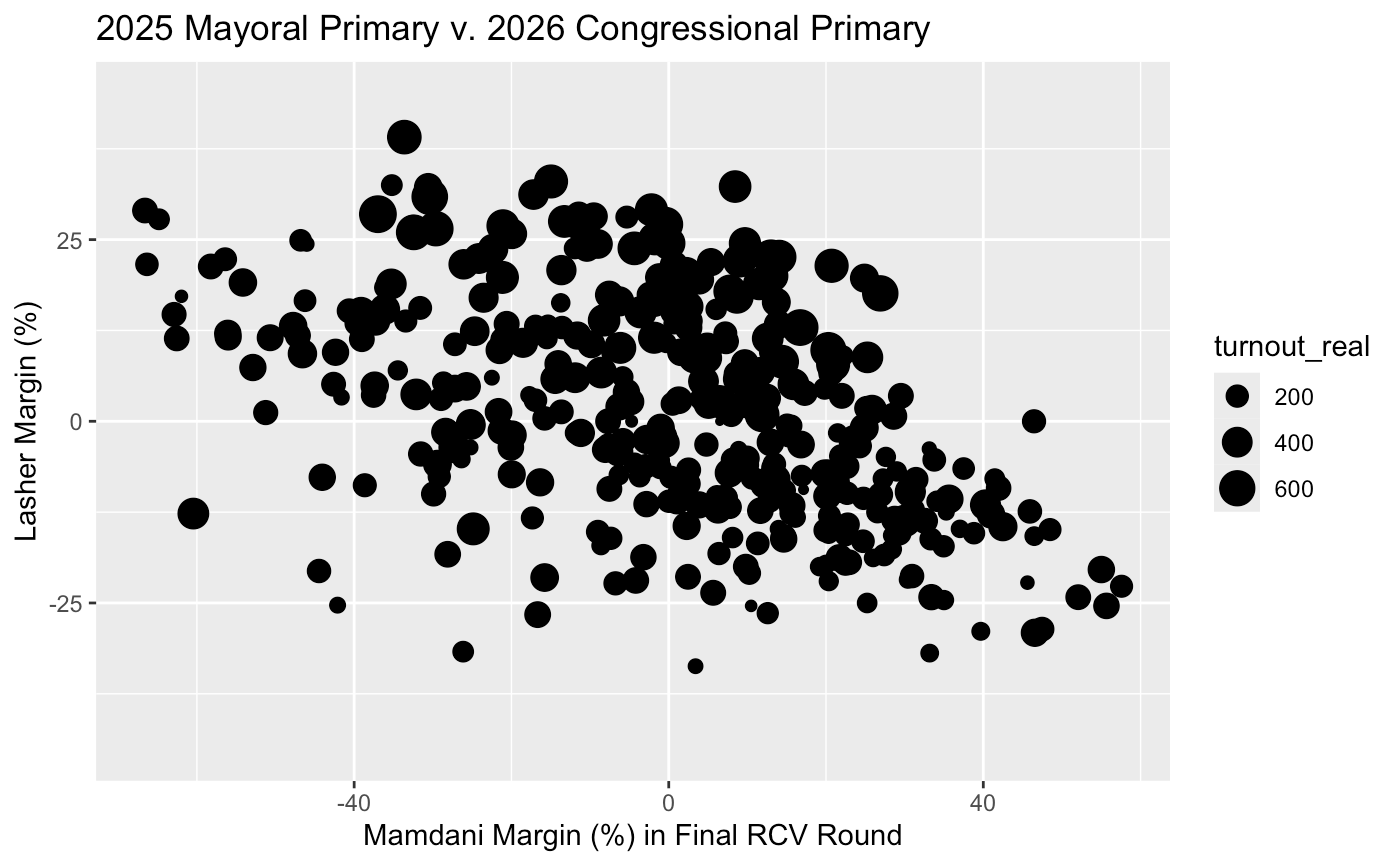
I argued two weeks ago that Lasher should be the progressive voter’s choice, focusing on his record of picking difficult fights and his willingness to buck the loudest voices in his coalition, more than any particular policy position or philosophy. It seems that voters on both sides of this district’s political spectrum disagreed with my assessment: more moderates voted for Lasher, more progressives voted for Bores.
Who was right? And what happens now? Lasher may feel beholden to his moderate East Side supporters, whom he needed to push him over the top in this brutally close race. Conversely, he might feel that more needs to be done to shore up his support with the district’s left flank, and focus his efforts there. Or he might feel neither: unless he does something that a large majority of the district finds truly heinous (see Goldman, Dan), or the demographics of the district change more rapidly than he can keep up with (see Crowley, Joe and Espaillat, Adriano), this seat is likely his for as long as he wants it.
The latter dynamic could work to the benefit of those of us who want to see Lasher pursue meaningful progressive policy changes. As Mason Williams (whose new book City of Fortune: Inequality and the Making of Contemporary New York is out now) pointed out to me in our conversation a few months ago, efforts to redistribute wealth and improve the material conditions of the less fortunate always run into uncomfortable coalitional strains when you represent some of the wealthiest people in the country, no matter how liberal those people claim to be. An unencumbered Congressman Micah Lasher, with political capital to spare, might have more flexibility to navigate those strains.
He might not, though. Or he might have flexibility and political capital, but choose to use it on other matters. Electing someone to represent you at any level of government is, at the end of the day, always a bit of a leap of faith.
Programming Note: This concludes my coverage of the 2026 NY-12 Democratic Primary. I will have one more thing out tomorrow (it’s a podcast episode, and you can probably guess who the guest is), but for now, that should be it. I want to take this opportunity to thank everyone for being such a generous and supportive audience throughout this project, for sharing my blogs with your friends and colleagues, engaging so thoughtfully in the comment section, and generally making this such a fun experience for me!
This was a labor of love; I got really obsessed with this race, couldn’t stop thinking about it, and found writing and podcasting about it incredibly fun and rewarding. It also took a lot of time and work. If you liked my work and want to show your support, I’ve set up a Buy Me A Coffee page here. Please do not participate if you know me personally (instead, just text me and actually buy me coffee!) or if you work for a campaign or an elected official (in which case you shouldn’t be bribing journalists! Shame on you!)
Lastly, please let me know what you think I should focus on next. I have a few ideas, but would be eager to hear yours. The world is large and full of ghosts…
Once again, well done !
Very well done! The passage about the UWS Little League and the UES law firm associates is quite Langeian. As someone who was canvassing for Eli Northrup, I wanted to know if there was an overlap between Northrup and Lasher voters, because that would indicate that other people thought Lasher was more progressive.